
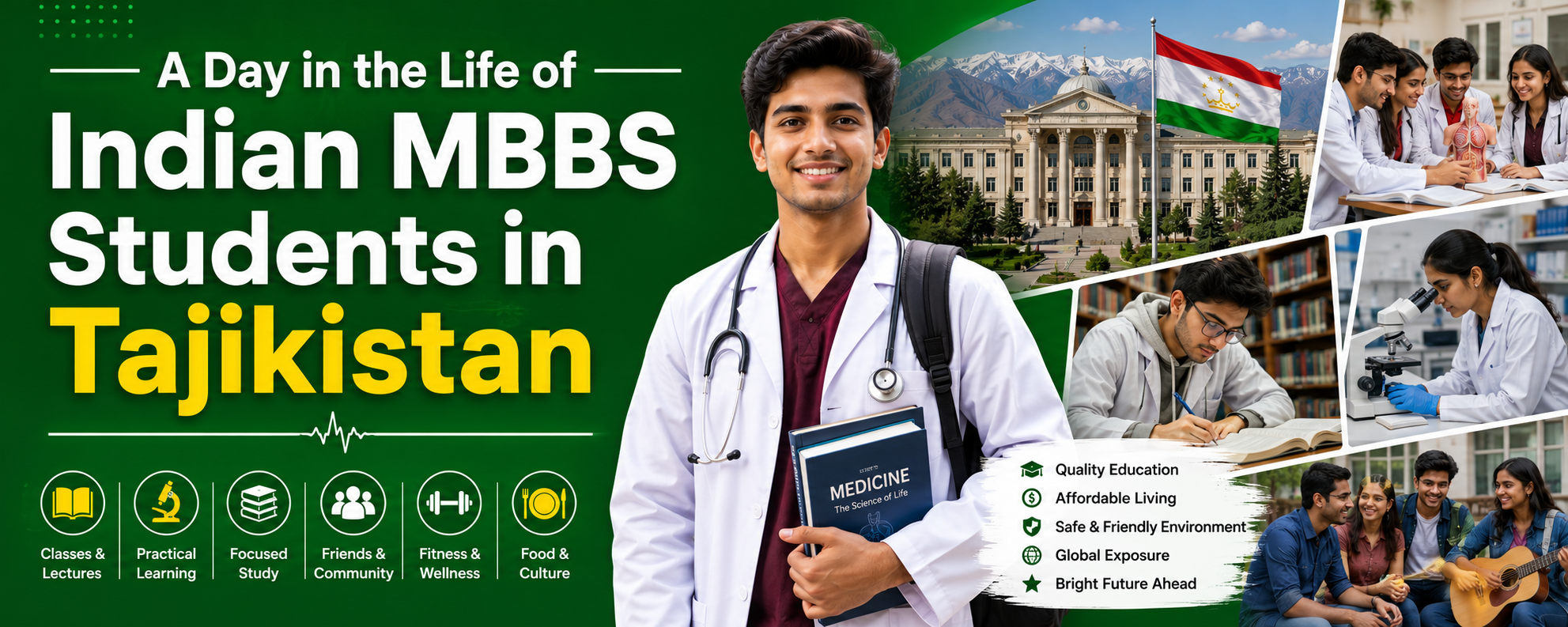
Pursuing a medical degree overseas has never been merely an ordinary academic journey; it is a major life transformation capable of reshaping an individual’s entire life trajectory. Today, thousands of Indian students view studying for an MBBS in Tajikistan as a popular path to fulfill their dream of practicing medicine. The core appeal of this choice lies in the high-quality local medical education resources that come at an affordable cost. However, most prospective study-abroad students and their parents only focus on hard indicators such as tuition fees, university rankings, and admission thresholds, completely ignoring the equal importance of gaining in-depth understanding of international students’ daily lives — a pervasive cognitive misconception prevalent today.
Understanding the Reality of Student Life Abroad
We may first consider two core questions: What exactly is the real daily life of overseas students like? What easily overlooked details can directly affect students’ academic progress? This paper fully reconstructs the typical day of this group of Indian international students, covering in sequence five core areas: academic schedules, dormitory life,cultural experiences, clinical training, and the support systems that facilitate students’ overseas development.
Why Tajikistan is Becoming a Preferred MBBS Destination
Tajikistan’s status as a popular study-abroad destination rests on 8 core strengths. Beyond low tuition fees, these core conditions also include full English-medium instruction and compliance with the requirements of the NMC of India.
Morning Routine and Lifestyle of MBBS Students
The strict discipline of medical programs has nurtured an early-rising habit among international students, who rely on structured daily routines to sustain their academic progress.
Early Morning Schedule (6:00 AM – 7:00 AM)
Every day between 6 and 7 a.m., they complete a sequence of activities:
- Washing up
- Reviewing lecture notes
- Preparing for that day’s practical courses
- Setting aside time for morning exercise or a walk
Most local dormitories are equipped with heating facilities to withstand the harsh winter. The primary challenge for first-year students is adapting to the local climate, and most students can integrate smoothly after completing this adjustment period.
Breakfast and Preparation for Classes
The window of 7 to 8 a.m. each day is when students prepare breakfast before classes begin.
Student Support and Daily Living Arrangements
This project organizes the livelihood security, full-day daily schedule, and full-cycle academic support system for international MBBS students at institutions of higher learning in Tajikistan.
Food and Cultural Comfort for Indian Students
First, starting from the cross-cultural adaptation needs of international students staying in Tajikistan, the project first rolls out tailored life support resources: shared kitchens are built on campus, serving Indian meals, vegetarian options, and stocking South Asian groceries, to help international students maintain a sense of belonging in their life abroad via familiar food.
Academic Schedule During the Day
Next, it sorts out all academic, social, and practical arrangements for medical students from morning to night in full chronological order, with all modules clearly marking their applicable participants, implementation rules, and intended goals.
Classroom Learning (8:30 AM – 1:00 PM)
The period from 8:30 a.m. to 1:00 p.m. is the regular academic slot: local medical universities offer English-medium stratified courses covering three discipline categories:
- Pre-clinical
- Paraclinical
- Clinical
Students are required to take part in four types of supporting activities including interactive lectures to consolidate their foundational medical knowledge.
Practical Training and Laboratory Exposure
Core practical training is conducted outside the classroom, relying
on:
- Anatomy laboratories
- Histology laboratories
- Physiology laboratories
- Simulation centers
Tajikistan’s top medical universities require students to engage in hands-on practice from the early stage of their professional training to deepen their mastery of theoretical content.
Lunch Break and Social Interaction
The lunch break from 1:00 p.m. to 2:00 p.m. allows students to relax,
discuss coursework, share learning materials, and make cross-border friends.
The local diverse campus environment helps students connect with peers from Asia, Africa,
and the Middle East, and cultivates global thinking and cultural awareness.
Clinical Training and Hospital Exposure
Hospital-Based Clinical Learning (2:00 PM – 5:00 PM)
The clinical training at affiliated hospitals running from 2:00 p.m. to 5:00 p.m. is only open to senior international MBBS students enrolled at the university, covering six clinical activities including ward rounds and case discussions, and is supervised throughout by teaching faculty to improve students’ practical skills.
This model is the core advantage of this project.
Language Learning and Communication Skills
Even though all host universities adopt English as the medium of instruction, international students are still required to learn basic Tajik and Russian. These two languages support four types of scenarios:
- Doctor-patient communication
- Clinical interactions
- Community medical work
- Daily communication
Local medical institutions launch language support programs at the initial stage of the MBBS curriculum to help students adapt to clinical work and daily life.
Evening Study Routine
Self-Study Session (5:30 PM – 8:00 PM)
The evening self-study period from 5:30 p.m. to 8:00 p.m. requires students to complete five learning tasks, which are advanced through mutual support within study groups.
Peer support is a core component of local students’ academic and daily life.
Comprehensive Student Development Framework
This paper systematically sorts out all dimensions of the academic preparation, campus life, community building, housing conditions, encountered challenges, and career development of Indian international students pursuing MBBS degrees in Tajikistan.
Adopting a subheading-based modular narrative framework, it breaks down originally scattered information about the international student experience into seven independent, non-overlapping, logically progressive units, with all core details clearly marked.
This framework can be adapted to sort out the living and development status of other transnational international student groups.
Professional Licensing and Exam Preparation
The first module is preparation for professional licensing and further education entrance exams. It clarifies that the core research group is Indian MBBS students studying in Tajikistan. This group generally starts preparing early for India’s NExT, the U.S. USMLE, and various international graduate entrance exams. Local host universities provide matching academic support, and long-term exam preparation plays a key role in career planning.
Dinner and Leisure Activities
Evening Relaxation (8:00 PM – 9:00 PM)
The second module is the dinner and leisure activities module. It defines the fixed dinner and leisure window for on-campus students as 8:00 PM to 9:00 PM.
Six common activities during this period are:
- Watching movies
- Chatting with family
- Socializing with friends
- Participating in cultural events
- Exploring local food
- Using communication tools to maintain contact with relatives and friends in the home country
These activities effectively ease homesickness and mental stress.
Indian Student Community and Cultural Celebrations
The third module is the Indian student community and a cultural celebration module. It proposes that the fellow Indian community is the most comforting core element for this group during their study abroad. Students celebrate six core festivals including Diwali and Holi. Local host universities generally support such events, which help students build a sense of belonging, adapt to the new environment, and maintain cultural ties to their home country.
Dormitory and Housing Facilities
The fourth module is the dormitory and housing facilities module. University dormitories in Tajikistan form the core of the international student experience. Most dormitories are equipped with six types of facilities:
- Furnished rooms
- Internet access
- Heating
- Security
- Study areas
- Leisure areas
Living with fellow Indian students helps new students adapt quickly and build a long-term support network.
Challenges Faced by International Students
The fifth module is the challenges faced by international students. It first introduces that studying abroad can bring considerable growth returns, then lists four major challenges encountered by this group:
- Winter temperatures in Tajikistan are far lower than those in most parts of India
- Clinical communication requires mastery of Russian or Tajik
- Medical programs require consistent long-term effort
- Students are easily troubled by homesickness in the early stage of their study
University support services and the local Indian community can alleviate these difficulties.
Career Planning for MBBS Students
The sixth module is career planning for currently enrolled students. Most current MBBS students start career planning early, with five common types of career development goals. Early planning helps students align their on-campus academic activities with long-term career objectives.
Future Career Opportunities After MBBS in Tajikistan
The seventh module is the future professional practice and career opportunities module.
Earning an MBBS in Tajikistan provides students with seven non-academic advantages including exposure to international cultures. This experience offers dual support for students’ academic and personal growth.
Conclusion
This study analyzes the academic engagement, cultural life, and interpersonal growth of Indian international students pursuing an MBBS degree in Tajikistan, and confirms that this group successfully balances rigorous academic training and personal development, making their study-abroad journey substantial and meaningful.
This program has prominent core strengths:
- Low study-abroad costs
- Host country institutions accredited by WDOMS and WHO
- Sufficient practical training
- Attentive faculty
- A highly inclusive local community
We recognize the practical value of this program, while also reminding international students to regularly track
NEET updates, verify institutional qualifications through official NMC guidelines and the WDOMS database, and pursue their studies in compliance with all relevant regulations.