
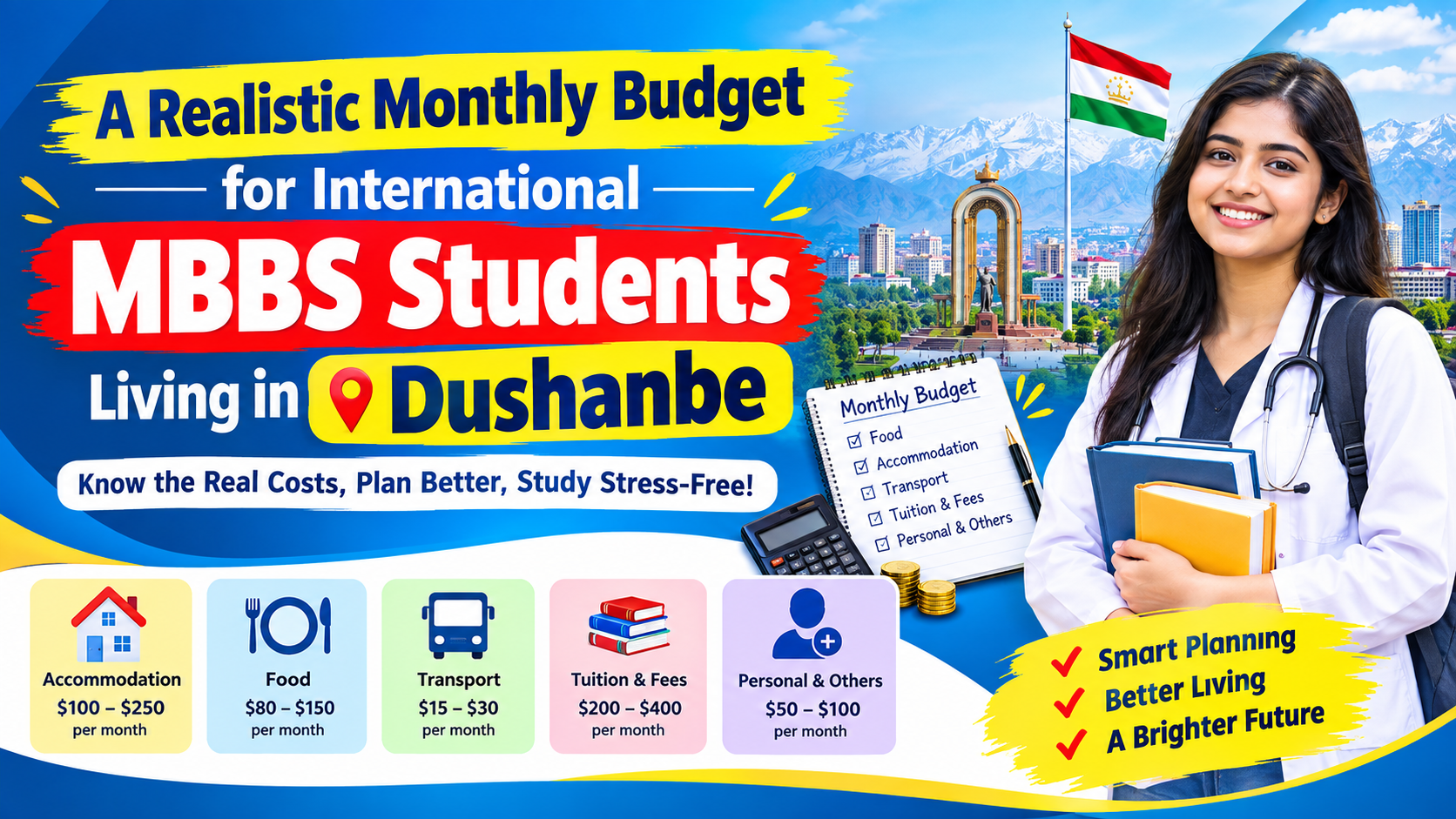
Studying medicine abroad is usually discussed through tuition fees. That’s only half the story. Once you actually start living in Dushanbe, the smaller expenses begin showing up — groceries, hostel or apartment rent, SIM recharge, transport, winter clothes, occasional restaurant meals, books, residence-related expenses, and those random 50 or 100 somoni payments nobody added to the original budget. For Indian students planning MBBS in Tajikistan, a practical monthly living budget in Dushanbe can roughly sit between TJS 2,000 and TJS 4,500 per month, depending heavily on accommodation and lifestyle. In Indian currency, that is roughly ₹15,000–₹35,000, but exchange rates move, so don’t treat the INR conversion as permanent. A hostel student who cooks regularly can stay near the lower side. Someone renting privately, ordering food frequently and using taxis almost every day? Very different calculation. This guide breaks down what students may actually spend rather than presenting an unrealistically low figure just to make studying abroad look cheaper.
How Much Money Does an MBBS Student Need Per Month in Dushanbe?
Start with a realistic target: ₹20,000–₹30,000 per month excluding university tuition is a sensible planning range for many international medical students. Some students manage below this. Others easily cross ₹35,000. Both can be true because accommodation creates the biggest difference.
|
Monthly Expense |
Approximate Budget |
|
Hostel/shared accommodation |
TJS 500–1,500 |
|
Food and groceries |
TJS 800–1,500 |
|
Local transport |
TJS 150–400 |
|
Mobile and internet |
TJS 100–250 |
|
Study/personal expenses |
TJS 200–500 |
|
Entertainment/eating out |
TJS 200–600 |
|
Emergency/miscellaneous |
TJS 200–500 |
|
Approximate Total |
TJS 2,150–5,250 |
These aren't official government rates or fixed university charges. They are practical planning ranges and can change with exchange rates, accommodation type, inflation and individual habits. Before travelling, students should confirm the latest hostel and university-related charges directly with their institution.
Accommodation: The Expense That Changes Everything
Here’s where two students studying at the same university can end up with completely different monthly budgets. University hostel accommodation is normally the economical route, especially during the first year. Depending on the institution and what is included, students may effectively spend around TJS 500–1,500 per month on hostel or shared accommodation. Some universities collect hostel charges semester-wise or annually instead of monthly, so calculate the annual amount into a monthly equivalent before comparing options. Private accommodation is another story. A shared apartment can offer more freedom, a proper kitchen and sometimes better privacy, but rent isn't the only payment. Electricity, heating arrangements, internet, deposits and household items may come separately. If three or four students share the apartment, the cost per person becomes much easier to handle. Living alone usually pushes the budget considerably higher.For students beginning MBBS in Tajikistan, staying in the university hostel during the first year often makes financial sense. You learn the city first. Then decide whether shifting out is actually worth it.
Food Costs: Indian Food Every Day Can Get Expensive
Can you manage food on ₹7,000–₹10,000 a month? Possibly, particularly if you cook.Basic groceries such as rice, flour, vegetables, eggs, milk, bread, pasta, potatoes and locally available fruits can be reasonably manageable. Imported products are where the bill starts behaving badly. Indian spices, packaged snacks, branded foods and specialty ingredients may cost noticeably more than they do back home.A student cooking most meals could plan roughly TJS 800–1,500 per month for groceries and food. Frequent restaurant visits will increase that quickly.There’s another practical issue. Medical students don't always have the energy to cook after lectures, practical sessions and study hours. One takeaway becomes three. Then five. By the end of the month, food is suddenly the second-biggest expense.Honestly, this part is underestimated quite often.A simple system works better: cook breakfast and dinner, prepare lunch when practical, and keep restaurant meals for one or two days a week. Students choosing MBBS in Tajikistan mainly for affordability should pay particular attention to this habit.
Local Transport in Dushanbe Is Usually Manageable
Dushanbe isn't a city where transportation necessarily has to destroy your monthly budget. Students living close to their university or teaching hospital may spend only around TJS 150–400 per month on routine local travel, depending on how frequently they use buses, shared transport or taxis.Taxis are convenient. Too convenient, actually.Using one occasionally after a late class or for a longer journey isn't a problem. Using taxis for every short trip can quietly add a few hundred somoni to your monthly expenses. If your hostel is within walking distance of the university, use that advantage.
SIM Card, Mobile Data and Internet Expenses
A surprisingly small category, but still worth putting into the spreadsheet. Students can roughly keep TJS 100–250 per month aside for mobile connectivity and internet-related expenses, although the actual figure depends on the operator, data package and whether Wi-Fi is already provided by the hostel.Don't purchase a huge mobile data plan immediately after arriving. Check how reliable the hostel Wi-Fi is first. If it works well, a smaller mobile package may be enough for maps, calls, messaging and emergency use outside campus.Video calls home, online lectures and streaming consume far more data than WhatsApp messages. Obvious, yes. Still forgotten during budgeting.
Study Materials and Medical Education Expenses
Books aren't necessarily a monthly purchase, which makes this category slightly tricky. One month you may spend almost nothing. Another month you need reference material, printing, stationery, a lab coat or another academic item.Keeping around TJS 200–500 per month as an averaged academic and personal-study budget is sensible.Before purchasing expensive textbooks, ask senior students what is actually required. University libraries, legitimate digital resources and shared books can reduce expenses considerably. Buying every recommended textbook during week one? Usually unnecessary.Students should also verify whether their chosen medical institution and course meet the requirements applicable to foreign medical graduates who intend to practise in India. The National Medical Commission should be treated as the primary source for current Indian regulatory requirements rather than relying solely on an agent, senior student or social-media video.
Personal Expenses: The Category Nobody Calculates Properly
Now the unpredictable stuff. Toiletries. Haircuts. Laundry. Coffee. A birthday dinner. Medicines. A broken charger. New shoes because the pair you brought isn't surviving winter.Small amounts. Together, not so small.Setting aside TJS 300–700 monthly for personal and miscellaneous spending provides some breathing room. You might not use all of it every month, which is good. Leave the remaining amount untouched rather than finding something to spend it on.Students researching MBBS in Tajikistan should build this buffer into their financial plan from day one rather than calculating only hostel plus food.
Winter Can Change Your Monthly Budget
This deserves its own section because Dushanbe's colder months can create one-time costs that don't appear in a normal monthly estimate. A student arriving from Delhi, Mumbai, Hyderabad, Chennai or another warmer part of India may need proper winter jackets, thermal wear, gloves and suitable footwear.
Buying everything after arrival can create a sudden expense.
Bring useful winter basics from India where practical, but don't fill an entire suitcase with unnecessary clothes before understanding local conditions. Heating arrangements also matter if you're renting privately. Ask whether heating and utilities are included in rent.
Yahan—well, this is exactly where budgeting needs a little extra attention: seasonal costs aren't evenly distributed across 12 months.
Three Realistic Student Budgets
Not everyone lives the same way, so a single “monthly cost” number isn't very useful.
Budget Student: Around TJS 2,000–2,700
Think hostel accommodation, mostly home-cooked meals, buses or walking, limited eating out and controlled personal spending. This is possible for disciplined students, although there won't be much room for unnecessary purchases.
Comfortable Student: Around TJS 2,800–4,000
This is probably the safer planning bracket. It allows decent food, occasional restaurant meals, regular mobile data, transport, academic purchases and some entertainment without tracking every single somoni.
Higher-Spending Student: TJS 4,500+
Private accommodation, frequent taxis, restaurant meals, imported groceries and regular outings can push monthly spending beyond TJS 4,500 fairly easily. There's nothing inherently wrong with that lifestyle if the family has planned for it. The problem starts when parents were originally told the student would need only ₹10,000–₹12,000 every month.
What About Tuition Fees?
Living expenses shouldn't be confused with the total cost of medical education. Universities generally charge tuition separately, and the amount can vary substantially by institution and academic year. Hostel fees, medical insurance, visa or residence documentation, registration, administrative charges and other payments may also be collected separately. For MBBS in Tajikistan, medical education is generally structured over several years, and Indian students need to look beyond the headline tuition figure. Ask for a written year-wise fee structure covering the complete course. Also ask what happens if currency conversion changes.Very important: don't assume that a university appearing in a directory automatically means its program satisfies every Indian regulatory requirement. Students can independently check medical-school information through the World Directory of Medical Schools and should understand that directory listing itself isn't the same thing as approval to practise in India.
NEET, NMC Rules and Your Budget Are Connected
This may look unrelated to monthly living expenses. It isn't.An Indian student intending to pursue medical education abroad and later follow the pathway for medical practice in India needs to understand the applicable eligibility and foreign medical graduate rules before paying tuition or calculating six years of expenses. Check the official NEET portal for current examination information and the NMC website for applicable regulations.Why mention this in a budget article? Because the cheapest university isn't cheap if the course doesn't fit your long-term licensing plans.Students should also avoid treating WHO references as a shortcut for Indian recognition. The World Health Organization is an international public-health body; Indian licensing and foreign medical graduate requirements should be verified through the relevant Indian authorities.
Hidden Costs Students Should Keep Separate
This is the part parents should screenshot. Your normal monthly budget isn't your complete annual budget.Keep a separate reserve for international flights, visa/residence documentation, medical insurance, university registration charges where applicable, airport transfers, winter clothing, medical examinations, books/equipment and emergency travel. Some payments may occur only once or once per academic year.A sensible approach is to maintain at least one to two months of normal living expenses as an emergency reserve. Don't include this money in the student's everyday spending balance.Also remember flight prices around holidays can be painful. Booking India–Dushanbe travel at the last minute may change an otherwise well-planned annual budget considerably.
How Students Can Keep Dushanbe Living Costs Under Control
A budget doesn't mean living miserably. It means knowing where your money went.
- Choose university accommodation initially. Understand Dushanbe before committing to private rent.
- Cook regularly. Restaurant food should be a choice, not the default meal plan.
- Track expenses for the first 60 days. Even a simple Notes app is enough.
- Share major household purchases. Kettles, cookware and cleaning supplies don't need to be bought individually.
- Use public transport for routine journeys. Save taxis for situations where they genuinely help.
- Keep emergency money separate. If it's sitting in your normal spending account, eventually it becomes spending money.
- Review exchange rates before transferring large amounts. INR-to-somoni conversion changes, so old YouTube budget videos can become outdated surprisingly fast.
Pros and Cons of Living in Dushanbe as an International Medical Student
The financial advantage is fairly straightforward: a disciplined student may find day-to-day living manageable compared with many more expensive international study destinations. Shared accommodation, local groceries and sensible transport choices can keep costs controlled. Students also have the chance to experience a different culture while completing their medical studies.
The trade-offs? Language adjustment, colder weather, unfamiliar food habits and the temptation to overspend on imported products. There can also be a major difference between the lifestyle shown during counselling and everyday student life after arrival. Better to know that before boarding the flight.
FAQs
Is Dushanbe expensive for Indian MBBS students?
Not necessarily. Students using hostel accommodation and cooking regularly may manage on roughly TJS 2,000–3,000 per month, while a more comfortable lifestyle can require TJS 3,000–4,500 or more. Current prices should be checked before travel.
How much money should parents send every month?
A planning range of around ₹20,000–₹30,000 per month, excluding tuition and major annual expenses, gives many students reasonable flexibility. Actual requirements depend mainly on accommodation and lifestyle.
Can students cook Indian food in Dushanbe?
Yes, especially where hostel or apartment kitchen facilities permit cooking. Locally available staples can help control costs, while imported Indian products may be comparatively expensive.
Is NEET required for Indian students studying medicine in Tajikistan?
Indian students planning foreign medical education should check the current NEET eligibility requirements on the official NEET website and verify NMC regulations applicable to foreign medical graduates. Rules can change, so don't rely on an old admission brochure.
Should I choose a hostel or private apartment?
For first-year students, a hostel is usually the simpler and more economical choice. Private apartments can make sense later when students understand local rent, transport and utility costs and have reliable roommates.
What monthly budget should I use while planning MBBS in Tajikistan?
For practical family planning, consider roughly TJS 2,500–4,000 per month as a working living-expense range, then keep tuition, flights, documentation and emergency funds separately. Verify current Dushanbe prices and your university's latest hostel charges before finalising the figure.
Conclusion
For most international students, planning ₹20,000–₹30,000 per month for living expenses in Dushanbe is more sensible than chasing the lowest possible number advertised online. A careful hostel student may spend less; a private-apartment student with frequent restaurant meals and taxis may spend considerably more. That's normal. What matters is calculating the full picture.If you're considering MBBS in Tajikistan, prepare a six-year financial plan rather than looking only at first-year tuition. Add tuition, accommodation, food, transport, flights, documentation, insurance, seasonal expenses and an emergency reserve. Then verify the university, course structure and current Indian eligibility requirements before paying anything. A realistic budget isn't as exciting as a “Study MBBS Abroad at Lowest Cost” advertisement, but it is far more useful once you actually land in Dushanbe.