
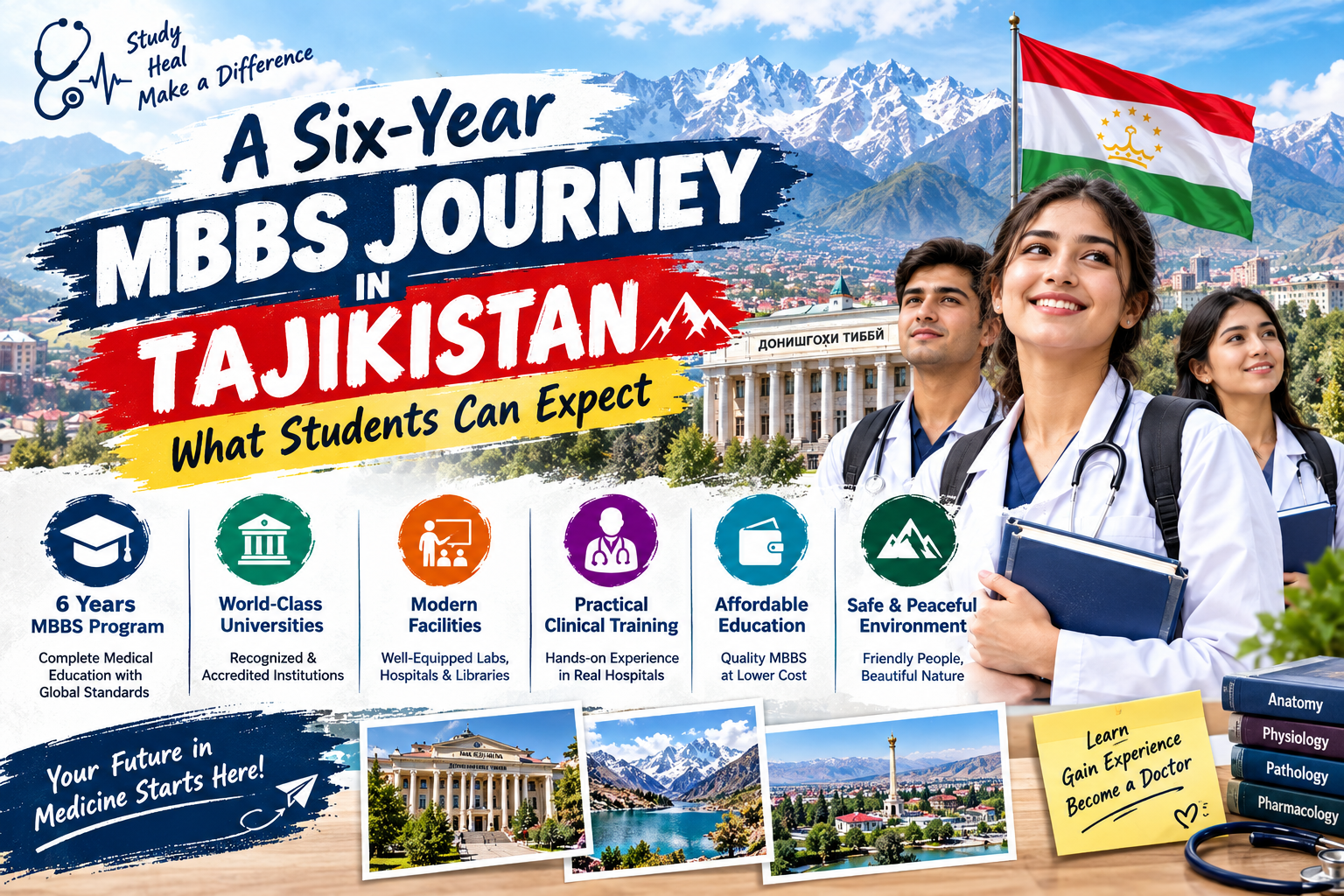
Six years sounds simple when printed on an admission brochure. Year one, year two, a few hospital photographs, internship, graduation. Real medical school is messier. There are anatomy viva sessions, language mistakes, hostel disagreements, difficult patients, unexpected expenses, missed family festivals, and many nights when one chapter somehow takes four hours. For Indian students, MBBS in Tajikistan can be an affordable route to medical education, provided the university and programme are selected carefully. The journey generally moves from basic medical sciences to disease-based subjects, hospital rotations, and supervised practical training. Alongside all this, Indian students must remain aware of NMC regulations and the licensing route they may face after graduation. One year at a time. That’s how it really works.
Before the Journey: Eligibility and NEET Qualification
Who can apply? Indian applicants generally need Class 12 Physics, Chemistry, Biology or Biotechnology, and English from a recognised board. Under the commonly applicable criteria, general-category students require at least 50% aggregate marks in PCB, while eligible reserved-category candidates generally need 40%. Requirements for PwD applicants may differ. The student should ordinarily be at least 17 years old by December 31 of the admission year. Individual universities may also set their own science-mark requirements or conduct an online interview. NEET qualification is generally required for Indian students seeking a primary medical qualification abroad and planning to obtain medical registration in India. The qualifying score changes every year, so applicants should follow the official NEET portal for the examination bulletin, result, cutoff, and applicable instructions. Qualifying for the NEET is different from getting a government medical seat in India. The latter usually requires a much higher score. Still, merely qualifying NEET doesn’t guarantee that every foreign course will meet Indian registration conditions.
First Check: Is the Six-Year Structure Actually Clear?
Here’s where a little suspicion helps. Medical programmes in Tajikistan may be described online as five years, five-plus-one years, or six years. Students shouldn’t assume these descriptions refer to identical academic structures. Before choosing MBBS in Tajikistan, obtain a written, semester-wise curriculum directly from the university. It should state the total academic duration, clinical subjects, teaching months, internship, examination pattern, and qualification awarded. Indian applicants must compare that structure with the current Foreign Medical Graduate Licentiate Regulations and related notices issued by the National Medical Commission. Relevant requirements include the prescribed duration of medical education, compulsory subjects, English-medium instruction, clinical training, internship, and eligibility to obtain a medical licence in the country awarding the qualification. The programme should be checked before payment. Not after arrival. Definitely not in the final year.
Year One: Anatomy and a Completely New Routine
The first year doesn’t begin with difficult medicine. It begins with adjustment. Students learn local transport, hostel rules, currency, grocery shopping, university attendance procedures, and how to share a room with someone whose sleep schedule makes no sense. Then anatomy, physiology, biochemistry, histology, and medical terminology start demanding attention. An ordinary academic day may include lectures, laboratory work, practical demonstrations, oral questioning, and evening revision. Attendance can be closely monitored. Missed practical sessions may require additional assignments or make-up classes, depending on university rules. Anatomy often becomes the first academic shock. There are structures, diagrams, relations, nerve supplies, blood vessels—and a professor pointing at something during viva while your mind becomes completely blank. Students who manage well usually do three things: review lectures on the same day, prepare before practical classes, and revise older topics each weekend. Basic, but effective.
Year Two: From Normal Body Functions to Disease
Something starts connecting during the second year. Physiology is no longer just a collection of mechanisms, because pathology and pharmacology begin explaining what happens when those mechanisms fail. The exact subject sequence varies by university, but students may study microbiology, immunology, pathological processes, pharmacological principles, genetics, and early clinical skills. Practical work can involve slides, specimens, laboratory reports, and oral examinations. This is also the right stage to improve local-language ability. English may be the teaching medium for international students, yet Tajik and Russian remain important outside the classroom. Learn medical phrases early—pain, fever, breathing difficulty, vomiting, allergy, pregnancy, previous surgery, and medicine use. Honestly, students who postpone language learning until hospital postings make life harder for themselves.
Year Three: The Heavy Middle of Medical School
Third year often feels crowded. Pathology, microbiology, pharmacology, forensic medicine, community-oriented subjects, and introductory clinical work begin overlapping. Memorising every subject separately doesn’t work particularly well. A better method is to study by system. While covering tuberculosis, for example, connect the organism, transmission, pathology, diagnosis, medication, adverse effects, prevention, and public-health programme. This is a useful time for Indian students to begin regular licensing-exam preparation. Nothing extreme. Around 75–150 topic-based MCQs a week can gradually identify weak areas.
Maintain a small mistake notebook containing:
- Concepts you misunderstood
- Similar drugs you confused
- Frequently forgotten facts
- Images you couldn’t identify
- Questions misread under pressure
Don’t copy entire explanations. One or two lines are enough.
Year Four: Hospital Training Becomes Serious
Now the patient enters the learning process. Clinical postings may involve internal medicine, general surgery, paediatrics, obstetrics and gynaecology, and other departments according to the university timetable. A typical hospital session can include patient allocation, history-taking, physical examination, investigation review, differential diagnosis, and discussion with the clinical teacher. The amount of direct participation depends on the institution, hospital, faculty, language ability, and number of students in the group. The language barrier becomes very real during this phase of MBBS in Tajikistan. A professor may discuss a case in English while the patient answers in Tajik or Russian. Translation helps, but it isn’t a replacement for direct communication. Students should learn enough local language to collect basic history and give examination instructions. Keep a clinical notebook too. For every useful case, record the complaint, findings, probable diagnosis, investigations, and management. Five lines per patient. Over a year, that becomes a personal clinical reference.
Year Five: Advanced Subjects and Growing Pressure
By fifth year, students are expected to think beyond naming a disease. They must decide which investigation comes first, what the differential diagnoses are, whether the patient is stable, and which treatment shouldn’t be delayed. Clinical medicine, surgery, paediatrics, obstetrics and gynaecology, psychiatry, dermatology, ENT, ophthalmology, orthopaedics, anaesthesia, and radiology may appear across the later curriculum. The precise arrangement differs between universities. This year can feel stretched because university examinations and Indian licensing preparation begin competing for time. The solution is to connect them. If the ward case involves heart failure, revise cardiac physiology, pathology, ECG findings, medicines, imaging, complications, and treatment together. Students can use one structured MCQ platform or revision resource alongside their university syllabus. One. Buying four courses usually creates four unfinished dashboards. A realistic weekly plan may include 300–500 MCQs, one visual-question session, one older-subject revision block, and regular case discussions with classmates.
Year Six: Internship or Final Clinical Phase
The final year should be practical. Depending on the official university structure, it may consist of internship rotations, advanced hospital training, or a combination of clinical work and examinations. Students may rotate through medicine, surgery, paediatrics, obstetrics and gynaecology, emergency care, and other required departments. Attendance, duties, assessments, and completion dates should be properly documented. This isn’t just administrative fuss. Indian students need clear evidence that their internship and clinical education satisfy the conditions applicable to their batch.
Collect documents during each rotation:
- Department completion certificate
- Rotation dates
- Attendance record
- Internship logbook
- Supervisor’s signature
- Clinical assessment
- Final internship certificate
Don’t wait until graduation week to collect everything. Faculty members change, hospital offices delay files, and missing signatures become strangely difficult to obtain once you leave.
What Clinical Exposure May Look Like
A large hospital can be impressive without offering good student participation. The real question is whether international students are allowed to learn actively. Before admission, ask when clinical postings begin, how often they occur, which hospitals are affiliated, and how many students attend each unit. Speak with fourth-, fifth-, or sixth-year students rather than relying only on an admission representative.
Useful clinical exposure should gradually include:
- Taking patient histories
- Performing supervised examinations
- Presenting clinical cases
- Reading laboratory reports
- Interpreting basic imaging
- Discussing differential diagnoses
- Understanding management plans
- Observing or assisting with permitted procedures
During MBBS in Tajikistan, local-language ability can directly affect the quality of hospital learning. Students who communicate with patients independently usually get more from the same rotation.
Recognition: What Students Should Verify
A medical school’s appearance in the World Directory of Medical Schools provides useful directory information, but WDOMS states that listing doesn’t itself mean recognition, accreditation, or endorsement. It also doesn’t guarantee registration eligibility in India. Students may also encounter the phrase “WHO-approved university.” The World Health Organization works on international public health and doesn’t issue an individual university approval that automatically makes a qualification valid in every country.
Recognition needs several separate checks:
|
Check |
Why it matters |
|
University’s legal status |
Confirms authority to operate |
|
Programme accreditation |
Confirms the medical course’s status |
|
WDOMS information |
Provides directory details |
|
Local licensing eligibility |
Shows whether graduates can pursue registration locally |
|
NMC compliance |
Relevant for Indian registration |
|
Internship documentation |
Establishes clinical training completion |
A logo isn’t proof. An official record is.
Tuition Fees and Six-Year Expenses
Medical tuition may broadly range between USD 3,000 and USD 5,500 per year at selected institutions, although exact charges vary by intake and programme. Hostel accommodation may cost approximately USD 500–1,200 annually. Food and ordinary living expenses can fall around USD 120–250 per month for students using shared accommodation, cooking regularly, or selecting an economical mess. Private rooms, restaurant meals, frequent taxis, and imported goods increase the budget.
|
Expense |
Approximate range |
|
Tuition per year |
USD 3,000–5,500 |
|
Hostel per year |
USD 500–1,200 |
|
Monthly food and living |
USD 120–250 |
|
Insurance and health checks |
Varies |
|
Visa and registration |
Varies |
|
Flights |
Depends on route and season |
|
Books and personal supplies |
USD 200–500 approximately |
The total cost of MBBS in Tajikistan may reach roughly ₹20–35 lakh or more across six years. This broad estimate includes tuition, hostel, food, travel, and basic additional expenses, but exchange rates and university policies can change the final figure. Families should ask about registration charges, visa renewal, insurance, mess fees, hostel deposits, laboratory costs, examinations, airport pickup, document translation, and consultancy charges. The first-year package rarely tells the whole story.
Hostel Life and Personal Adjustment
I’ve noticed that students talk about hostel life with equal amounts of irritation and affection. The same roommate who leaves dirty dishes in the sink may also stay awake helping you revise for a difficult viva. Rooms may be shared by two or more students. Kitchens, bathrooms, laundry facilities, and study areas can be common. Ask whether heating, electricity, water, bedding, Wi-Fi, and kitchen use are included in the hostel fee. Indian mess facilities may be available near campuses with larger student groups. Cooking remains cheaper, though it requires planning. Rice, lentils, eggs, vegetables, chicken, bread, and a few familiar spices solve most weekly food problems. Homesickness tends to appear after the excitement settles. Regular family calls help, but students also need friends, exercise, sleep, and a routine outside academics. Some weeks are lonely. Then they pass.
FMGE or NExT Preparation During the Course
Graduation from a foreign university doesn’t automatically result in medical registration in India. Eligible graduates must complete the licensing process applicable at the time of their return. FMGE remains relevant in 2026. NExT regulations have also been notified, but implementation developments should be checked through current NMC notices. A student beginning a six-year programme can’t safely predict which route will apply at graduation.
The preparation method should work for either examination:
- Build strong basic-science concepts.
- Connect pathology with clinical subjects.
- Solve MCQs throughout the course.
- Practise ECGs, X-rays, slides, and clinical images.
- Study Indian public-health programmes.
- Take timed full-length tests in later years.
- Review every incorrect answer.
Small preparation from the first year is far easier than rebuilding 19 subjects after graduation.
Main Advantages and Challenges
The advantages include lower tuition, manageable living costs, international exposure, and access to medical education without the financial burden associated with many private colleges in India. The challenges include local-language communication, university-wise variation in clinical exposure, inconsistent online course information, documentation requirements, travel logistics, and separate licensing-exam preparation. The destination can work well for a disciplined student. Not magically. The university provides the programme; the student still has to build the knowledge and clinical skill.
Frequently Asked Questions
Is the medical course in Tajikistan six years?
Many programmes are presented as five academic years plus one year of internship or practical training. Exact structures vary, so students should verify the official curriculum and internship documents.
Is NEET compulsory for Indian students?
Indian students seeking a foreign primary medical qualification and intending to pursue registration in India generally need to qualify NEET under applicable regulations.
Is the course taught in English?
Selected universities offer English-medium teaching for international batches. Students still need Tajik or Russian for patient communication during hospital training.
How much does the full programme cost?
A broad six-year estimate may range from ₹20 lakh to ₹35 lakh or more. Tuition, accommodation, food habits, flights, exchange rates, and additional university charges affect the final cost.
Can a graduate practise in India?
Eligible graduates may pursue the applicable Indian licensing and registration pathway if their course, internship, qualification, and admission meet current NMC conditions.
When should FMGE preparation begin?
Light subject-based MCQ practice can start during the first two years. Structured preparation should increase from the third or fourth year and become intensive during the final clinical phase.
Conclusion
The student who arrives worried about hostel food eventually worries about clinical case presentation. Then internship documents. Then the licensing examination. Each stage replaces the last one. That’s the journey. Students considering MBBS in Tajikistan should verify the six-year course structure, internship, hospital training, complete fees, local licensing eligibility, and current NMC regulations before accepting admission. After that, the formula is less complicated: attend classes, learn the language, study consistently, collect every document, and take clinical work seriously. Six years. Many ordinary days. One medical degree built across all of them.