
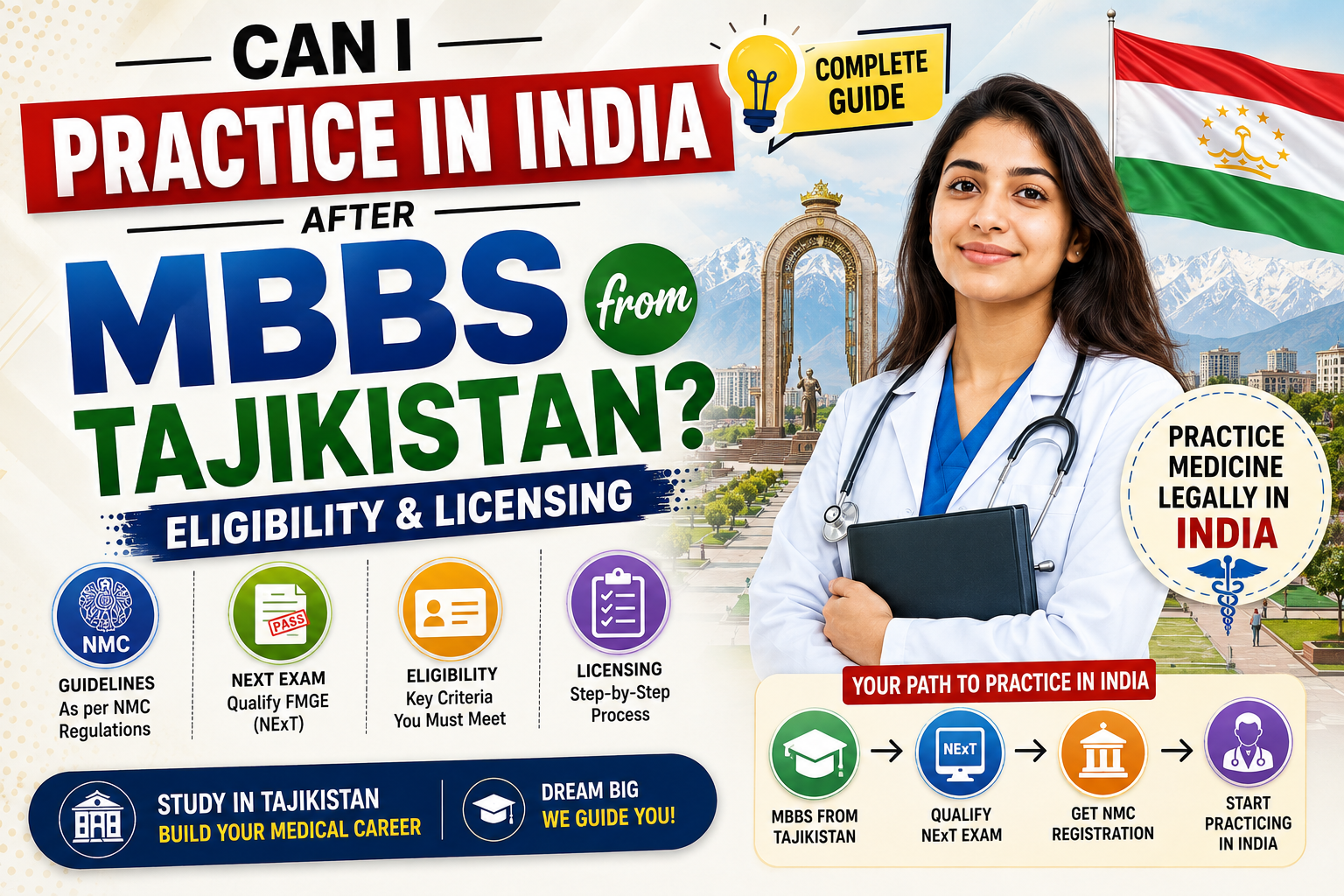
Studying medicine abroad is one decision. Coming back to India and legally working as a doctor is another.That difference matters.For Indian students considering MBBS in Tajikistan, the real question shouldn't stop at tuition fees, hostel facilities, or whether classes are available in English. A much more practical question is: Will this medical degree actually make me eligible to obtain registration and practice medicine in India?The short answer is yes, potentially. An Indian student who completes a compliant medical program in Tajikistan can return to India and pursue medical registration. But a foreign degree by itself doesn't give anyone an automatic licence to practise here. The medical course, internship, clinical training, medium of instruction, local licensing eligibility, screening/licensing examination and Indian internship requirements all come into the picture.
And this is where students sometimes make expensive mistakes.A university may advertise a six-year medical program and admission for international students. Fine. That still doesn't answer whether the exact program offered to an Indian student satisfies the requirements applicable to foreign medical graduates in India.Before paying even the first major instalment, students should compare the university's written curriculum and training structure with the current rules published by the National Medical Commission (NMC).
Can an MBBS Graduate from Tajikistan Practice in India?
Yes, provided the graduate satisfies the applicable Indian regulatory requirements and obtains the required registration.Under the NMC's Foreign Medical Graduate Licentiate Regulations, a foreign medical graduate cannot simply return with a degree and begin treating patients independently. Permanent registration depends on meeting specified educational and licensing conditions. The regulations include requirements relating to course duration, internship, English-medium instruction, mandatory subjects, eligibility for registration in the country where the qualification was awarded, internship in India and the prescribed licensing examination.So think of your Tajikistan degree as the academic foundation. Registration in India is the next stage.This distinction is especially relevant because students starting MBBS in Tajikistan now are studying under a regulatory environment quite different from the one that applied to some older batches of foreign medical graduates.
What Does NMC Require from Foreign Medical Graduates?
Here's the part worth reading slowly.For students covered by the Foreign Medical Graduate Licentiate Regulations, 2021, the NMC specifies several core requirements. The foreign medical course must include at least 54 months of study, followed by at least a 12-month internship in the same foreign medical institution. The degree must have English as the medium of instruction, and the student must study the mandatory subjects prescribed by the regulations.The graduate must also be registered with the appropriate professional regulatory body, or otherwise be eligible for a licence to practise medicine in the country where the medical degree was awarded, on terms comparable to local citizens.Then comes the Indian side of the process.Foreign graduates covered by these rules are also required to complete a supervised internship in India for at least 12 months and clear the examination prescribed under the applicable regulatory framework.
A useful pre-admission checklist looks like this:
|
Requirement |
What an Indian Student Should Verify |
|
Medical education |
Minimum 54 months as required under FMGL rules |
|
Foreign internship |
Minimum 12 months at the same foreign medical institution |
|
Medium |
English |
|
Subjects |
All mandatory subjects prescribed by NMC |
|
Clinical training |
Proper hands-on clinical education under the applicable rules |
|
Local eligibility |
Degree should make the graduate eligible for registration/licensing in the awarding country |
|
Indian licensing exam |
Must clear the examination applicable to the student's batch |
|
Internship in India |
Minimum 12-month supervised internship where required |
|
Registration |
Final registration through the appropriate Indian medical regulatory system |
One missing component can create trouble later. Sometimes in serious trouble.In a 2026 advisory, NMC again cautioned students about foreign institutions whose curriculum, duration, clinical training or internship arrangements don't satisfy Indian requirements. It specifically highlighted course duration, medium of instruction, syllabus, clinical training and internship/clerkship arrangements as areas students need to verify.
Is NEET Required Before Studying MBBS in Tajikistan?
For an Indian student planning to return and practise medicine in India, NEET shouldn't be treated as optional paperwork.Students should check the current eligibility requirements through the official NEET website before accepting foreign admission. NEET-UG is conducted by the National Testing Agency, and the official portal publishes current examination information, notices and results.Don't confuse NEET qualification with admission competitiveness in India.A student may not have the score required for an affordable government MBBS seat in India yet may still meet the relevant NEET qualification requirement for studying medicine abroad. The exact qualifying criteria depend on the examination year and category, so using an old YouTube video or a three-year-old consultancy PDF is a bad idea.Check the official result for your own examination year. Simple.
The 54-Month Course and 12-Month Internship Rule
This is probably one of the most important checks before selecting a Tajik medical university.NMC's FMGL Regulations specify a foreign medical course of at least 54 months, along with a minimum 12-month internship at the same foreign medical institution. The internship is separate from clinical postings undertaken during the academic course.That last part gets overlooked.Clinical rotations during the academic program don't automatically replace the post-course internship requirement. NMC's FAQ specifically distinguishes clinical posting/training during the medical course from internship or clerkship completed after the academic course.So if a university tells you, "Our six-year program includes everything," ask for the year-wise curriculum.Then ask again.You need to know exactly how many months constitute academic medical education, where the internship takes place, whether it is conducted by the same institution and what qualification/licensing rights the completed program provides in Tajikistan.
Is English-Medium Medical Education Necessary?
Yes, for students covered by the FMGL Regulations, English as the medium of instruction is specifically included among the conditions for permanent registration.But there's a practical side to this too.An "English-medium" brochure doesn't necessarily mean every patient in a teaching hospital speaks English. Clinical medicine is different from classroom anatomy. Students studying MBBS in Tajikistan may need to develop enough Russian or Tajik communication ability to interact with patients during clinical postings.That's not necessarily a disadvantage. Patient communication matters everywhere.What matters from an Indian licensing perspective is that the university can formally document the medium of instruction and that the overall program satisfies the applicable NMC requirements.
Is a WDOMS-Listed University Automatically NMC Approved?
No. This misconception refuses to disappear.The World Directory of Medical Schools (WDOMS) is extremely useful for checking whether a medical school appears in the international directory and for reviewing available program information. But WDOMS itself explicitly states that listing a medical school does not mean the school is recognised, accredited or endorsed by the directory or its publishers.That changes how students should use WDOMS.Use it as a verification tool. Don't treat the words "WDOMS listed" as a complete guarantee that a particular program satisfies every Indian registration requirement.For example, WDOMS records can contain information about program duration, language of instruction and eligibility of foreign students. Some Tajik programs listed in the directory show six-year MD pathways and English among the languages of instruction.Still, verify the exact university, exact campus and exact program you are joining.A similarly named branch campus isn't automatically the same institution. One WDOMS entry for the Khujand Branch of Avicenna Tajik State Medical University, for example, currently identifies that branch as not operational.Details like this are precisely why checking the full university name matters.
Does WHO Recognition Mean You Can Practice in India?
Not by itself.Students often see phrases such as "WHO recognised" in overseas MBBS advertising and assume that this settles the licensing question. It doesn't.The World Health Organization (WHO) is an international public-health body. Eligibility to obtain medical registration in India is governed by Indian law and the requirements of the NMC and relevant registration authorities.So don't select a university based on a single recognition logo.Check the university's legal status in Tajikistan, its medical program, WDOMS information where available, course duration, internship structure, medium of instruction, clinical training and eligibility for local medical registration.That takes longer than reading an advertisement. Worth it.
FMGE or NExT: Which Exam Will Tajikistan Graduates Need?
This is where students need to avoid rigid assumptions.The Foreign Medical Graduate Examination, or FMGE, has historically been the screening route used by foreign medical graduates seeking registration in India. The NMC framework also provides for the National Exit Test, or NExT. However, NMC's published regulations page still lists the 2023 public notice deferring NExT, while the Foreign Medical Graduate Licentiate Regulations remain part of the current regulatory framework.For a student entering university now, graduation is several years away.Rules can change before then.Rather than building your entire admission decision around the assumption that "I will definitely give FMGE after six years," follow official NMC notifications throughout your course. The examination applicable when you graduate and seek registration is what will matter.Preparation shouldn't wait until final year either.
Indian-style clinical questions, pharmacology, pathology, community medicine and other core subjects need consistent attention from the early years. A low-cost foreign medical degree isn't much use if the student treats the Indian licensing examination as an afterthought.
What Happens After You Return to India?
Picture the process as a chain rather than one examination.First, complete a compliant foreign medical program and the required internship in Tajikistan. Make sure your degree, transcripts, internship records and other academic documents are properly issued and preserved.Next comes the applicable Indian screening/licensing requirement.After meeting the relevant examination and registration conditions, foreign medical graduates covered by the current framework are required to undergo supervised internship in India for at least 12 months. NMC has clarified that allocation for such internships is handled through the concerned State Medical Council and that eligible FMGs should undertake the internship at approved medical colleges or institutions.After completing all applicable requirements, the graduate can proceed toward permanent registration according to the rules in force at that time.So no, returning from Tajikistan doesn't mean walking out of the airport and joining a hospital as an independently registered doctor.There are steps in between.
How Long Can the Full Journey Take?
A compliant overseas medical pathway itself can take around six years where the structure consists of the required academic education plus internship.Then consider the Indian phase.Depending on the examination schedule, result timeline, documentation, internship allocation and rules applicable to your batch, additional time may be required before permanent registration is completed.A simplified timeline could look something like this:Medical education abroad → foreign internship → degree/local licensing eligibility → Indian licensing or screening requirement → supervised Indian internship → permanent registrationDon't treat this as a guaranteed fixed timeline because examination systems and administrative processes can change during a six-year degree.For students researching MBBS in Tajikistan, this full pathway is far more useful than comparing tuition fees alone.
MBBS in Tajikistan Fees and the Cost Beyond Tuition
Tajikistan attracts attention partly because its medical education can be priced below many private MBBS options in India.Depending on the university, exchange rate, hostel choice and services included, students may encounter tuition quotations roughly in the range of US$3,000–5,500 per year at some institutions. Actual university charges can differ significantly, so this range should be treated as an orientation figure, not an official fee quote.And tuition isn't the whole bill.Students should budget separately for hostel or accommodation, food, visa and residence documentation, medical insurance, airfare, local transportation, university registration charges where applicable, textbooks, personal expenses and licensing-exam preparation.Currency movement matters too.A fee that looks affordable when converted into rupees today may cost more over the next five or six years if exchange rates change.Before taking admission through any consultancy or representative, ask for the university's current official fee letter. Not a WhatsApp message. Not a handwritten estimate.For country-specific university information, admission guidance and cost comparisons, students can also review MBBS in Tajikistan while cross-checking regulatory claims against official NMC documents.
What Should You Check Before Choosing a Tajikistan Medical University?
University selection deserves more attention than most students give it.Don't begin with "Which one is cheapest?" Begin with "Which exact program keeps my future registration pathway safe?"
Check these points before transferring money:
- Exact legal name and campus of the medical institution
- Current operational status
- Medical program duration
- Separate internship structure and duration
- English as the documented medium of instruction
- Mandatory medical subjects required by NMC
- Clinical training arrangements and teaching hospitals
- Whether clinical training occurs in the same country
- Eligibility for registration/licensing in Tajikistan after completing the program
- WDOMS entry and program details
- Written tuition and hostel fee structure
- Refund policy
- Indian student support and documentation process
There's another useful question: Where exactly will I examine real patients?A glossy campus doesn't tell you much about clinical exposure.Ask about affiliated hospitals, patient load, clinical rotations, bedside teaching and whether international students actually participate in practical training rather than simply observing.
Common Mistakes That Can Affect Indian Registration
The cheapest admission offer can become the most expensive mistake.One common problem is selecting a university based only on statements such as "NMC approved," "WHO approved" or "100% valid in India." These phrases need evidence behind them.Another mistake is ignoring internship structure. Some students focus entirely on whether the total program says five years, five-and-a-half years or six years without checking how the academic and internship components are actually divided.Then there are transfers.Switching institutions, campuses or countries midway through a foreign medical program can create regulatory complications because NMC requirements address the structure and location of education and internship. NMC's 2026 advisory again warned that deviations involving course duration, curriculum, clinical training and internship arrangements can affect eligibility for registration in India.Cheap now. Complicated later.Get written clarification before admission whenever the structure looks unusual.
Is MBBS in Tajikistan a Sensible Option for Indian Students?
It can be, but only for the right student and the right university.The country can appeal to families looking for an overseas medical program at a comparatively manageable budget.English-medium options and admission of international students are other reasons students investigate Tajik universities.But affordability should never outrank licensing eligibility.A student who plans to build a career in India should select MBBS in Tajikistan backwards: start with the requirements for Indian registration, then find a foreign medical program that fits them.Not the other way around.You'll also need to be comfortable studying away from home, adapting to another healthcare system, communicating with local patients and preparing independently for the examination system that applies when you return to India.
FAQs About Practicing in India After MBBS from Tajikistan
Can I directly practice in India after completing MBBS in Tajikistan?
No. Completing the foreign medical degree alone doesn't provide automatic permanent registration in India. You must satisfy the applicable NMC requirements, including the prescribed licensing/screening examination, internship and registration conditions.
Is NEET compulsory for Indian students going to Tajikistan?
Indian candidates planning foreign undergraduate medical education and later registration in India should ensure they satisfy the applicable NEET and NMC eligibility requirements for their admission year. Always verify the current position through the official NEET and NMC portals rather than relying on older admission material.
Do I need another internship in India after completing one in Tajikistan?
Under the FMGL Regulations applicable to covered students, yes. NMC's FAQ states that in addition to the minimum 12-month internship in the same foreign medical institution, the foreign medical graduate must undergo at least 12 months of supervised internship in India.
Is every Tajikistan medical university valid for Indian students?
Don't assume so. Eligibility depends on the specific medical program and its compliance with the regulations applicable to you. Verify course duration, internship, English-medium instruction, mandatory subjects, clinical training, local licensing eligibility and other NMC conditions before admission.
Is WDOMS listing enough to guarantee registration in India?
No. WDOMS itself states that inclusion in its directory doesn't constitute recognition, accreditation or endorsement. Indian students must separately check NMC requirements.
Will I have to clear FMGE after graduating from Tajikistan?
That depends on the examination framework applicable when you seek registration in India. FMGE has been the existing screening route, while NExT has also been provided for under the NMC framework and its implementation has undergone changes and deferrals. Since a medical degree takes several years, students should follow current NMC notifications instead of assuming today's examination arrangement will necessarily remain unchanged until graduation.
Conclusion
Yes, you can build a medical career in India after completing MBBS in Tajikistan, but admission abroad and a licence to practise in India are two separate milestones.The safer approach is straightforward: qualify under the applicable NEET rules, select the exact foreign medical program carefully, verify the 54-month academic requirement and 12-month foreign internship, confirm English-medium education and mandatory subjects, check clinical training and local licensing eligibility, and then follow India's examination, internship and registration requirements after graduation.Don't choose a medical university because someone says, "This university is approved."Ask approved by whom. For what purpose. And under which rule.Those three questions can save a student years of trouble.Before finalising admission, compare the latest university documents with the current NMC regulations, verify the institution through WDOMS, check your NEET requirements and research the complete MBBS in Tajikistan pathway rather than looking at tuition fees alone.Because getting admission is the easy part.Making that degree work for your future in India — that's the part worth planning before you leave.