
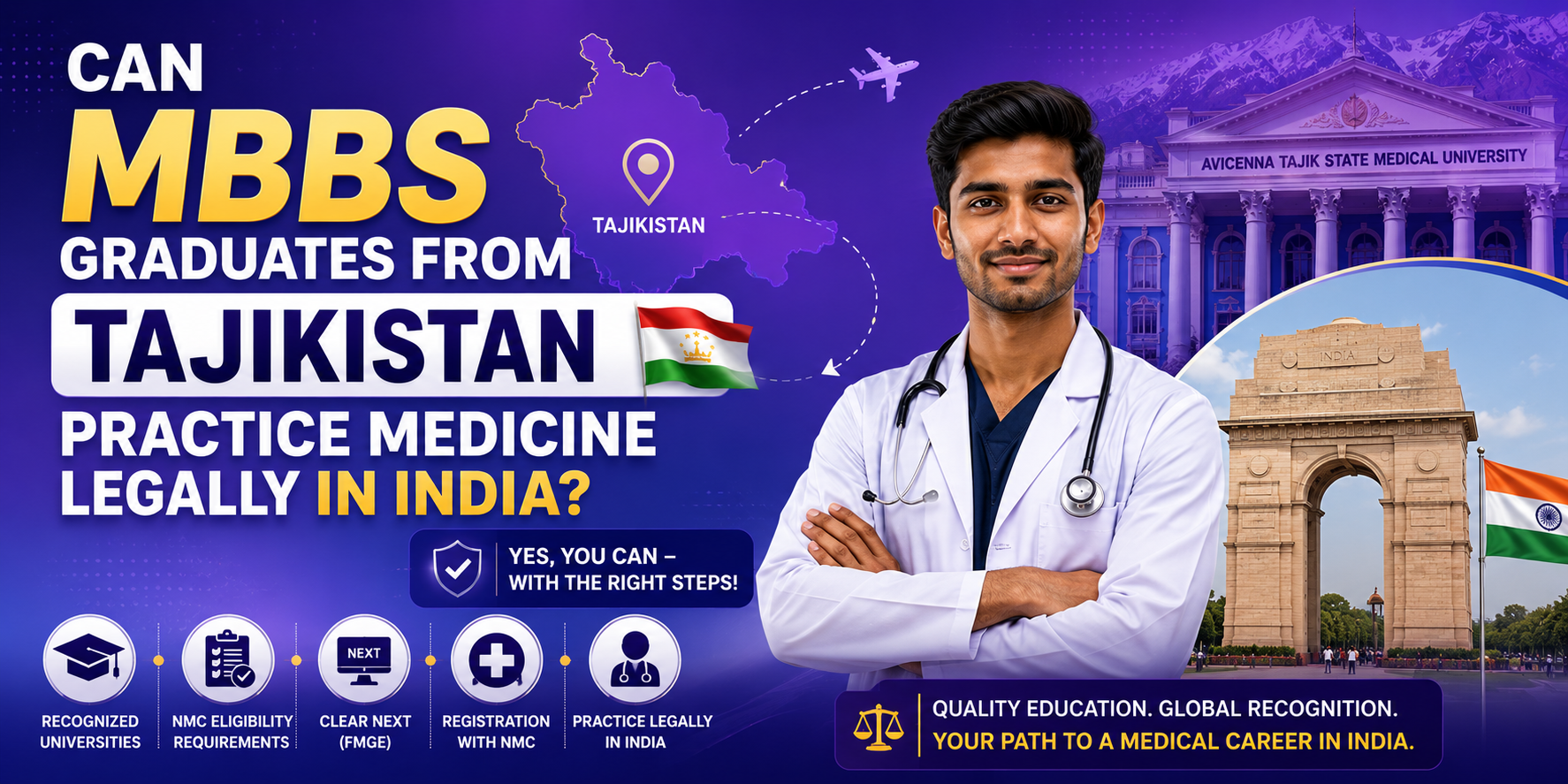
Many Indian students planning to study medicine abroad almost always raise the same core question at the outset: Can graduates who complete their MBBS degree in Tajikistan legally practice medicine in India?
To answer this question, we first need to lay out the background of the supply-demand mismatch in India’s domestic medical education sector.
Every year, millions of students take the NEET-UG national medical entrance exam, competition for spots at public medical colleges is extremely fierce, and the total tuition fees for a full MBBS program at private medical colleges can reach as high as 50 lakh to over 100 million Indian rupees.
The vast majority of ordinary Indian families cannot afford these costs at all, which has created a large rigid demand for overseas medical study.
As a result, Tajikistan has become a popular choice for Indian students, as it boasts eight core advantages:
- Low tuition and living costs
- Medical colleges accredited by India’s NMC
- English-taught medical programs
- Modern teaching infrastructure
- Internationally awarded degrees
- A safe living environment for international students
- A greatly simplified admission process
- High cultural compatibility between India and Tajikistan
Core Answer: Legal Medical Practice in India
Our core answer is clear: As long as all prerequisite regulatory requirements are met, MBBS graduates from Tajikistan are fully eligible to practice medicine legally in India.
These requirements are five mandatory steps explicitly stipulated by the NMC:
- Pass the NEET-UG exam before leaving India to study medicine abroad.
- Graduate from a Tajikistani institution that meets NMC qualification requirements.
- Pass the FMGE or NExT licensing exam.
- Complete all mandated internship requirements.
- Obtain professional physician registration in India.
Subsequent sections of this guide will cover in detail all core modules, including:
- The NMC’s full set of regulatory rules
- Registration and preparation processes for licensing examinations
- Eligibility requirements for each stage
- Common challenges of studying abroad and practicing medicine
- Post-graduation career development opportunities
Compliance Requirements for Foreign Medical Graduates
As a compliance guide for Indian medical students planning to study in Tajikistan, this section first clarifies the core prerequisite for legal medical practice:
All foreign medical graduates may only practice medicine legally in India after completing all stipulated requirements and obtaining registration qualifications from India’s National Medical Commission (NMC) or the relevant state medical council.
This guide adopts a clear modular structure, breaking down complex, specialized compliance requirements and application processes into logically distinct entries.
Four Mandatory MBBS Degree Accreditation Standards
For Indian students planning to pursue medical education in Tajikistan, the guide sorts out four mandatory MBBS degree accreditation compliance standards set by the NMC.
The four compliance standards are as follows:
- The target medical school must receive NMC recognition.
- The school must be listed in the WDOMS.
- The program duration must meet India’s MBBS equivalence standards, including:
- A minimum of 54 months of medical education
- Sufficient academic training
- Required internship and clinical rotation components
- Clinical training must meet specified criteria, including:
- Standardized rotations
- Regular hospital training covering all required departments
- Complete supporting clinical records
First Two Mandatory Steps for Medical License Eligibility
The two mandatory preconditions for the first two steps of the medical license application process are:
- Passing the NEET-UG exam before enrollment.
- Completing MBBS studies at an institution that meets all NMC requirements.
Failure to meet either requirement may create core barriers, including:
- Blocked registration
- Ineligibility to take subsequent licensing examinations
Complete Roadmap from Study Abroad to Medical Registration
For all Indian medical students who intend to pursue an MBBS in Tajikistan and plan to return to India to practice medicine after completing their studies, this paper sorts out all process milestones, compliance requirements, and potential risks spanning from pre-study preparation to official medical practice registration.
All content is tailored to the target group’s practical needs, with no vague, general statements.
We break down the complex cross-border medical qualification application process into three clear modules:
- Steps
- Rules
- Challenges
with specific implementation details laid out for each.
Six Core Steps in the Medical Registration Process
The steps module includes 6 core operations, each specifying:
- The implementing party
- Required documents
- Liaison agency
Among these, the third step requires retaining 8 categories of supporting documents, covering academic, clinical, and identity-related materials.
FMGE and NExT Requirements
The fourth step currently requires taking the Foreign Medical Graduate Examination (FMGE) hosted by India’s National Board of Examinations in Medical Sciences (NBEMS).
India will replace this exam with the National Exit Test (NExT) in the future.
The new exam will assess 4 core medical practice competencies.
Internship and Registration
- The clinical practicum required in the fifth step must be recognized by India’s competent authorities.
- The medical practice registration application for the sixth step must be submitted to India’s National Medical Commission (NMC) or state medical councils.
Key Compliance Rules
The rules module clarifies the control nodes of 3 mandatory rules.
Applicants must retain:
- 3 categories of documents related to the National Eligibility cum Entrance Test (NEET)
- 4 categories of certificates related to clinical training
Applicants must also monitor 4 timeline nodes throughout the entire process.
Non-compliance at any link may lead to delays in the registration application.
Common Challenges Faced by Indian Students
The challenges module highlights two core adaptation problems that require proactive preparation:
Differences Between Medical Education Systems
Students must understand 4 key differences between the medical education systems of Tajikistan and India.
Language Barriers During Clinical Training
Students need to interact with three groups of people:
- Local patients
- Hospital staff
- Native local medical practitioners
Mastering basic local language skills can greatly improve their clinical internship experience.
FMGE and NExT Preparation Challenges
The biggest challenge this group faces, however, is the extremely low pass rate of India’s medical licensing exam, the Foreign Medical Graduate Examination (FMGE).
Students must sort out the four layers of competition in their career track:
- FMGE/National Exit Test (NExT)
- Internship placement matching
- Postgraduate admission
- Recruitment by medical institutions
Eight Core Subjects for Exam Preparation
Exam preparation must focus on eight core medical subjects:
- Anatomy
- Physiology
- Biochemistry
- Pathology
- Pharmacology
- Microbiology
- Internal Medicine
- Surgery
Four Mandatory Preparation Tasks
Students must complete four mandatory tasks:
- Build solid conceptual understanding.
- Follow a structured preparation plan.
- Practice with question banks regularly.
- Stay updated on the latest rules from the NMC.
Four Actionable Strategies to Improve Exam Scores
We have sorted out four actionable strategies to improve exam scores:
- Strengthen core foundational knowledge.
- Start preparation as early as possible.
- Use standard medical learning resources.
- Take mock exams regularly.
Mock exams can help students:
- Improve time management skills
- Identify weak points in their knowledge
- Build test-taking confidence
- Increase answer accuracy
We consistently maintain that continuous preparation throughout the entire MBBS program is far more efficient than last-minute cramming before the exam.
Career Opportunities After Medical Registration
After completing medical registration in India, graduates can choose from diverse career paths:
Clinical Practice in India
- Public hospitals
- Private hospitals
- Community health centers
- Corporate medical organizations
- Private clinics
Postgraduate Medical Education
Students may pursue:
- Doctor of Medicine (MD)
- Master of Surgery (MS)
- Professional diploma programs
- Superspecialty training programs
International Medical Practice
Students may prepare for:
- United States Medical Licensing Examination (USMLE)
- UK Professional and Linguistic Assessments Board (PLAB)
- Australian Medical Council (AMC) examination
to practice medicine overseas.
Essential Requirements for Returning to India
For Indian international students planning to travel to Tajikistan to pursue a Bachelor of Medicine and Bachelor of Surgery (MBBS) degree, this paper first sorts out the four core professional qualification requirements that must be met to legally practice medicine in India after returning home.
All requirements are anchored in the current regulations of India’s National Medical Commission (NMC), covering core mandatory standards including:
- Passing the NEET-UG examination
- Passing FMGE and NExT qualification examinations
- Attending a medical school listed in the World Directory of Medical Schools (WDOMS)
Common Registration Mistakes and School Selection Criteria
The guide also:
- Lists seven common mistakes that international students frequently make during the professional registration process.
- Defines six actionable assessment criteria for screening Tajikistani medical schools before studying abroad.
All listed items are verifiable action points that can be checked one by one, with no ambiguous content.
Final Recommendations for Indian Students
This paper reminds all international students that they must independently verify the official qualifications of their target school before enrolling and continuously follow updates to medical regulatory rules released by the NMC to avoid practice risks caused by policy changes.
Finally, it summarizes action guidelines covering the full cycle from study abroad application to post-return registration.
The entire set of content is organized along a timeline, breaking down complex compliance requirements into an itemized structure.
All key proper nouns retain their standard English abbreviations, which greatly lowers the information access barrier for international students and can be directly used as a practical guide for practice compliance.