
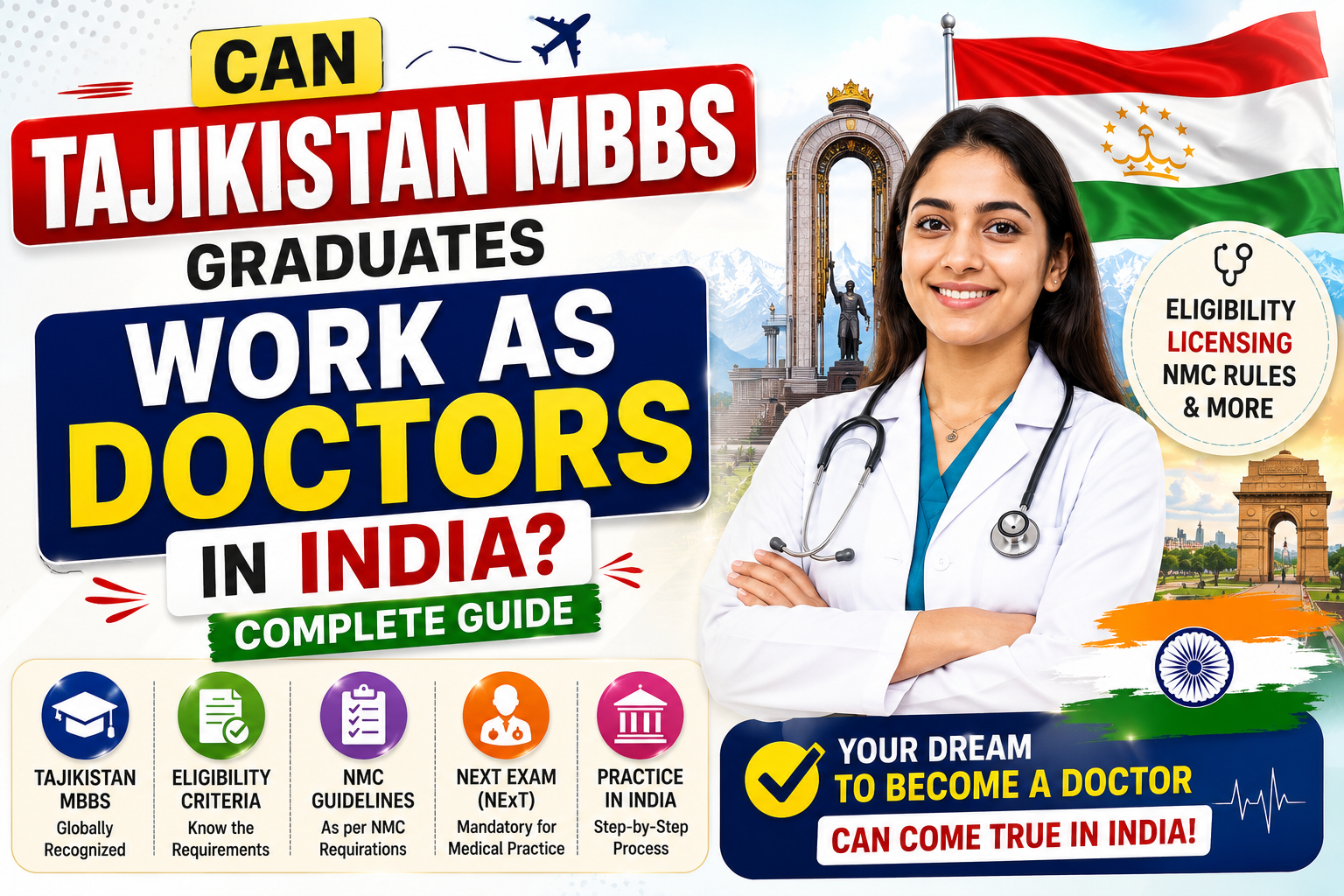
Yes, an Indian student who completes MBBS in Tajikistan can work as a doctor in India. But the foreign medical degree alone doesn't give you the right to start practising after landing back home.There are regulatory steps in between. And these steps matter a lot.The biggest mistake students make is checking only whether a university appears in an international medical-school directory. That isn't enough. What really matters is whether the medical program you join satisfies the rules applicable to foreign medical graduates in India.The National Medical Commission currently lists the Foreign Medical Graduate Licentiate Regulations, 2021 among its regulations and has repeatedly advised students to check course duration, medium of instruction, curriculum, clinical training and internship arrangements before taking admission abroad. Its recent advisory states that deviation from these requirements may make a graduate ineligible for registration in India.
So, can you return from Tajikistan and become a registered doctor?Yes. Provided your education is compliant and you complete the licensing pathway applicable to you.Let's break down what that actually means.
Is an MBBS Degree from Tajikistan Valid in India?
A foreign medical qualification isn't judged simply by the country printed on the degree.The actual program matters.For students covered by the Foreign Medical Graduate Licentiate Regulations, 2021, the NMC framework includes requirements related to the duration of medical education, internship, subjects studied, clinical training, medium of instruction and eligibility for medical registration in the country where the qualification is awarded.That last part is easy to overlook.Students considering MBBS in Tajikistan should therefore investigate the exact university and course rather than assuming that every medical program in Tajikistan follows an identical structure.
NMC's 2026 advisory specifically highlights a minimum of 54 months of education in a single institution, a 12-month internship at the same foreign university, English as the medium of instruction, and restrictions concerning clinical training being split across different countries.Before paying a university deposit, verify these conditions against the latest official regulations. Rules can change, and admission agents aren't regulators.
What NMC Rules Should Tajikistan MBBS Students Check?
Here is where students need to slow down.Under the current regulatory framework, simply studying medicine for several years abroad doesn't automatically establish eligibility for permanent registration in India. Your program itself needs to fit the required conditions.
A prospective student should check these points carefully:
- Medical education of at least 54 months, where applicable under the FMGL Regulations
- 12-month internship at the same foreign medical institution
- English as the medium of instruction
- Required medical subjects comparable with the Indian MBBS curriculum
- Proper hands-on clinical training
- Education and training completed according to NMC requirements
- Eligibility to obtain registration/licence to practise medicine in the country where the degree is awarded
- Compliance with the screening/licensing requirement applicable in India
- Completion of the required supervised internship in India before permanent registration, subject to applicable regulations
The NMC has specifically warned students about foreign colleges whose curricula, training arrangements or timelines don't match Indian regulatory requirements.This is why checking the university before admission is far easier than trying to fix a compliance problem five or six years later.
Is NEET Required Before Studying MBBS in Tajikistan?
For an Indian candidate planning to study medicine abroad and later pursue medical practice in India, NEET qualification is a critical requirement under the applicable Indian framework.The official NEET website is operated for the National Eligibility cum Entrance Test by the National Testing Agency. Students should use the official portal for the current information bulletin, notices and examination-related updates.Don't confuse "NEET qualified" with a high NEET rank.
A student doesn't necessarily need the kind of score required for a government MBBS seat in India to consider foreign medical education. The relevant requirement for studying medicine abroad for an Indian candidate intending to practise in India is tied to NEET eligibility/qualification under the rules applicable to that admission year.Cut-offs change each year.So don't rely on a consultant quoting last year's qualifying marks as if they're permanent. Check your actual result and the official regulations applicable when you take admission.
Medical Course Duration in Tajikistan: Why It Matters
This part deserves more attention than tuition fees.Some universities may describe their medical course as a six-year program. Others may present academic years and internship arrangements differently.Don't stop at the words "6-year MBBS."Ask what those six years actually contain.For an Indian student covered by FMGL Regulations, the relevant NMC requirements include at least 54 months of medical education and a 12-month internship at the same foreign medical institution.Suppose a brochure says:
Course duration: 6 years
Sounds fine.
But then you discover that part of the clinical training is arranged elsewhere, the internship isn't structured as expected, or the university's academic documents describe the program differently.
Now you have a problem.
This is why students planning MBBS in Tajikistan should request the written curriculum, internship structure and clinical-training details before admission.
Not after reaching Dushanbe.
Before paying.
WDOMS Listing and NMC Compliance Are Not the Same Thing
This causes a surprising amount of confusion.The World Directory of Medical Schools is a useful place to check information about medical schools internationally. Students often refer to this as checking whether a university is "WDOMS listed."Good first check. Not the final one.A school's presence in an international directory should not be interpreted as automatic approval for Indian medical registration. Your eligibility in India depends on satisfying the rules laid down by the relevant Indian authorities.Similarly, the World Health Organization is a major global public-health institution, but students shouldn't treat vague marketing phrases such as "WHO approved university" as a substitute for checking the actual medical qualification and Indian regulations.That distinction can save you from a very expensive admission mistake.
What Happens After Completing MBBS in Tajikistan?
Coming home with your medical degree is a big moment. Professionally, though, there's still work left.The broad pathway for an Indian foreign medical graduate looks like this:Complete compliant foreign medical education → meet the applicable licensing/screening requirement → complete required internship formalities in India → obtain registration → practise medicine in India.The exact examination and registration pathway should always be checked against the latest NMC and other competent authority notifications at the time you graduate.Why?Because a student entering medical school now may graduate several years later. Examination systems, implementation timelines and administrative procedures can change during that period.Never choose a university today based purely on someone's prediction about what the licensing examination will look like six years from now.
FMGE or NExT: Which Exam Will Tajikistan Graduates Take?
This is probably the question students ask most often.Traditionally, foreign medical graduates have been associated with the Foreign Medical Graduate Examination, commonly called FMGE. At the same time, India's medical licensing framework has been discussing and developing the National Exit Test, or NExT.For a student beginning a foreign medical course now, making a hard promise about the exact licensing examination that will apply at graduation would be irresponsible.Your graduation is years away.The safer approach is simple: follow the regulations and examination system officially applicable when you become eligible for registration.Don't select a university because someone says, "FMGE won't exist by then" or "NExT will definitely be easier."Nobody selling an admission today should be guaranteeing future examination policy.
Is an Internship in India Required?
For foreign medical graduates covered by the relevant regulations, internship requirements don't necessarily finish with the internship completed overseas.NMC has previously clarified that foreign medical graduates falling under the relevant framework are required to undergo a supervised internship in India for a minimum period of 12 months after applying as prescribed. It has also stated that the internship should be undertaken in eligible medical colleges or institutions, with allocation handled by the concerned State Medical Council.
So students should understand that there can effectively be two separate internship-related considerations:
|
Stage |
What Students Should Check |
|
Internship abroad |
Whether it satisfies FMGL requirements |
|
Return to India |
Applicable screening/licensing requirements |
|
Internship in India |
Requirement under prevailing NMC/CRMI rules |
|
Registration |
Eligibility with the competent medical authority |
Procedures may be revised over time, so graduates should check current NMC and State Medical Council instructions rather than relying on an old YouTube video or admission brochure.
Can You Directly Open a Clinic After Returning from Tajikistan?
No.Completing MBBS in Tajikistan doesn't mean you can return to India, put "Dr." on a clinic board and immediately begin independent medical practice.You need to complete the regulatory process applicable to foreign medical graduates and obtain the appropriate medical registration.Only after satisfying the required conditions should you practise independently as a registered medical practitioner.This distinction matters because a medical degree is an academic qualification. Permission to practise medicine is a regulatory matter.Two different things.
How Difficult Is the Licensing Exam for Foreign Graduates?
There isn't a useful one-word answer.Some graduates clear the required examination without repeated attempts. Others struggle. Your outcome depends heavily on how you studied throughout medical school rather than simply which country appears on your degree.Students sometimes think licensing preparation begins in the final year.Too late.Subjects such as Anatomy, Physiology, Pathology, Pharmacology, Microbiology, Medicine, Surgery, Pediatrics, Obstetrics and Gynecology need to be built properly from the beginning. Clinical reasoning matters too.A cheaper university with weak patient exposure can eventually become a very expensive choice if you spend years after graduation trying to compensate for gaps in training.That's one reason university selection matters so much.
How Much Does MBBS in Tajikistan Cost?
Affordability is one of the main reasons students investigate Tajikistan.Depending on the university, exchange rate, hostel choice and other charges, tuition at Tajik medical universities marketed to international students can broadly fall around USD 3,000–5,500 per year in many cases. This should be treated as an approximate planning range, not a universal official fee.Hostel, food, visa/registration, medical insurance, local transportation, airfare and personal expenses come separately.
A rough budget may look something like this:
|
Expense |
Approximate Range |
|
Tuition fee |
USD 3,000–5,500/year |
|
Hostel |
USD 500–1,200/year |
|
Food & daily expenses |
USD 100–200/month |
|
Insurance/registration/other charges |
Variable |
|
Air travel |
Depends on route and season |
|
Total course expenditure |
Depends heavily on university and exchange rate |
Don't choose a university based on an attractive "total package" printed on a counselling poster.Ask for a year-wise fee document.Also ask whether tuition can increase, whether hostel is compulsory, what the mess costs, whether insurance is separate and which administrative charges repeat every year.For current university options and planning information, students can review MBBS in Tajikistan and then cross-check regulatory claims independently with official authorities.
Which Tajikistan Medical Universities Should Indian Students Check?
Names commonly researched by international students include Avicenna Tajik State Medical University and other medical institutions offering programs to foreign students.But a "top university" list alone won't tell you whether a particular intake, curriculum or program satisfies Indian regulations.
Before selecting any institution, ask for:
- Exact course duration
- Internship duration and location
- Medium-of-instruction confirmation
- Full curriculum
- Teaching-hospital information
- Clinical rotation structure
- Degree title awarded after graduation
- Local medical-registration eligibility
- Current tuition and hostel charges
- International-student rules
Get these details in writing where possible.University policies can change between admission cycles. A fee quoted for one batch isn't automatically the fee for another, and a program structure advertised several years ago may not describe the current course.
Can a Tajikistan Graduate Get Permanent Registration in India?
Potentially, yes.The country itself doesn't automatically block an Indian graduate from obtaining registration. The student's qualification and training need to satisfy the regulations applicable to foreign medical graduates, followed by completion of the required examination, internship and registration process.NMC's own FAQ defines a foreign medical graduate as someone who obtained their primary medical qualification outside India and seeks a licence for medical practice in India. The FMGL Regulations came into force on 18 November 2021.That means the question shouldn't really be:"Is Tajikistan valid?"A better question is:
"Does this exact medical program satisfy the rules that will allow me to pursue registration in India?"Much more useful.
Common Mistakes Indian Students Should Avoid
I've seen students spend weeks comparing hostel rooms while barely checking the medical curriculum. Priorities get flipped.The expensive mistakes usually happen before admission.Avoid choosing a university solely because an agent says it's "NMC approved." NMC's current approach places responsibility on students to ensure that the foreign medical education meets prescribed requirements.Don't assume WDOMS listing alone guarantees Indian registration.Don't ignore internship structure.Don't accept verbal promises about English-medium teaching. Get proper information from the university.Don't choose only by tuition fee.And definitely don't assume that passing NEET before admission means your foreign degree will automatically be accepted after graduation. NEET eligibility and post-graduation registration requirements are separate parts of the journey.
Pros and Cons of Studying Medicine in Tajikistan
There are genuine reasons why students consider Tajikistan. There are also points that deserve careful checking.
Possible Advantages
Tuition can be lower than many private MBBS options in India. The overall living budget may also be manageable for families looking at lower-cost foreign destinations.Admission can be comparatively straightforward for NEET-qualified candidates who satisfy the university's academic criteria.Another practical point: Indian students increasingly research Central Asian medical destinations, so information about accommodation, food and student communities is easier to find than it used to be.
Things to Check Carefully
Clinical exposure shouldn't be assumed.Language outside the classroom can affect hospital interaction, even if academic teaching is officially in English. Students may need to learn enough of the local language to communicate with patients during clinical years.Weather, food and cultural adjustment take time too.And then there's licensing preparation. If you intend to return to India, your study strategy should keep Indian registration requirements in view from the first year itself.
How to Choose a Tajikistan Medical University if You Want to Practise in India
Start with compliance. Everything else comes second.Before confirming admission for MBBS in Tajikistan, compare the university's current program against the latest NMC regulations rather than relying on labels such as "recognized," "approved" or "internationally accredited."
Ask yourself:
- Does the course satisfy the required duration?
- Is the internship completed at the same institution as required?
- Is the entire medical curriculum taught in English?
- Will I receive proper clinical training?
- Does the qualification make me eligible for medical registration in Tajikistan under the applicable local rules?
- Can the university provide these details officially?
If any answer is vague, investigate further.A slightly higher tuition fee at a properly structured university can make far more sense than saving a few lakh rupees on a program that creates registration problems later.
FAQs
Can I practise in India immediately after MBBS from Tajikistan?
No. A foreign medical graduate must satisfy the applicable Indian licensing, internship and registration requirements before practising independently in India. Completing a foreign degree alone isn't sufficient.
Is Tajikistan MBBS recognized by NMC?
Students should avoid thinking in terms of a blanket "NMC-approved Tajikistan university list." NMC regulations focus on whether the foreign medical qualification and training satisfy prescribed requirements. Check your exact university and program against the latest official rules.
Is NEET compulsory for MBBS in Tajikistan?
Indian students intending to pursue the foreign medical graduate pathway for medical registration in India should meet the NEET requirement applicable to foreign medical education. Always check the current official NEET and NMC rules for your admission year.
Is WDOMS listing enough to practise in India?
No. WDOMS listing and eligibility for medical registration in India aren't the same thing. Indian graduates must satisfy NMC requirements and the applicable licensing and registration process.
How long does it take to become a doctor in India after studying in Tajikistan?
The timeline depends on your foreign course duration and how quickly you complete the applicable licensing examination, internship and registration requirements after graduation. Students should therefore think beyond the university's advertised course duration when estimating the complete journey.
Is MBBS in Tajikistan worth it for Indian students?
It can be a practical option for students who find a compliant medical program with reasonable fees, proper clinical exposure and a suitable internship structure. But cheap tuition by itself isn't enough. If your long-term plan is India, regulatory compliance should influence the admission decision from day one.
Conclusion
So, can Tajikistan MBBS graduates work as doctors in India?
Yes.But there is a condition behind that: yes: your medical education and subsequent licensing pathway must satisfy the rules applicable to foreign medical graduates.That means qualifying NEET as required, selecting the right foreign medical program, completing the prescribed education and internship, meeting the applicable licensing or screening requirements, completing required internship formalities in India and finally obtaining medical registration.Don't treat MBBS in Tajikistan as simply an admission decision. Think six or seven years ahead. Ask what happens when you return to India.That's the question that matters.Before finalising a university, compare its current curriculum, course duration, internship, clinical-training structure and local licensing eligibility against the latest NMC regulations. For Tajikistan-specific university and admission information, you can also explore MBBS in Tajikistan and verify important regulatory details independently before paying any admission fee.