
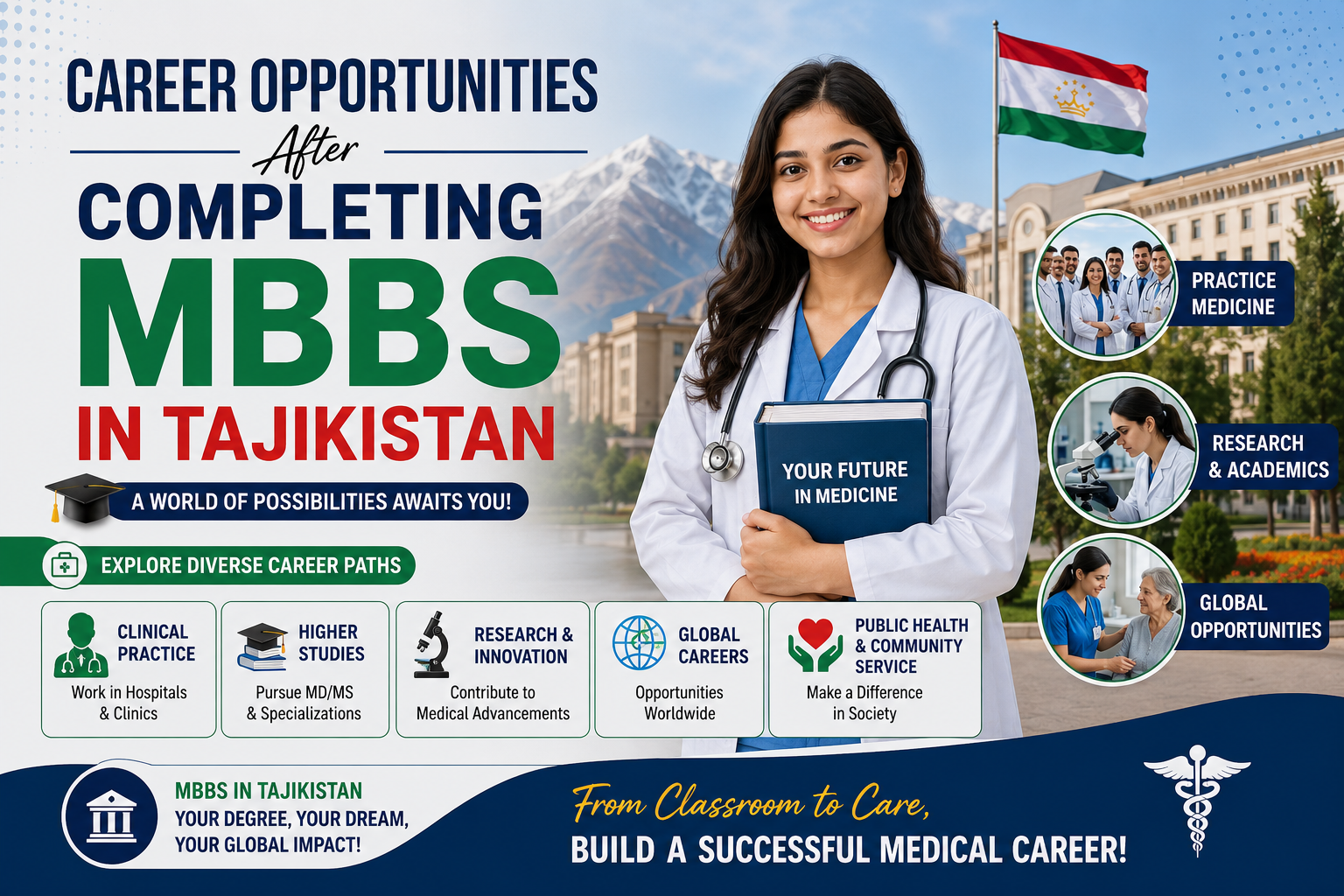
One's graduation from medical school in Tajikistan is the first step on the career path. Many doctors who graduated with an MBBS degree in Tajikistan, including Tajikistan graduates in Tajikistan, are now actively engaged in clinical practice, teaching, medical research, public health, and administration of health services. Graduates are able to pursue careers in the public or private sectors of health care, depending on the licensing requirements of their desired country and their career objectives.
For students from India, the most common pathway is to return to India, complete the newly established NMC (National Medical Commission in India) screening process or licensing procedures, and start practicing medicine. Others plan to sit for international licensing exams and/or prepare for the postgraduate entrance exams to study medicine abroad.
The exposure that students gain while studying medicine in Tajikistan facilitates the confidence they need to work in multicultural healthcare settings. Graduates with international exposure tend to adjust to the global healthcare systems rapidly.
Success Story 3: Striving for Improvement
Aman, a medical aspirant from Rajasthan, compared different nation’s medical education systems before selecting MBBS in Tajikistan. Tajikistan's low tuition, skilled staff and a strong focus on clinical practice were highly appreciated.
Aman wasn’t just a passive learner in the classroom. He attended medical conferences organized by the hospital, participated in case discussions and anatomy work, and engaged in student research. All of these contributed to the development of both his clinical and theoretical skills.
After earning his MBBS degree, Aman spent additional months focusing on licensure prep. Thanks to ongoing diligence, refinement of his study habits, and self-appraisal via clinical revisions, he qualified to pursue the next level of his medical training and is currently enrolled in a postgraduate program.
In describing his training abroad, Aman highlights a balance of both personal growth and enhancement of his medical expertise. In his personal growth, he cites his newfound self-discipline and maturation of his sense of responsibility to support his medical career flourishing.
Preparing for Licensing Examinations
One of the most widespread misconceptions is that those who earn an MBBS degree get an open license to practice medicine globally. The harsh truth is that all nations have their own licensing norms that have to be separately fulfilled.
The MBBS graduates in Tajikistan most often prepare for the examinations of the country where they plan to practice. With the Indian students, it is the NMC, or the National Medical Commission, and for others, the licensing examinations can be taken in the United Kingdom, the United States, Australia, or the Gulf Cooperation Council.
The students who prepare early for these examinations find that the transition as a new physician to be the easiest, as they have the benefit of concept training in medicine during their MBBS. Revision, practice, mock tests, and mentorship are all crucial for the success of the students.
With a strong academic foundation, Tajikistan medical graduates have the confidence to practice medicine in various countries.
Skills That Make Tajikistan Graduates Successful
Though academic success is the foundation of a medical career, it certainly is not sufficient. Medical universities in Tajikistan focus on building these skills to prepare graduates for future aspects of a medical career that rely on these skills.
Absolutely essential skills attained during the MBBS program include:
- Advanced logical thinking and diagnosis development skills.
- Good listening and counselling skills.
- Ability to work with others in multidisciplinary healthcare teams.
- Ability to make sound decisions in the best interest of the patient.
- Ability to manage time and be punctual.
- Ability to work in and adapt to different systems and environments.
- Ability to do research and apply the findings to the practice of medicine.
These abilities enable graduates to function effectively in any practice setting, be it a hospital, clinic, research institution, or an agency involved in the practice of public health.
Overcoming Obstacles on the Way
Obstacles are a part of the life of every professional doctor and MBBS students in Tajikistan are no different. The program requires them to live in a foreign country and get adapted to a new culture, food, climate and new ways of learning.
Some students struggle with homesickness and community language barriers. However, orientation and community engagement events, language programs, and student mentors provided by the universities, help students to settle in easily.
Due to the intensive nature of the clinical years, students face the stress of balancing hospital duties and classroom lessons. Alumni of the program advise that practicing the discipline, studying regularly and attending to practical lessons help students succeed.
They adapted to challenges of the program by developing a stronger and more confident spirit to practice medicine.
Worldwide Healthcare Opportunities for Graduates
Due to the growing need for doctors in countries with old populations and developing healthcare systems, graduates of the MBBS in Tajikistan have a wide choice of careers in medicine provided they meet the licensing requirements. They can work in:
- Government clinics and hospitals.
- Private multipurpose specialty hospitals.
- Community healthcare centers.
- Medical colleges and teaching hospitals.
- Clinical research organisations.
- Public health departments.
- Telemedicine services.
- International healthcare organisations.
After graduation, some further specialize in:
- Internal Medicine
- General Surgery
- Paediatrics
- Obstetrics and Gynaecology
- Radiology
- Orthopaedics
- Psychiatry
- Dermatology
- Emergency Medicine
- Cardiology
This aspect offers flexibility in how students shape the long-term career paths and professional goals.
The Importance of International Recognition
One of the most significant factors causing the increase in students applying for the MBBS program in Tajikistan is that many of these medical universities enjoy international recognition. Students should check that the medical school that they have chosen is listed in the WDOMS and that the school is upholding the current standards in medical education.
Recognition by international agencies demonstrates that there is a quality medical curriculum, faculty, and clinical training and infrastructure in the concerned medical school. Additionally, students should check the most recent updates by the National Medical Council (NMC) in India regarding eligibility and licensing to practice medicine in India.
Healthcare education around the world is evolving, and in line with the WHO, there is a greater emphasis on medical schools incorporating value-based integrated medical education, medical ethics, patient care and safety, and evidence-based practice. With a focus on medical schools which are recognized, students increase the likelihood of enhancing their future career, further education, and professional opportunities.
Tips from Successful Graduates
Doctors who completed their MBBS in Tajikistan offer the same guidance. They are of the opinion that the selection of the correct university for medical education is very important, but success is dependent on the individual. It is therefore suggested that students:
- Prepare well in advance for the NEET exam before submitting an application.
- Research the university thoroughly and check its recognition and accreditation status.
- Take equal consideration of theoretical knowledge and practical clinical training.
- Practice highly developed communication and people skills.
- Attend relevant seminars, workshops, and research.
- Start preparatory work for the licensing exam well in advance.
- Aim to keep up the momentum in your studies and the MBBS program.
- Take time to learn about the latest discoveries in the field of medicine and healthcare.
The above will help you maximize your chances of building a successful career in medicine.
Conclusion
The path from a selective medical university in Tajikistan to a globally prestigious medical doctor hinges on motivation, advanced education, and the will to continue learning. Each year, a multitude of students accomplish their goals by commencing MBBS studies in Tajikistan as a first step to their international medical careers.
Affordable education that does not sacrifice on quality is illustrated by their success in credentialed, foreign medical schools that house talented faculty, up-to-date teaching strategies, and comprehensive clinical training. Tajikistan is producing talented medical graduates that can meet the needs of a global clientele.
Those who pair their studies with the rest of the activities mentioned along with ethics and the desire to learn and teach, will be successful in the Indian healthcare system and global medical practice. Graduates from the medical schools in Tajikistan are a living example that the healthcare field offers never-ending avenues and that one is able to pursue any path in this vocation with dedication and the will to overcome obstacles.
Frequently Asked Questions (FAQs)
Is MBBS in Tajikistan globally recognized?
Multiple medical schools offering MBBS in Tajikistan provide medical education that fulfills the NMC requirements and are WDOMS listed medical schools. Students are encouraged to research the recognition of the medical school prior to enrollment.
Can Indian students practice in India after studying in Tajikistan?
Yes. Indian students can practice in India after pursuing MBBS in Tajikistan by fulfilling the eligibility and licensing requirements introduced by the NMC.
Is NEET mandatory for admission?
Yes. Indian students are mandatorily required to clear the NEET exam for pursuing MBBS in Tajikistan as per the current regulation.
What are the reasons for the increasing interest of Indian students in pursuing MBBS in Tajikistan?
Indian students prefer pursuing MBBS in Tajikistan due to multiple reasons such as affordable tuition and cost of living, English as the medium of education, experienced faculty, sufficient clinical exposure, internationally accredited universities and good job opportunities post studies.