
Introduction
Things like university fees, course length, and admission requirements aren’t the only factors when selecting MBBS destinations. Practical hospital exposure is integral for students to become comfortable and competent as doctors. Indian students going abroad to study MBBS often inquire about the timing and duration of the clinical training component of their program.
The affordable medical education, globally accredited medical universities, English programs, and the friendly environment for international students make Tajikistan a relatively new hotspot for Indian medical aspirants. Along with classroom education, Tajikistan’s medical universities offer a lot of training through laboratory work, clinical demonstrations, and hospital rotations.
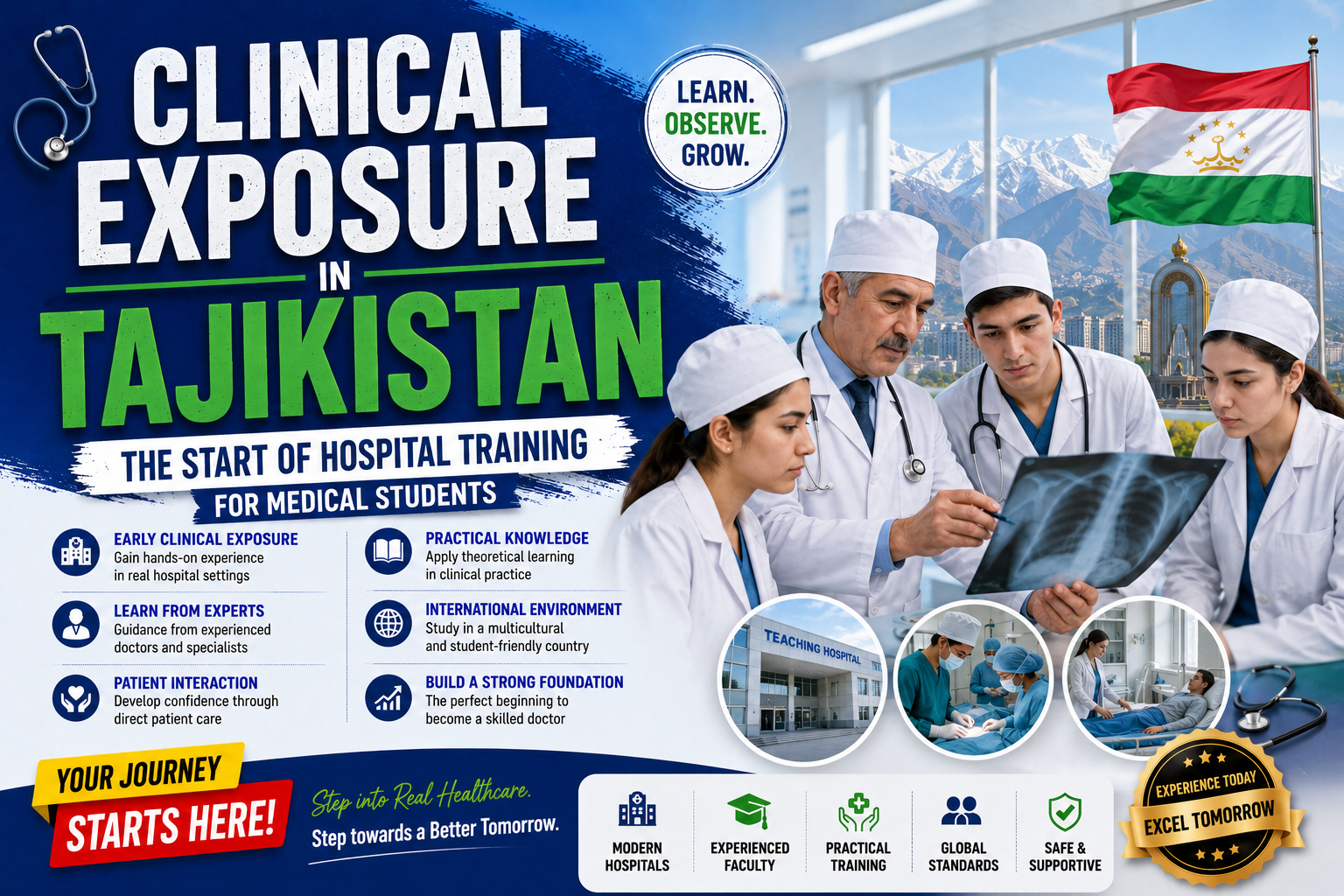
One of the most popular queries is, “When do MBBS students in Tajikistan start clinical training?” The answer varies by university, but generally students get professional exposure in the early years and begin formal hospital training by the clinical phase.
Students should also verify the recognition and status of medical institutions before admission through reliable sources such as the World Directory of Medical Schools (WDOMS).
MBBS Clinical Training in Tajikistan
The structure of the MBBS degree in Tajikistan, like many other countries, is a six-year program. The degree is divided into two main components:
- The first few years: Basic medical sciences (theory).
- The remaining years: learning in a clinical environment (practice).
Throughout the early years of medical school, students learn mainly the basics. Subjects include, but are not limited to, Anatomy, Physiology, Biochemistry, and Medical Biology. Once students grasp the fundamentals, they begin learning the clinical subjects and begin their clinical training.
This structure allows for students to learn about the human body and the mechanisms behind diseases before putting them in the real-world situation of working with patients.
When Do Medical Students Begin Their Clinical Training in Tajikistan?
Clinical Exposure is Begun in the Third Year
At most medical universities in Tajikistan, formal clinical training is begun in the third year of the MBBS when students begin learning the clinical subjects of:
- Pathology
- Pharmacology
- Microbiology
- Internal Medicine
- Surgery
- Pediatrics
- Obstetrics
- Gynecology
During the training, students learn about the clinical environment and the management of patients as well as clinical skills by observing physicians in teaching hospitals.
During the training, students learn about the clinical environment and the management of patients as well as clinical skills by observing physicians in teaching hospitals.
Years One and Two: The Clinical Foundations of Medicine
While formal training in the hospitals starts in the third year, students do have the opportunity to learn about the practice of medicine in their first two years.
First Year of the MBBS Program
The first Year of the MBBS program focuses on the structure and functions of the human body and includes the subjects of:
- Anatomy
- Physiology
- Medical Chemistry
- Biology
- Medical Terminology
Practical Work in the First Year Includes:
- Laboratories
- Anatomical demonstrations
- Medical Skill workshops
- Introduction to Basic Health Care
The workshops and practical work done in the first year help prepare students for their first interactions with patients.
Second Year MBBS
Students in their second year study the mechanisms of medical science and the progression of diseases. Relevant subjects are:
- Pathology
- Pharmacology
- Microbiology
- Immunology
At this stage, students are taken to hospitals as part of a learning exercise, where they will study the operations of a health care institution.
Third Year MBBS: Commencement of Hospital Learning
The third year of study is the first year students spend a majority of their study in hospitals learning from the real world. Students begin to understand:
- Patient communication
- Patient history taking
- Physical examination
- Clinical symptoms
- Diagnosis
Students shadow the doctor during ward rounds and learn the art of making clinical decisions. Hospital learning during this period is important as it helps students appreciate the applications of medical theory.
Fourth and Fifth Years: Clinical Learning
The fourth and fifth year of study are the most clinically intensive years of the MBBS program. Students spend a majority of their study in hospitals and in many of the medical wards. Learning rotations include:
- Internal Medicine
- Surgery
- Pediatrics
- Obstetrics and Gynecology
- Emergency Medicine
At the conclusion of each of these learning rotations, students have the knowledge and understanding necessary to begin their career as a medical doctor.
Sixth Year MBBS: Internship and Advanced Clinical Practice
In their final year, MBBS students in Tajikistan engage in practical, supervised clinical work.
Students spend time in hospitals learning about:
- Making and recording a patient’s diagnosis
- Making and documenting clinical decisions
- Performing treatment procedures
- Filling out treatment forms and medical files
- Managing emergencies
Students get an opportunity to apply their book knowledge thanks to the practical nature of this period.
Indian students who have completed MBBS in Tajikistan and wish to practice medicine in India, post MBBS, need to comply with the National Medical Commission (NMC) requirements, including the currently applicable licensing examination.
Categories of Hospitals Students May Work In
Generally, medical universities in Tajikistan sign agreements with government hospitals, teaching hospitals, and specialized medical centers.
Students work in:
- Hospitals associated with the university
- Institutions comprising the public health system
- Specialized medical treatment institutions
- Medical research hospitals
These hospitals give students an opportunity to work on a diverse set of medical cases.
Useful Skills Acquired from Training in a Hospital Setting
Being in a clinical setting helps students gain important skills such as:
Patient Interaction
Students learn how to:
- Act in a professional manner when interacting with a patient
- Document patients’ medical histories
- Patient’s concerns and respond to them appropriately
Physical Exam
Students learn how to:
- Take a patient’s vital signs
- Perform a physical exam
- Clinical Symptoms of a Patient and how to conduct an Exam
Students learn:
- Blood tests and their significance
- Imaging and how to interpret the images
- Other diagnostic tests and how to interpret the results
Students learn by observing:
Treatment Procedures
- Administration of patient’s medications
- Surgical procedures
- Monitoring of patients
These skills are essential for becoming a competent healthcare professional.
Key Factors Relating to Clinical Exposure for Indian Students
Studying clinical exposure for Indian students who are pursuing an MBBS degree abroad is essential during university selection.
Students who benefit from adequate clinical training in hospitals can:
- Acquire medical knowledge that is more relevant and less abstract
- Gain more self-assurance in dealing with patients
- Learn about systems of healthcare
- Sit for medical licensing examinations with more preparation
- Go through clinical cases
Students who study clinical exposure can learn more about the disparity between theoretical medical knowledge and the knowledge that is useful in the clinical setting.
Utilization of Clinical Training in Tajikistan for FMGE/NExT
Clinical exposure is also useful for the Indian students who are returning from study abroad programs and who need to have a sound and strong understanding of the concepts and the practical component of that particular field.
Training in hospitals is also crucial.
Understanding of:
- Common Clinical Pathologies
- Symptoms
- Clinical Management
- Making Clinical Decisions
Students need to also prepare for the licensing examinations in accordance with the most recent policies put forth by the medical authorities in India.
Students preparing for medical licensing examinations should regularly check the latest updates and guidelines provided by the National Medical Commission (NMC).
Parameters to Assess to Select Medical Universities in Tajikistan
Students should check the availability of:
Teaching Hospitals
Does the University have a connection to teaching hospitals?
Clinical Rotations
Students should understand:
- When does the Clinical Training commence
- How long are placements in the hospitals
- Which departments will students rotate through
Availability of Faculty
Experienced professors and clinical mentors play an important part of learning in practice.
Language of Patient Interactions
While many universities have English-medium instruction in MBBS, students will often need to pick up the local languages to communicate with patients.
Benefits of Studying MBBS in Tajikistan with Clinical Training
Here are the major benefits of pursuing MBBS in Tajikistan.
- Early Contact with Medical Fundamentals
- Cost Effective Medical Education
- Hospital Exposure
- International Medical College
- Opportunity to Work on Different Medical Cases
- Build Clinical Confidence
Indian students seeking low-cost MBBS options abroad can consider Tajikistan for the combination of satisfactory theoretical and practical components of medical training.
Role of Medical Education Standards in Clinical Training
Clinical training quality depends on factors such as hospital facilities, faculty expertise, patient exposure, and curriculum structure. Students should research medical education standards and international healthcare practices before selecting a destination.
The World Health Organization (WHO) provides global health information that can help students understand healthcare systems and medical education environments worldwide.
NEET Requirement for Indian Students Studying MBBS Abroad
Indian students planning to pursue MBBS in Tajikistan must fulfil the eligibility requirements applicable for studying medicine abroad.
NEET qualification is an important requirement for Indian students who want to pursue medical education outside India. Students can check the latest examination-related updates through the NEET official website.
Conclusion
Clinical training forms an important component of medical education. The students pursuing MBBS in Tajikistan get an opportunity to commence formal clinical training in hospitals from the 3rd year onward. The first two years are devoted to the study of basic medical sciences and practical lab work.
During the 3rd, 4th and 5th years, students undergo clinical rotations in various hospital departments, while the last year is dedicated to advanced clinical training and internships.
Indian students who wish to study abroad to pursue a career in medicine should familiarize themselves with the clinical training of the targeted medical schools before making a final choice. The degree of a medical professional is far more useful and valuable to society than an untrained and unpracticed medical professional. Therefore, it is vital to look into a medical school’s partnership with hospitals, along with its other clinical facilities, when selecting a Tajikistan medical university.
A well-planned decision based on clinical exposure, university recognition, and future career requirements helps students build a stronger foundation for their medical journey.