
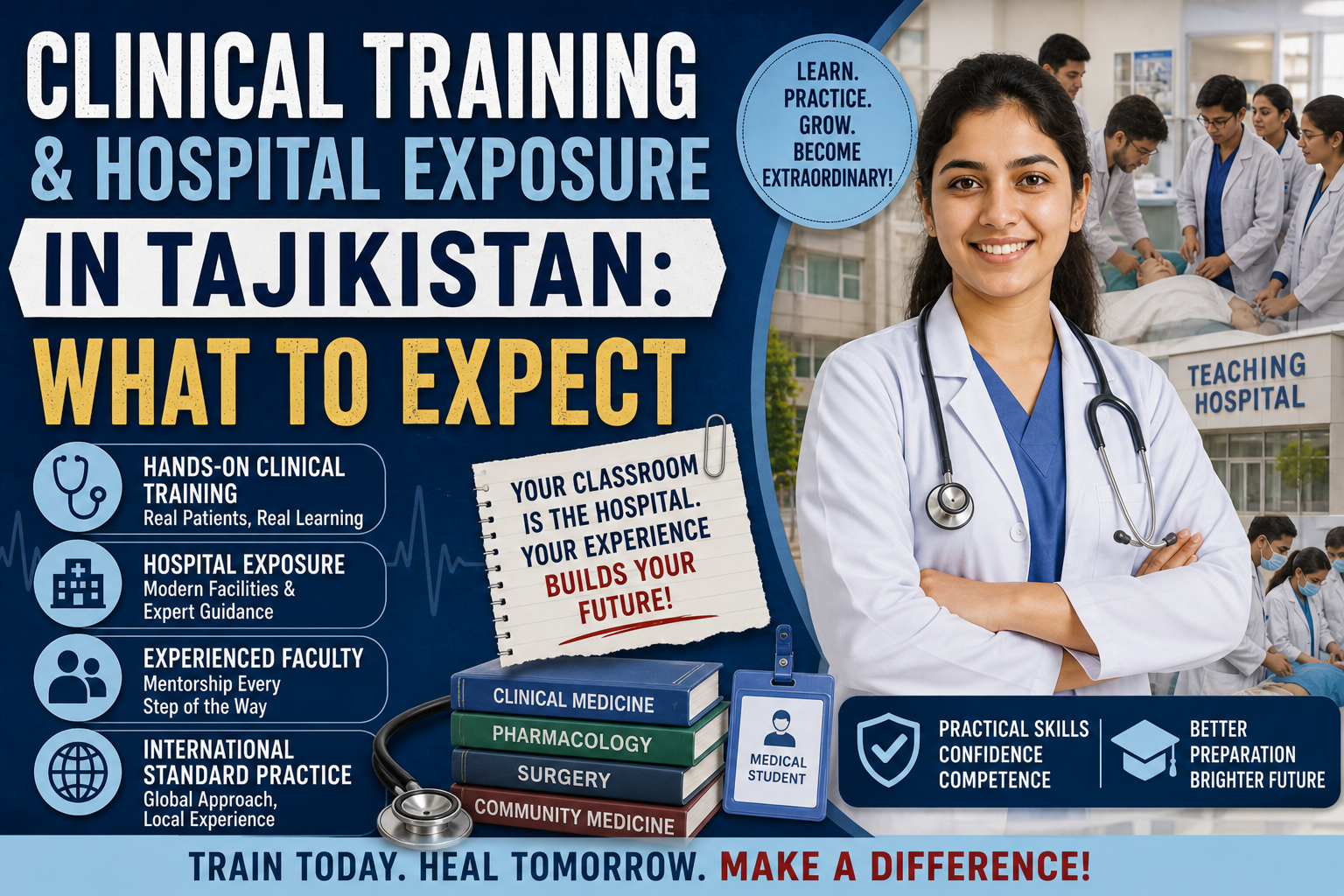
Conducted research Clinical training is undeniably one of the most crucial stages in a student's life, especially at a medical college. Clinical exposure offered in mbbs in tajikistan is tailor-made to align academic inputs with a practical approach- coming with adequate hospital training which assures a good degree of amalgamation, between theory and practice. With a cost-effective fee structure, internationally approved curriculum, and practical-based training approach, Tajikistan has emerged as an excellent option for medical education.
Early Clinical Exposure
One of the main benefits of pursuing medicine in one of Tajikstan´s universities is that students are exposed to clinical settings from their very first years. In Tajikistan, however, medical universities train students in basic clinical orientation starting from the second or third year – unlike in some countries where hospital exposure begins at later years.
Students get opportunities to:
- Visit affiliated hospitals
- Observe patient diagnosis and treatment
- Understand hospital workflows
- Learn basic patient interaction skills
Students see Patients Early Impressions This early exposure offers students the opportunity to build their confidence and a practical understanding of medical concepts.
Hands-On Clinical Training
In the last years of education (4th to 6th year), clinical training becomes more intense. Students actively engage in various hospital functions with supervision from senior doctors and faculty.
Clinical training includes:
- Patient history taking
- Physical examinations
- Assisting in minor procedures
- Case discussions and presentations
- Training for various specialties like Medicine, Surgery, Pediatrics, and Gynecology
The training you receive is structured, which equips students in the medical profession to be prepared for practicing medicine in the real world.
Affiliated Hospitals & Infrastructure
Medical universities providing mbbs in tajikistan are associated with Government and private hospitals which have well-established medical facilities for students. These hospitals provide:
- Advanced diagnostic tools
- Well-equipped laboratories
- Focused exposure to a wide range of cases due to higher patient inflow
- Experienced medical professionals
A large patient load is particularly important because it exposes students to a breadth of clinical material, thereby improving diagnostic and decision-making skills.
Global Standards & Recognition
The format of clinical training in Tajikistan conforms to international standards for medical education. It includes institutions recognised by global organisations such as the World Health Organization and registered in the World Directory of Medical Schools.
Additionally, the university must also comply with National Medical Commission guidelines to enable Indian students to sit in licensing exams such as FMGE.ReadMore
This across-the-board recognition allows Tajikistan graduates to take up work as doctors or advance their education in a number of countries.
Language & Patient Interaction
Most universities use English as the medium of instruction, though students may encounter patients who speak local languages like Tajik or Russian. In overcoming this gap, universities frequently offer basic language training.
Benefits include:
- Improved patient communication
- Improved quality of symptoms and medical history
- Enhanced confidence during clinical practice
Language is at the heart of good clinical training and practice.
Practical Skills Development
In Tajikistan, they grind you with skill. Students are trained in:
- Clinical diagnosis techniques
- Use of medical instruments
- Emergency care basics
- Interpretation of lab reports
In fact, continually conducting assessments as well as viva sessions along with learning majorly on case bases assists their practical knowledge considerably.
Compare to Other Study Destinations
Many students also opt for MBBS in Georgia also known as one of the destination to study abroad. Georgia boasts high infrastructure and European exposure but Tajikistan is known for its low cost of living, as well as the volume of patients that guarantee strong clinical exposure to students.
It completely relies on your budget, career goals and the kind of learning environment you are looking for when choosing countries.
Internship & Final-Year Training
The 5th year of MBBS in Tajikistan is mainly based on practical trainning and internship. In hospitals, Students works closely with doctors and gain the experience of dealing patients on the real time basis.
Internship highlights:
- Rotations across major departments
- Direct involvement in patient care
- Exposure to critical and emergency cases
- Practical application of theoretical knowledge
This phase is particularly important for having confidence and preparation for your medical licensing board examinations.
Challenges to Be Aware Of
Even though clinical training in Tajikistan can be very beneficial, there are some challenges that students should also know about:
- Language barriers in hospitals
- Differences in healthcare systems
- Lack of independence and self-learners
But these challenges can and will be solved with sufficient prep, commitment and discipline.
Conclusion
Tajikistan then trains aspiring doctors with a good amount of clinical exposure at the early time, and hospital experience. So, the early exposure, practical motions and recognition globally makes it an ideal option for medicine study abroad.
Students who choose mbbs in tajikistan not only get theoretical knowledge but also gain practical skills essential for making a mark in the medical field. By going into the classroom with a determined approach and engaged clinical training, students can establish a prosperous and satisfying medical path.
Students planning to return to India after graduation must also qualify NEET as per eligibility requirements.