
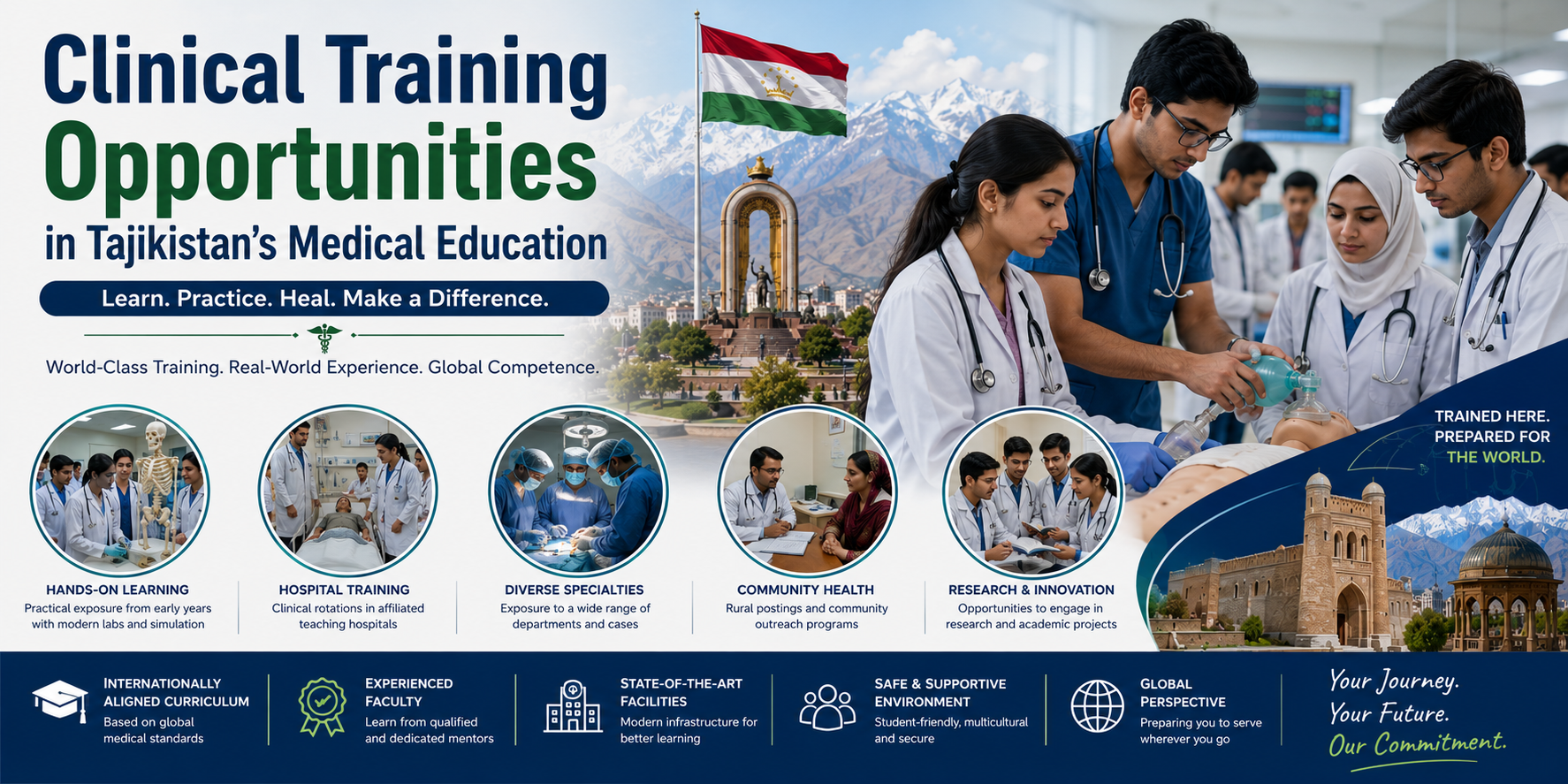
For those who wish to become doctors, the selection of a medical university is a decision that carries great weight. Considerations of cost, accommodation, and the university's recognition on an international level are among the factors. Nevertheless, the quality of clinical training that an institution has will provide a student with a greater degree of readiness for the practice of medicine.
As a result of modern and developing curricula and faculties, Tajikistan has become a great opportunity for Indian students who are looking for quality, affordable, and internationally recognized opportunities to study medicine. Tajikistan also recognizes the need to enhance clinical training.
Indian students who are considering studying abroad for quality and affordable medical education, have Tajikistan as a great opportunity for the reasons provided.
Over the past decade, Tajikistan's Medical Universities have invested significantly in strengthening clinical training opportunities for students. Diagnostic medical centers as well as specialist hospitals have been established to help students conduct further practical medical work beyond the theoretical learning done in the classroom and the teaching hospitals in use.
Why Clinical Training is Important in Medical Education
Developing the practical element of medicine that is required for the diagnosis of an illness, and making the treatment and diagnosis of the illness is simply not possible by teaching from the textbooks.
The most effective clinical training programs provide students with the opportunity to:
Learn the components of an effective patient exam
Understand the concepts of diagnosis and treatment of disease
Gain an understanding of the various procedures and policies that govern hospitals
Develop the confidence needed to address medical and clinical concerns that arise during the practice of medicine
Enhance their communication and interpersonal skills
Improve their readiness for various medical licensing examinations (i.e. FMGE, NExT, USMLE, and PLAB)
This is why students looking to study MBBS in Tajikistan must assess the clinical practice avenues provided by the university.
Medical Education System in Tajikistan
In Tajikistan, the medical study period spans about six years. The initial years are dedicated to pre-clinical and para-clinical studies of Anatomy, Physiology, Biochemistry, Pathology, and Pharmacology. The latter years are dedicated to clinical rotations of the various medical specialties.
Most universities collaborate with government hospitals and health care centers, enabling students to gain practical exposure, under the guidance of qualified doctors and university faculty.
Students must check whether the university is listed in the World Directory of Medical Schools (WDOMS), complies with the National Medical Commission (NMC) regulations and World Health Organization (WHO) guidelines.
Avicenna Tajik State Medical University: Pioneer in Clinical Education
Avicenna Tajik State Medical University is one of the best medical university in the country. It is renowned for the depth of its medical programs and its wide hospital network.
Clinical Benefits
Students are exposed to:
Multi-specialty government hospitals
Teaching clinics attached to the university
Diagnostic laboratories
Community healthcare centers
Specialized departments for further learning
At Avicenna University, students learn through direct case studies of patients, encouraging the faculty to consider and teach actively. The faculty promotes learning through active engagement in clinical rounds and promotes development of clinical skills and judgment from the early years of study.
Patient-Centric Learning
The student-focused and patient-centric clinical method is one of the main advantages of Avicenna University.
Students will:
Practice recording patient histories
See how treatment plans are developed
Learn what diagnostics entail
Engage in clinical talks
Understand ethics in patient care
This strategy equips graduate doctors with necessary skills and helps them understand and apply compassion.
Focus on Practical Learning at Khatlon State Medical University
International students are flocking to Khatlon State Medical University mainly because of the low fees and the course structure that focuses on practical training.
Clinical Exposure
The university cooperates with many regional hospitals that cater to very large patient populations. Because of this, students are offered the chance to see an assortment of diverse clinical scenarios.
Students gain the following:
A good number of visits to hospitals
Clinical demonstrations
Learning sessions based on case studies
Observations at the outpatient department
Exposure to emergency care
Because of the large patient population, students have the opportunity to see both basic and complicated clinical cases.
Learning through Simulation
Also, to help with the learning process, Khatlon State Medical University uses the mannequin and simulation labs to help students learn clinical skills and procedures.
This process makes the students feel more comfortable when faced with the clinical rotation challenges.
Tajik National University Medical Faculty
The faculty of Tajik National University's School of Medicine has been building its reputation through an integration of modern medical education with practical training at hospitals.
The Clinical Learning Environment
Students get their training as a result of partnerships with health care institutions around Dushanbe and the bordering areas.
The major offerings here are:
Clinical ward rotations
Laboratory-based diagnostics training
Participation in preventive health care programs
Specialized departmental postings
Community Medicine Projects
Supporting students with the necessary skills to deal with public health issues and understand the importance of preventive medicine to be preparing for work in both clinical and community medicine is vital and helps the university achieve its aims.
Early Clinical Exposure: A Distinct Advantage
Providing students with the opportunity to gain clinical experience early on in their studies is one element that sets many of the universities in Tajikistan apart from many medical schools internationally and is a clear early clinical exposure benefit.
Students do not need to wait until their final year to begin to gain experience in the clinical setting; often this clinical exposure occurs in one of the earlier years, in the second or third year.
Clinical exposure early on in medical studies is very valuable and assists students to:
Gain the ability to work in a clinical setting
Understand the clinical setting from the perspective of both the physician and the patient
Gain an understanding of the burden of illness
Develop and refine communication skills for the clinical setting
Understand the role of a physician in the clinical setting and relate appropriate clinical theories to the practice of medicine
The earlier clinical studies begin the better.
Community and Rural Healthcare
Modern healthcare is not solely based in urban hospitals. Some of the medical schools in Tajikistan have community-based healthcare as part of their curriculum.
Students are involved in:
Rural health camps
Community education
Health surveys
Preventive medicine
Primary healthcare
These experiences teach aspiring doctors how to deliver healthcare in different settings and improve their understanding of public health.
Advantages for Indian Students
Indian students pursuing MBBS in Tajikistan frequently enjoy numerous benefits from the availability of clinical training.
Opportunities to Develop Diagnostic Skills
Encounters with different hospital patients and a wide range of clinical cases enhance flexibility in different diagnostic approaches.
Cost-effective Clinical Opportunities
In comparison to many other countries offering medical training to international students, Tajikistan has a health system with numerous clinical opportunities and is more affordable.
Readiness for Medical Licensing Exams
Clinical training integrates essential and advanced concepts of medical practice and management and therefore prepares students to sit for FMGE, NExT, and other similar exams with confidence.
Enhanced Self-confidence
Constant interactions with medical professionals and patients allow the students to acquire self-confidence before they start practicing medicine.
Factors to Assess Clinical Training Opportunities
Before students apply to any medical school, they may assess the following:
Availability of numerous teaching hospitals
Patient diversity and volume
Structure of internship
Clinical rotation
Faculty to student ratio
NMC compliance
WDOMS registration
Availability of sufficient clinical practice opportunities
The school’s clinical training opportunities must be assessed together with the school’s reputation.
Conclusion
Clinical training transforms medical students into professionals in great demand. Medical schools in Tajikistan have focused on integrated health system partnerships and advanced structural and organizational education to meet the health needs of the communities. Students interested in pursuing their MBBS in Tajikistan will find excellent, affordable, internationally recognized medical training with ample clinical opportunities. Avicenna Tajik State Medical University, Khatlon State Medical University, and Tajik National University aim to enhance medical education by focusing on ensuring that graduates are ready to take licensing boards and practice medicine internationally. Clinical training is valuable in helping to develop the practical skills and the confidence to meet the challenges of the profession and practice within the boundaries of medical knowledge.