
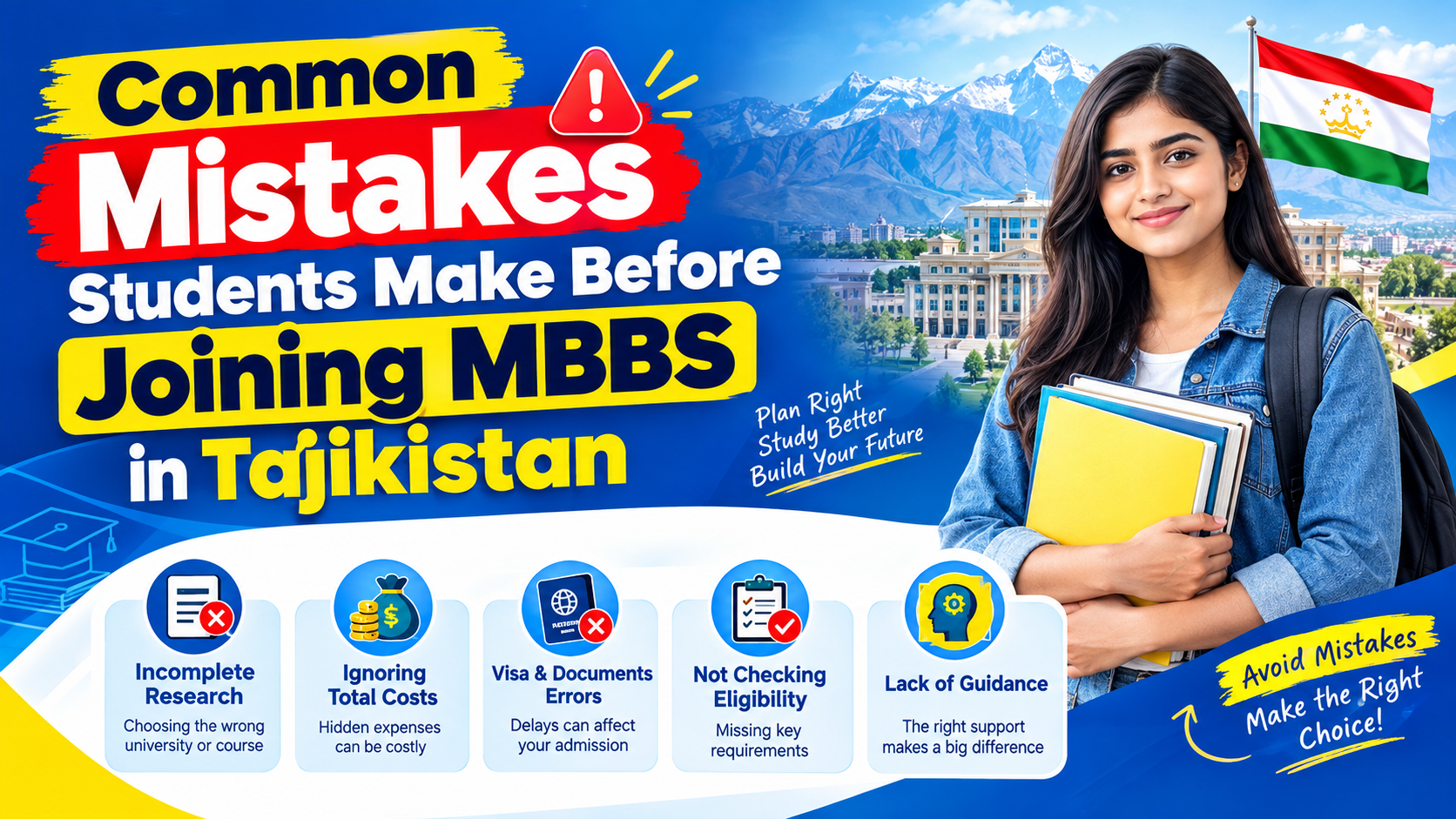
Choosing MBBS in Tajikistan can look fairly straightforward at first. Tuition fees are lower than many private medical colleges in India, admission procedures are usually less complicated, and universities in the country are attracting more international students. Sounds simple. But this is exactly where students sometimes become careless. They compare tuition fees, watch a few student videos, speak to an admission representative and make a decision within days. Medical education abroad doesn't work well with that approach. A small mistake before admission—wrong course structure, unclear internship arrangement, poor clinical exposure, incomplete documentation or misunderstanding NMC requirements—can create a much bigger problem five or six years later. For an Indian student, the real question isn't simply, "Can I get admission?" It is, "Will this degree and my complete training pathway allow me to pursue medical registration in India later?" The current NMC framework places specific requirements on foreign medical graduates, including course duration, internship, English-medium instruction, required subjects and clinical training. So before paying the first installment, slow down. Check everything. Twice.
Mistake 1: Choosing a University Only Because the Fees Look Cheap
A low fee catches attention immediately. Fair enough. Medical education is expensive. But choosing a university purely because one consultant quotes a lower package is probably one of the weakest ways to select a medical school.For students considering MBBS in Tajikistan, the actual budget should include tuition, hostel accommodation, food, visa-related expenses, insurance, local transportation, registration charges, books, travel to India and personal expenses. Currency conversion also matters because your final INR spending can change over several years.Depending on the university, accommodation choice and exchange rate, students may see advertised overall academic packages ranging roughly around ₹15–25 lakh or sometimes higher. Treat such numbers as estimates, not guaranteed six-year bills. Ask for the latest official university fee letter and a year-wise breakup before making payment.
Check these separately:
- Annual tuition fee
- Hostel charges
- Mess or food expenses
- Medical insurance
- Visa and registration expenses
- University examination charges, if applicable
- Airfare and local transportation
- FMGE/NExT preparation expenses
- Currency conversion and bank charges
A package that looks ₹2 lakh cheaper initially isn't necessarily cheaper after all these additions.
Mistake 2: Assuming "Listed in WDOMS" Automatically Means NMC Approval
This one needs attention.Students often hear phrases such as "WHO approved," "NMC approved" and "WDOMS listed" as though all three mean exactly the same thing. They don't.The World Directory of Medical Schools (WDOMS) is useful for checking the directory status and details of a medical school. For example, WDOMS currently identifies Avicenna Tajik State Medical University in Dushanbe as a public, operational medical school. But directory listing by itself should not be treated as a blanket guarantee that an Indian graduate automatically becomes eligible for registration in India.That's the mistake.Your university, course, internship and training arrangement need to satisfy the applicable National Medical Commission requirements. NMC's FMGL framework is what Indian students need to examine carefully if they intend to return and practise in India.You can also check general international health information through the World Health Organization, but don't confuse WHO-related references with Indian medical registration eligibility.
Mistake 3: Ignoring the NMC Course-Duration and Internship Rules
"Six-year course hai, so everything must be fine."Not necessarily.For students governed by the Foreign Medical Graduate Licentiate Regulations 2021, NMC's published requirements include at least 54 months of medical education and a minimum 12-month internship at the same foreign medical institution. The medium of instruction must be English, and other conditions concerning subjects, clinical training and eligibility for professional registration in the country awarding the qualification also matter.NMC has also clarified that clinical posting during the academic course and internship are separate components.This distinction is easy to miss.Before joining a university, get written clarification about the exact duration of classroom education, clinical rotations and internship. Ask where the internship takes place. Ask whether it forms part of the qualification. Ask whether the program permits graduates to meet local licensing requirements applicable to citizens in that jurisdiction.Honestly, this paperwork feels boring before admission. Five years later, it can become the most important paperwork you have.
Mistake 4: Thinking NEET Doesn't Matter Because Admission Is Abroad
Another surprisingly common misunderstanding is that an overseas university may admit a student without looking closely at the Indian entrance process, therefore NEET doesn't matter.For an Indian student planning a foreign medical degree and eventual practice in India, don't make that assumption.Always check the current eligibility rules through the official NEET website and NMC before admission. The NEET portal publishes current eligibility criteria, information bulletins, notices and examination updates.NEET rules can change across admission cycles, so don't rely on an old YouTube video or a screenshot circulating in a WhatsApp group.Your NEET qualification status should be verified before you commit money to MBBS in Tajikistan.Simple precaution. Big consequences.
Mistake 5: Not Investigating the Actual Medium of Teaching
"English-medium MBBS."That phrase appears everywhere. The practical situation can be more complicated.A university may officially deliver its international medical program in English, while communication with patients during clinical rotations naturally happens in Tajik, Russian or another locally used language. Medicine isn't studied only through PowerPoint slides. Once students enter hospitals, they need to communicate with patients, understand complaints and follow doctors during rounds.So ask current students—not just admission representatives.Find out how much teaching is genuinely conducted in English from first year onward. Ask whether local-language classes are included. More importantly, ask how international students communicate during clinical years.Learning basic Tajik or Russian medical vocabulary can make hospital exposure far more useful.
Mistake 6: Looking at the Campus but Not the Teaching Hospital
A modern building photographs well. A crowded hospital teaches medicine. That difference matters. Before selecting MBBS in Tajikistan, students should investigate the university's clinical ecosystem. How many hospitals are affiliated? When do clinical postings begin? What kind of patient volume do students encounter? Are international students actually allowed meaningful participation during rotations, or are they mostly observers? Don't settle for "good clinical exposure."Ask for specifics.You can request details about affiliated hospitals, department rotations, bedside teaching, surgery observation, emergency exposure and internship locations. Speak with students who are already in the fourth, fifth or final year because first-year students usually can't tell you much about clinical training. Here—well, this is where students need to be especially careful. A medical college is ultimately judged by what you learn around real patients, not by how polished its admission brochure looks.
Mistake 7: Assuming FMGE/NExT Preparation Can Wait Until Final Year
The first year feels early. It isn't.Indian students studying abroad eventually need to satisfy the licensing examination requirements applicable when they return. Under the current FMGL framework, NMC refers to passing the prescribed screening test, National Exit Test or another mandated examination as applicable.That means your preparation shouldn't begin as a panic project during the last few months.Build concepts from year one.Anatomy, physiology and biochemistry may feel distant from final licensing preparation, but weak foundations follow you into pathology, pharmacology, medicine and surgery. A student who studies only to clear university semester exams may struggle later with integrated clinical questions.Your university teaches medicine. Your licensing preparation needs a separate strategy.Both matter.
Mistake 8: Paying Money Without Verifying the Admission Letter
I've seen students become unusually relaxed once someone says, "Seat confirmed."Don't.Before transferring a major amount, verify whose bank account receives the payment, whether the university issued the admission/invitation document, what refund conditions apply and whether every payment comes with an official receipt.Never treat a WhatsApp confirmation as equivalent to an official university admission document.Also verify the spelling of your name, passport number, program name, academic session and university campus on every document. Even small inconsistencies can create unnecessary trouble during visa processing or university registration.Keep digital copies. Keep originals. Keep payment receipts too.
Mistake 9: Forgetting About Hidden Living Costs
Tuition is only one part of the calculation.A student's monthly spending depends heavily on lifestyle. Hostel residents who cook occasionally and control discretionary spending will obviously spend differently from students renting privately, ordering food regularly and travelling frequently.Build a separate monthly budget for food, mobile data, transportation, winter clothing, toiletries, medicines and occasional personal spending. Then keep an emergency reserve.Also remember flights.A student returning to India once or twice during holidays can add a noticeable amount to the overall cost over several years. Exchange-rate movement adds another variable, which is why an INR figure quoted today shouldn't be treated as permanently fixed.For updated university and cost information, students can compare options through MBBS in Tajikistan and then cross-check important financial figures directly with the university before paying.
Mistake 10: Not Comparing Universities Properly
Three universities with similar tuition fees can provide very different student experiences.Don't compare only the annual fee.Compare course duration, internship structure, English-medium teaching, hospital affiliations, clinical exposure, location, hostel conditions, Indian student population and local licensing eligibility.
A sensible comparison may look like this:
|
Factor |
What You Should Verify |
|
Course Structure |
Academic years + internship separately |
|
Teaching Medium |
English throughout required instruction |
|
Clinical Training |
Hospitals, patient flow and rotations |
|
Internship |
Duration and location |
|
WDOMS Status |
Verify the exact school/campus |
|
NMC Compliance |
Check against current FMGL rules |
|
Tuition |
Official year-wise fee |
|
Hostel |
Availability and annual charge |
|
Local License Eligibility |
Whether degree/training meets the relevant local requirement |
|
Indian Licensing Path |
Current FMGE/NExT or other applicable requirement |
One detail deserves special attention: verify the exact campus, not merely the university name. WDOMS, for example, currently shows the main Avicenna Tajik State Medical University in Dushanbe as operational, while its separately listed Khujand Branch is shown as not currently operational.That's precisely why checking the exact institution matters.
Mistake 11: Ignoring Life Outside the Classroom
Some students research medicine for weeks and research the country for about ten minutes.Not ideal.Tajikistan has a different language environment, food culture, climate and social routine from India. Winters can be challenging for students arriving from warmer parts of India. Vegetarian food may require more planning. Homesickness is real too, particularly during the first semester.Talk to students already living there.Ask about hostel heating, Indian groceries, mess facilities, transportation, internet, safety around campus and airport transfers. These aren't glamorous questions, but you'll deal with them every day.A comfortable routine won't make you a good doctor. An unstable one can certainly make studying harder.
Mistake 12: Choosing a Consultant Before Checking the University
This happens backwards quite often.Students find an agent first and then select whichever university that person promotes most strongly. A better approach is to shortlist universities independently, verify regulatory and academic details, and only then decide who should assist with admission.Ask for everything in writing: university fee, service charges, hostel costs, refund policy, visa assistance and additional expenses.If somebody guarantees FMGE success, guaranteed registration in India or a "100% NMC-approved degree" without explaining the actual regulatory conditions, be cautious.No consultant controls your future licensing eligibility.
Mistake 13: Assuming Returning to India Will Be Automatic
This is probably the biggest long-term mistake.Completing a foreign medical degree does not, by itself, mean that you can land in India and immediately start practising. Students covered by the current FMGL rules need to satisfy the applicable educational, internship, examination and registration requirements.NMC's published FAQ states that qualifying foreign graduates covered by these rules must complete the prescribed foreign internship and also undergo supervised internship in India, subject to the applicable regulatory pathway. NMC issued further clarifications in 2026 concerning CRMI applicability, so students should check the latest notices rather than relying on information given to older batches.Think backwards.Start with the question: "What will I need to practise in India after graduation?"Then select your foreign university accordingly.
Is MBBS in Tajikistan a Bad Choice?
No. That's not the point MBBS in Tajikistan can be a practical option for students who have realistic budgets, choose their institution carefully and understand the Indian licensing pathway before admission. The mistake is treating an overseas medical degree like an ordinary study-abroad course.Medicine has regulatory consequences.The cheapest university isn't automatically the best. The most popular one isn't automatically suitable either. Look at academics, clinical exposure, course and internship structure, documentation and your post-graduation plans together.That gives you a much clearer picture.
FAQs About Joining MBBS in Tajikistan
Is NEET required for Indian students planning MBBS in Tajikistan?
Indian candidates intending to return and pursue medical registration in India should verify and satisfy the applicable NEET/NMC eligibility requirements before joining a foreign medical program. Since rules and admission-cycle requirements can be updated, check the official NEET and NMC portals rather than depending on old cutoff information.
How long should the foreign medical course be under NMC rules?
For students covered by FMGL Regulations 2021, NMC specifies at least 54 months of medical education plus a minimum 12-month internship at the same foreign medical institution, along with other prescribed conditions. Don't judge compliance simply from a brochure saying "5 years" or "6 years."
Is WDOMS listing enough to practise medicine in India?
No. WDOMS listing provides information about a medical school, but Indian registration eligibility depends on satisfying the applicable NMC regulations and licensing pathway. Verify both separately.
What should I check before paying the first-year fee?
Verify the official admission letter, exact university and campus, complete fee structure, refund terms, course duration, internship arrangement, teaching medium, clinical training and payment account. Get receipts for every transaction. No shortcuts here.
How much does MBBS in Tajikistan cost?
Costs vary by university, hostel, exchange rate and personal spending. Students may encounter approximate overall academic packages in the ₹15–25 lakh range or above, but advertised packages often exclude some living, travel and administrative expenses. Always request the current official fee schedule before admission rather than treating an online figure as final.
Conclusion
The biggest risk with MBBS in Tajikistan isn't necessarily the country or the university. It's making a five-to-six-year medical education decision using five days of research. Check the exact university, exact campus, course structure, internship, teaching language, clinical hospitals, NEET eligibility, NMC requirements and complete cost before you pay. Speak with senior students as well—not only first-year students or admission counsellors. If you're currently comparing universities, fees and admission options, use MBBS in Tajikistan as a starting point, then verify regulatory information independently through official NMC, NEET and WDOMS sources. A little extra checking before admission can save a lot of confusion after graduation.