
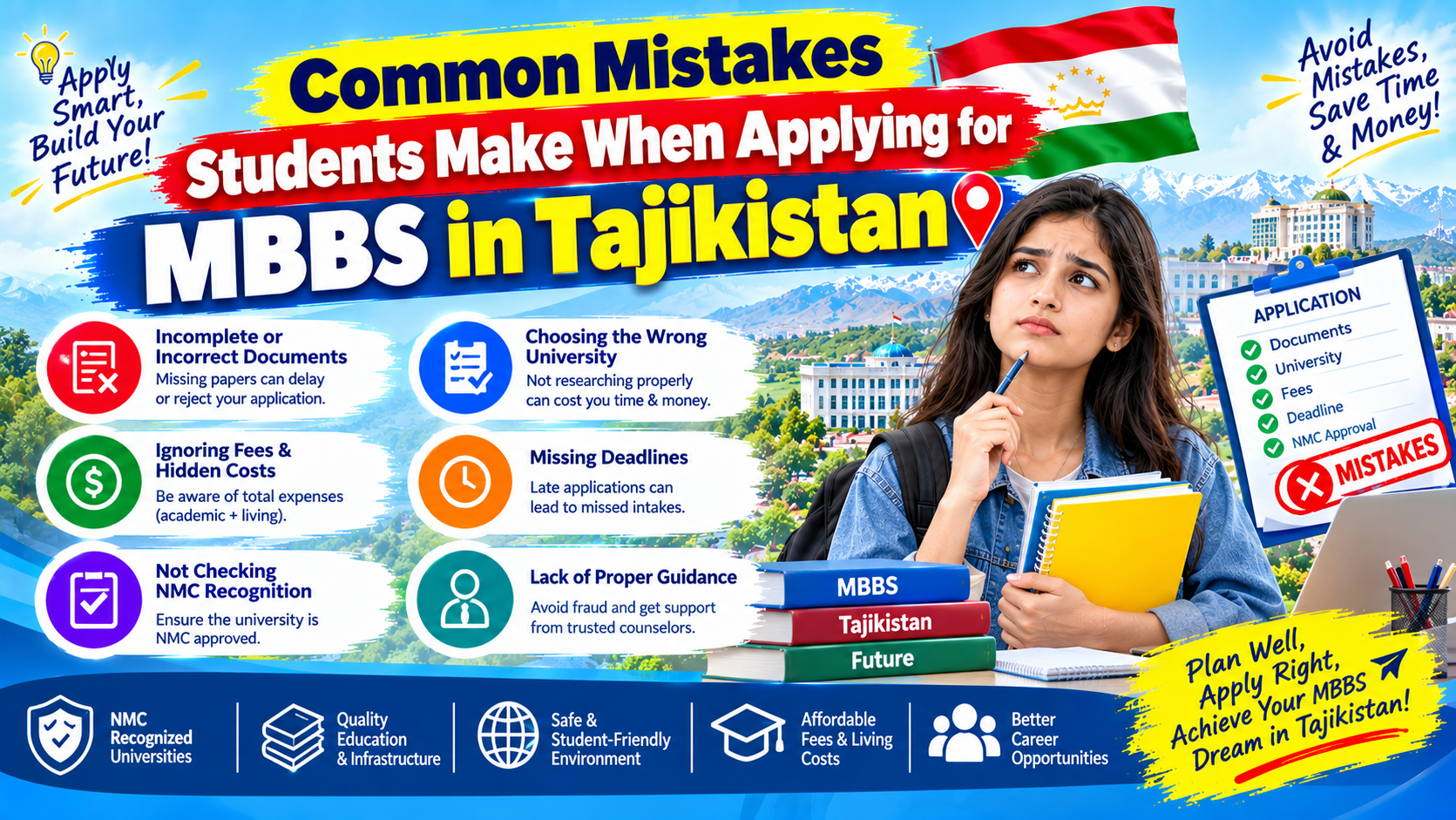
The admission offer arrives quickly. The university name looks respectable, the fee seems manageable, and someone says the seat will disappear unless payment is made by evening. That is usually the moment to slow down. Choosing MBBS in Tajikistan can make medical education financially possible for families who cannot manage expensive private-college fees in India. Still, an affordable offer is useful only when the course meets academic, clinical, and regulatory requirements. A wrong university, shortened programme, unclear internship, or missing document can create trouble years after the admission fee has been paid. Most application mistakes aren’t dramatic. They are small assumptions made at the beginning—and discovered at graduation. Here’s what students should avoid.
Mistake 1: Applying Without Qualifying NEET
Can a Tajikistan university admit an international student without examining their NEET rank? Its domestic admission process may be different from India’s. But Indian students intending to obtain medical registration in India must consider Indian eligibility rules separately. Students covered by the applicable regulations generally need to qualify NEET-UG before taking admission to a foreign undergraduate medical course. Qualifying NEET does not mean obtaining the rank required for an Indian government seat. It means meeting the prescribed percentile and corresponding score for that examination year. The cutoff changes annually. Check the official result and notices through the NEET portal rather than using a three-year-old score mentioned in a video.
Students should save:
- NEET application confirmation
- Admit card
- Scorecard
- Registered email details
- Category certificate, if applicable
- Identity documents used in the application
A digital copy matters. A printed copy too. Six years is a long time to trust one email account.
Mistake 2: Believing Every “MCI Approved” Claim
MCI no longer regulates medical education in India; it was replaced by the National Medical Commission. Yet “MCI approved” remains common in advertisements because families recognise the phrase. Here’s the problem: a university name on a promotional list doesn’t guarantee that every course, campus, or international programme offered there will satisfy Indian registration requirements. Before selecting MBBS in Tajikistan, students should compare the exact course with the rules applicable to their admission date. The National Medical Commission publishes regulations and notices covering foreign medical graduates.
Check the actual programme for:
- Required study duration
- English-medium instruction
- Compulsory medical subjects
- Hands-on clinical training
- Foreign internship
- Training location
- Local medical-registration eligibility
- Completion within the permitted period
Don’t accept “fully valid” as an answer. Ask which regulation has been checked and request supporting documents.
Mistake 3: Confusing WDOMS Listing With Automatic Indian Recognition
A medical school should be searched in the World Directory of Medical Schools. Use the exact institution name, city, and campus. Similar names can create confusion, particularly when universities have reorganised departments or operate separate educational units. A WDOMS entry is useful. It confirms that the medical school appears in an international directory. It does not independently guarantee that an Indian graduate will receive registration.
Students should examine:
- The institution’s operational status
- Address and campus
- Degree title
- Programme duration
- Graduation years
- Sponsor notes, if present
- Whether the listed institution actually awards the degree
Save a dated copy of the entry at admission. Check it again before graduation. Honestly, this distinction isn’t discussed enough: directory inclusion and regulatory eligibility are not the same thing.
Mistake 4: Choosing Only by the Lowest Fee
The cheapest quotation tends to win attention first. Fair enough. Medical education is expensive. Annual tuition in Tajikistan may broadly range from around USD 3,000 to USD 5,500 at some institutions, though current fees differ by university and may be higher. Hostel charges may fall around USD 500–1,200 per year. These are approximate planning ranges, not fixed offers.
A low tuition figure may exclude:
|
Expense |
Commonly Missed Cost |
|
University registration |
One-time or annual charge |
|
Hostel |
Sometimes compulsory |
|
Food |
Usually paid separately |
|
Visa or residence formalities |
May recur annually |
|
Medical insurance |
Often mandatory |
|
Document translation |
Depends on document count |
|
Flights |
Price changes by route and season |
|
Clinical equipment |
White coat, stethoscope, books |
|
Licensing preparation |
Course, question bank, test series |
A broad six-year budget may reach roughly ₹20–35 lakh or more, depending on the university, exchange rate, lifestyle, and travel frequency. Ask for a complete year-wise fee letter. Confirm whether fees are fixed in US dollars, somoni, or another currency. Exchange rates can quietly increase the family’s rupee expense.
Mistake 5: Not Checking the True Course Duration
“Six-year programme” sounds clear. Sometimes it isn’t. Students need to know how many months are spent in formal medical education and how much time is allocated to internship. Under the rules applicable to relevant foreign medical graduates, the NMC framework may require at least 54 months of medical education outside India, followed by a prescribed 12-month internship at the same foreign medical institution.
A programme’s advertised duration may include:
- Foundation classes
- Language courses
- Extended vacations
- Unclear internship arrangements
- Clinical training at a different institution
- Credit-transfer periods
Request the complete academic calendar and year-wise curriculum. Ask the university to identify the internship separately. Dates, locations, and supervisor arrangements should be visible in official documents. Students applying for MBBS in Tajikistan should not assume that a shortened foreign course can be repaired by completing an extra internship after returning to India. Foreign-course compliance and Indian internship requirements can serve different regulatory purposes.
Mistake 6: Ignoring Local Licensing Eligibility
This requirement surprises many applicants. A foreign primary medical qualification may need to make the graduate eligible for medical registration or a licence in the country where it is awarded, subject to local rules applicable to citizens there. In practical terms, the degree should not be an international-only qualification with no pathway toward registration in Tajikistan.
Ask the university:
- Is this the same primary medical qualification awarded within the recognised medical system?
- Can graduates apply for registration or licensing in Tajikistan?
- Is a local licensing examination required?
- Are language conditions attached?
- Will the university issue proof of eligibility?
- Which national authority regulates the programme?
Being eligible to apply for a local licence is different from automatically receiving one. Still, the underlying eligibility matters.
Mistake 7: Treating “English Medium” as the Whole Language Story
The admission letter may state that the programme is taught in English. Good. Now ask what happens inside hospitals. Patients in Tajikistan commonly speak Tajik or Russian. Nurses, records, and ward discussions may also use local terminology. A student who cannot ask basic questions may attend the posting without obtaining much clinical experience.
Before admission, confirm:
- Are lectures conducted in English?
- Are written examinations in English?
- Do teachers regularly switch to another language?
- Is Tajik or Russian taught during the early years?
- Are international students allowed to take patient histories?
- Is interpretation provided during initial clinical postings?
Learning a local language doesn’t change the official teaching medium. It makes clinical education usable. Students don’t need literary fluency. They need to ask where the pain is, when it started, what medicine the patient takes, and whether there are allergies. Basic. Essential.
Mistake 8: Failing to Investigate Hospital Training
A large academic building can photograph beautifully and still provide weak patient exposure. Medical education needs laboratories, classrooms, and libraries, but it also needs busy wards and regular bedside teaching. Before applying, ask for the names of affiliated hospitals and verify how frequently students attend them. Speak independently with fourth-, fifth-, or sixth-year international students.
Useful questions include:
- From which year do regular hospital rotations begin?
- How many students are placed in one clinical group?
- Can students examine patients under supervision?
- Are case presentations conducted in English?
- How far are hospitals from the hostel?
- Are rotations recorded in a clinical logbook?
- Is the internship completed at the same institution?
If every answer is vague, that itself is an answer.
Mistake 9: Assuming a WHO Claim Guarantees Everything
The World Health Organization has a central role in international public health. It does not personally approve an individual foreign medical programme for registration in India. Promotional material may use expressions such as “WHO recognised,” but students should ask what the statement actually refers to. It cannot replace national accreditation, WDOMS verification, local licensing eligibility, and NMC compliance. Logos create confidence. Documents create evidence. While evaluating MBBS in Tajikistan, students should focus on the exact awarding institution and medical programme rather than a row of international symbols at the bottom of a brochure.
Mistake 10: Applying Too Late
Admissions commonly focus on the autumn intake, with classes at many institutions beginning around September or October. Exact application deadlines differ. Visa processing, invitation letters, medical tests, translations, and travel arrangements all require time.
Late applicants are more likely to:
- Accept whichever seat remains
- Skip university comparisons
- Pay without reading refund terms
- Submit documents containing spelling errors
- Miss orientation or initial classes
- Purchase expensive last-minute flights
- Enter temporary hostel arrangements
Begin research several months before the expected intake. Shortlist at least three suitable institutions. Compare course structure first, then cost. A rushed admission can remain rushed for six years.
Mistake 11: Paying Through Unverified Channels
The offer letter looks convincing, but the bank account belongs to an individual. Stop there. Payments should follow the university’s official procedure. Ask for an invoice or fee demand letter showing the student’s name, programme, academic year, amount, beneficiary information, and payment purpose.
Avoid:
- Large cash payments without receipts
- Transfers to personal accounts
- Blank application forms
- Original documents handed over without acknowledgement
- “Seat-blocking” amounts with no refund policy
- Full-course advance payments without a university contract
Keep bank receipts, foreign-remittance records, invoices, and written correspondence. If a dispute occurs, verbal assurances disappear quickly.
Mistake 12: Overlooking Name and Document Mismatches
I’ve seen one missing middle name delay an otherwise straightforward file. Small error. A large headache. The student’s name, date of birth, parents’ names, passport number, and academic information should remain consistent across documents. Common problems include initials in one certificate, a complete surname in another, and different spellings on the passport.
Check these before submission:
- Passport
- Class 10 certificate
- Class 12 certificate
- NEET records
- Birth certificate
- Medical reports
- Admission letter
- Invitation letter
If a correction or affidavit is needed, arrange it before visa processing. Fixing errors from another country is slower.
Mistake 13: Forgetting the FMGE or NExT Pathway
Admission is only the opening stage. Indian graduates must later satisfy the licensing examination, internship, document-verification, and registration conditions applicable at that time. FMGE has traditionally contained 300 multiple-choice questions, with 150 marks required to qualify, subject to the current examination bulletin. NExT has been proposed for broader licensing and postgraduate-admission purposes, but students should check official notices for implementation and applicability.
Preparation should begin during the degree:
- Years 1–2: Strengthen Anatomy, Physiology, and Biochemistry
- Year 3: Connect Pathology, Pharmacology, and Microbiology
- Year 4: Begin mixed clinical MCQs
- Year 5: Complete structured subject revision
- Year 6: Practise full mock examinations and image-based questions
A university may provide classes. It cannot guarantee a licensing-exam result.
Mistake 14: Arriving Without a Realistic Living Plan
Hostel life sounds simple until the student needs medicine at midnight, loses a bank card, or discovers that the monthly budget lasted 18 days.
Before travelling, plan for:
- Food and cooking
- Local transportation
- Mobile and internet services
- Emergency healthcare
- Weather-appropriate clothing
- Personal safety
- Banking and international transfers
- Emergency family contact
- Passport and document storage
Students should carry an emergency fund separate from normal spending money. They should also keep digital copies of passports, visas, insurance, and university contacts. Independence is useful. Unplanned independence gets expensive.
A Safer Application Checklist
Before paying the first fee, confirm:
- NEET qualification
- Current NMC requirements
- Exact WDOMS institution entry
- Programme duration
- Foreign internship structure
- English-medium instruction
- Mandatory subjects
- Hospital affiliations
- Local licensing eligibility
- Total six-year cost
- Official payment method
- Written refund policy
- Hostel arrangement
- Visa process
- Correct spelling across documents
If three or four answers remain unclear, don’t treat that as normal. Delay the application until they are resolved.
FAQs
Is NEET mandatory for Indian students applying to Tajikistan?
Indian students covered by the applicable rules must qualify NEET before joining a foreign medical programme if they intend to seek medical registration in India.
Is every WDOMS-listed university valid for India?
No. WDOMS is a directory. The exact course must still satisfy NMC conditions related to duration, subjects, internship, clinical training, teaching medium, and local licensing eligibility.
What is the approximate total cost?
A broad six-year estimate may range from ₹20 lakh to ₹35 lakh or more. Tuition, hostel, food, insurance, flights, currency changes, and licensing preparation affect the total.
Is Tajik or Russian necessary?
It may not be the official medium of instruction, but basic local-language ability is extremely useful during clinical postings and everyday life.
Can students change universities during the course?
A transfer may affect course continuity, training location, internship, documentation, and Indian eligibility. Students should obtain regulatory clarification before making any transfer.
Can an admission agent guarantee registration in India?
No. Registration is decided under applicable regulations by competent authorities. An adviser can assist with paperwork, but cannot override NMC requirements.
Conclusion
Choosing a foreign medical college is not a one-day admission decision. It is a six-year academic commitment followed by licensing and registration steps. The programme must work not only at admission but also at graduation. Before applying for MBBS in Tajikistan, verify the university, course duration, internship, hospitals, teaching medium, local licensing eligibility, and complete cost in writing. Take a few extra days. Ask repetitive questions. Read every document. That slight delay is far easier than discovering a serious problem in the final year.