In the past ten years, Tajikistan has been one of the top countries for Indians to find affordable, quality medical education that is recognized internationally. Students are encouraged to study medicine abroad, and many of them are opting for MBBS in Tajikistan due to affordable educational costs, great quality education, English medium, and worldwide acceptance of their universities.
With its climbing fame, many students and their parents have created misconceptions that obstruct the students from pursuing their dreams. Most of the misconceptions that have been created are due to ineffective communication, a lack of knowledge about the education systems of other countries and willful thinking about studying abroad.
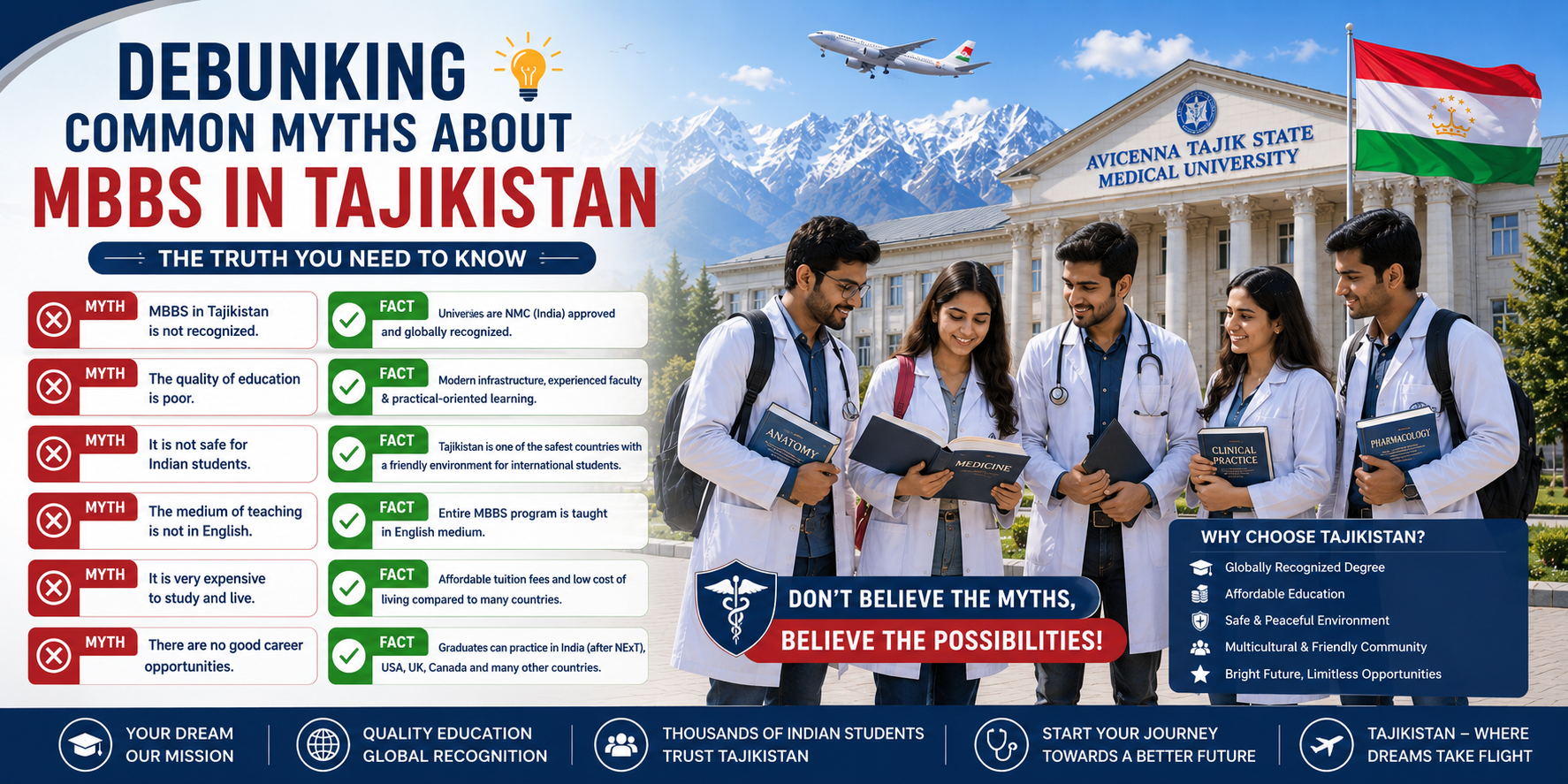
In this article we are busting the most popular misconceptions about MBBS in Tajikistan, and creating realistic opportunities for the students related to their medical journeys.
Myth 1: Degrees from Tajikistan Are Not Recognized
This is one of the most popular misconceptions that medical degrees from Tajikistan are not recognized internationally.
The Reality
Several medical universities in Tajikistan are listed in the World Directory of Medical Schools (WDOMS), which is widely recognized by medical councils, licensing authorities, and healthcare organizations worldwide.
Before submitting an application, students must check the WDOMS to confirm their selected university's listing status to maintain eligibility for global career options within the field.
Myth 2: You Can’t Work in India If You Study MBBS in Tajikistan
It is commonly thought among students and parents that if one graduates in medicine from Tajikistan, one is prohibited from working in India as a doctor.
The Reality
Those who complete their medical studies from recognized foreign medical institutes are allowed to work in India after completing the criteria prescribed by the National Medical Commission (NMC).
Students are thus required to choose universities according to the new NMC criteria, especially in regard to the duration of studies, internship duration, medium of instruction, and structure of the program.
A large number of foreign medical graduates are able to successfully work in India post the required licensing and registration.
Myth 3: The Medical Education in Tajikistan Is Not as Good as in Other Countries
It is believed by some that if the tuition fee is low, the quality of education is also low.
The Reality
It is not the quality of education that is low, but the structure of the economy in Tajikistan along with the low cost of living that makes their medical education affordable.
Numerous institutions provide:
- Modern Laboratories
- Digital Resources
- Clinical Training
- Qualified Faculty
- Support Systems
Medical education presents students with both the theory and practice of medicine, equipping them with the necessary skills for the profession.
Low fees are generally more indicative of educational quality than of poor government subsidization.
Myth 4: English Is Not Used in Medical Programs
A worry for many Indian students is whether they will have to learn the local language before they can commence their medical studies.
The Reality
Most universities offering MBBS in Tajikistan have English medium programs for foreign students.
Subjects related to Medicine, such as Anatomy, Physiology, Pathology, Pharmacology and Clinical Medicine are taught in English throughout the entire course.
While students may be instructed to learn some basic skills in the local language for purposes of better communication in the course of their clinical dealings, English continues to be the language of instruction for the International batches.
Myth 5: Clinical Exposure is Limited
Some students are of the opinion that if they study in Tajikistan, they may not get adequate opportunities for clinical exposure.
The Reality
Clinical training is an important aspect of medical education in Tajikistan.
Students get clinical exposure through:
- Teaching hospitals
- Clinical rotations
- Departmental posting
- Practical Medical training
The aim of clinical education is to provide training in an actual health care setting and to develop the skills of diagnosis, communication and management of patients.
The clinical exposure that Medical Schools provide, is similar to that of any Medical School across the world, and is dependent on the students' participation, regularity and activity.
Myth 6: Tajikistan is for Students with Poor Scores
This myth puts students of Medicine in Tajikistan at a disadvantage as they are of the opinion that studying Medicine in Tajikistan is a Plan B.
The Reality
There are various strategic reasons for students to select Tajikistan, for example:
- Value for Money education
- International Exposure
- Small Class Sizes
- English Medium
- World Class Career Opportunities
All of these reasons can be considered as a purposeful Plan B to avoid extremely competitive admission processes and overpriced educational systems in many other countries.
Students that are academically strong are considering this option.
The travel plans of students who wish to study outside their country show that their schooling was not a restriction, rather, their plans show that they had to strategically analyze the situation.
Myth 7: Life in Tajikistan for Indian Students Is Challenging
The primary concern of parents is that their child will not be able to adjust to life in a foreign nation.
The Reality
The number of international students residing in Tajikistan has substantially increased in recent years.
Indian students especially benefit from:
- Student hostels
- Availability of Indian foods
- Festive celebrations
- Student unions
- Peer support groups
The majority of students adjust in a relatively short time, often within a year, and acquire important life skills such as independence and flexibility, and inter-cultural communication skills.
The changes and development that come with the study abroad experience go beyond the traditional classroom learning.
Myth 8: Few Career Options Await Graduates
Some people are of the opinion that a medical Degree from Tajikistan closes off other career options.
The Reality
Graduates can open many doors for themselves, depending on their license and personal goals.
Some options are:
- Practice Medicine in India
- Further studies
- Health care administration
- Public health
- Clinical Research
- Medical education
- Travel the world and pursue a career in health care
Many graduates pursue other possibilities in the UK, US, Canada, Australia, several countries in the Middle East, after satisfying the license requirements.
Success in that career is directly linked to the effort and commitment to do their best, and not based on false perceptions of where they studied.
Myth 9: Major Safety Concerns
Anytime students contemplate studying abroad, there is the unavoidable concern of their safety.
The Reality
Like any other country in the world, students are expected to be aware of safety regulations, and follow them.
A majority of universities offer:
- Hostels
- Support for International Students
- Help with Administrative Affairs
- Orientations
- Safety Concerns
Most international students do not experience safety-related problems during their studies as long as they follow university regulations and local laws.
Myth 10: Employers Prefer Domestic Medical Graduates Only
Another myth is that foreign medical graduates are rejected by employers.
The Reality
Healthcare employers are concerned with:
- Professional Qualifications
- Clinical Competence
- Licensing
- Communication Skills
- Experience
- Conduct
After foreign medical graduates fulfill the licensing requirements, employers, in most cases, look at the graduate's capabilities and performance regardless of where the medical school is located.
Myth 11: Tajikistan is a Temporary Trend
Some critics argue that the increasing popularity of MBBS Courses in Tajikistan is a temporary trend.
The Reality
The growing interest in Tajikistan demonstrates the emerging patterns in the global context of medical education.
Students are looking for:
- Affordable Fees
- Internationally Recognized
- Quality Education
- Freedom of Movement
- Career Options
Countries that successfully combine affordable and quality education are likely to remain appealing to International students.
What Students Can Do to Combat Myth
The best way to dispel the myth is to have accurate information and use verifiable sources. Students are urged to:
- Confirm medical school status with the WDOMS
- Check the NMC website and guidelines
- Look for healthcare information on WHO’s website
- Talk to past and/or present students
- Research school webpages thoroughly
- Seek trusted educational counselors
Basing decisions on reality instead of gossip aids students in their decisions on education choices.
Conclusion
With MBBS programs in Tajikistan growing in demand, so have the false narratives and myths spreading around. Analyzing critically, most of these allegations are based on misleading assumptions.
Affordable medical programs, recognized higher education institutions, and clinical training programs in English exist in Tajikistan. Students can even benefit from training in various medical specialties. Success of study abroad depends on the university selected, knowledge of the law and the medical profession, and great planning of the profession. Great effort is needed to keep the focus on the profession and the medical practice.
Students who invest time and energy to research information that is factual have improved chances to secure a great medical position and to enjoy a successful medical career in India and abroad through proper preparation, including awareness of requirements such as NEET.