
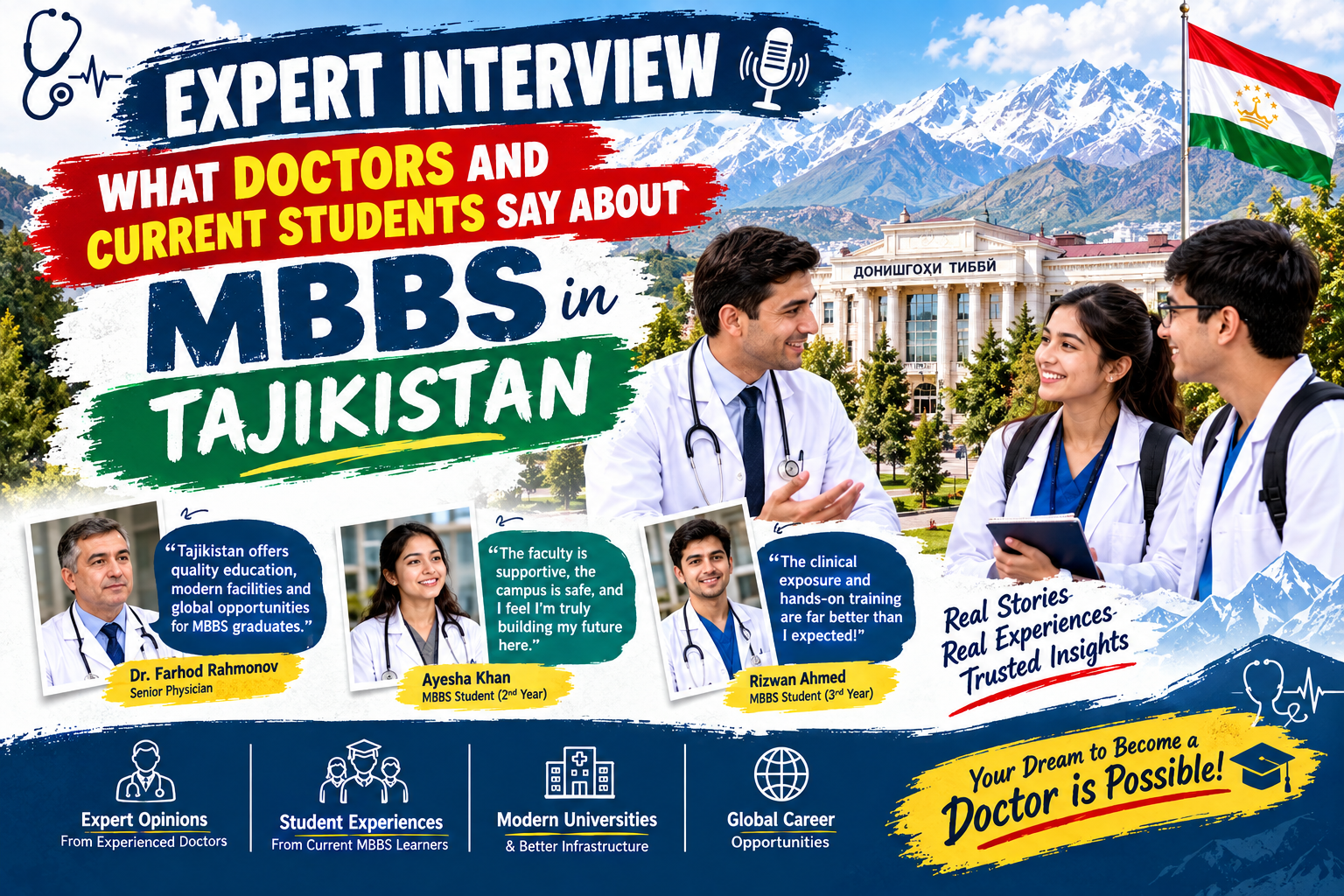
“Low fees can get you admitted. They can’t make you a doctor.” That one line captures what many practising doctors want Indian families to understand about foreign medical education. Current students usually put it more casually: don’t choose from a brochure, speak to seniors, check the hospital yourself, and learn enough Russian or Tajik to talk to patients. This interview-style guide brings together the practical observations doctors and senior students commonly share about MBBS in Tajikistan. The opinions aren’t presented as invented personal quotations from named individuals. Instead, they reflect recurring questions raised by applicants—course duration, clinical exposure, English-medium teaching, fees, recognition, NEET, and the licensing route back to India.
Why Are Indian Students Looking at Tajikistan?
Affordability brings most families to the discussion. Tuition at selected Tajik medical institutions can be significantly lower than the cost of an Indian private medical seat, and daily living expenses are usually manageable for students who use hostels and cook or join an economical mess. Doctors see another side. They point out that a country should never be selected only because admission appears simple. The medical programme must provide sufficient academic teaching, supervised clinical training, an acceptable internship, and eligibility for registration in the country awarding the degree. Students, meanwhile, talk about ordinary realities: shared rooms, local-language difficulties, unfamiliar food, cold winters, strict attendance, and learning to manage without parents nearby. Small details. Until you’re living them every day.
Question to Doctors: Is Tajikistan a Sensible MBBS Destination?
The balanced answer is yes, but only for the right student at the right university. Doctors generally don’t reject an entire country based on reputation or approve it based on popularity. They examine the institution, programme, attached hospitals, internship, teaching standard, and graduate outcomes. A recognised public university with organised clinical rotations may offer reasonable value. A weak programme promoted through aggressive discounts may not. Before choosing MBBS in Tajikistan, students should request the complete curriculum and verify how each academic year is structured. Ask where practical classes take place, when hospital postings begin, how many students attend one clinical unit, and whether international students can take patient histories. A modern-looking building is nice. A functioning teaching system is better.
Question to Students: Is the Course Really Taught in English?
Classroom teaching may be offered in English for international batches, but the hospital environment is rarely English-only. Professors may explain the case in English while patients respond in Tajik or Russian. That gap becomes obvious during clinical postings. Senior students commonly advise newcomers to begin local-language lessons in the first year. Waiting until fourth year makes clinical adjustment harder. Students don’t need perfect grammar; they need practical communication.
Useful areas include:
- Body parts and common symptoms
- Pain location and duration
- Previous treatment and surgery
- Drug and food allergies
- Family and personal history
- Pregnancy-related questions
- Basic examination instructions
- Numbers, dates and measurements
Honestly, this issue doesn’t receive enough attention during counselling. “English-medium” describes the academic programme. It doesn’t change the language spoken by local patients.
Question to Doctors: Does the Course Meet Indian Requirements?
This should be checked before admission, not during the final semester. The National Medical Commission publishes the regulations applicable to foreign medical graduates. The current framework contains conditions concerning the duration of medical education, required subjects, medium of instruction, clinical training, internship, and eligibility for medical registration in the country where the qualification is awarded. Programme descriptions in Tajikistan may vary. Some are presented as five academic years followed by one year of internship, while other online sources mention different durations. Don’t resolve this confusion through a phone call with an admission representative. Obtain the university’s official academic regulation.
Doctors advise families to confirm:
- Total months of academic study
- Number and length of semesters
- Compulsory clinical subjects
- Internship duration and location
- Institution awarding the qualification
- Eligibility for local medical registration
- Whether the entire course is completed in the same country
The six-year label is not enough. The content inside those six years matters.
Question to Students: What Is the Academic Routine Like?
The first year is usually a combination of medical-school pressure and personal adjustment. Students attend anatomy, physiology, biochemistry, histology, and practical sessions while also figuring out transport, currency, hostel rules, cooking, and local registration. Oral examinations can surprise students accustomed mainly to written tests. A professor may point to a structure or present a short case and expect an immediate answer. Attendance can also be closely monitored, with missed classes requiring additional work or make-up sessions.
Students who manage the course well tend to follow a simple routine:
- Review lectures on the same day.
- Prepare briefly before practical classes.
- Use standard textbooks alongside lecture notes.
- Revise older subjects each weekend.
- Solve topic-based MCQs from the early years.
- Ask questions before confusion becomes a backlog.
Medical school isn’t easy just because entry was less competitive. That assumption disappears quickly—usually around the first anatomy assessment.
Question to Doctors: How Important Is Clinical Exposure?
Extremely. Medicine can’t be mastered from slides alone. Doctors recommend examining the teaching hospitals before evaluating any programme. Ask for their names, departments, distance from campus, and the year in which regular patient-based learning begins. Then speak with students currently attending those hospitals. Good clinical exposure should involve more than standing behind a professor during rounds. Students should gradually learn to take histories, perform examinations, interpret investigations, present cases, identify differential diagnoses, and discuss management under supervision. Clinical experience during MBBS in Tajikistan can vary by university, hospital and department. Large international batches may sometimes reduce individual patient interaction. Language ability also affects participation. A student who can ask basic questions in Tajik or Russian will usually learn more from the same posting. Senior students suggest keeping a clinical logbook even if the university doesn’t insist on one. Record the case, findings, diagnosis, investigations, management, and one unresolved question. Ten minutes. That’s it.
Question to Students: How Much Does It Really Cost?
Students rarely complain about the fee printed on the brochure. They complain about the charges that weren’t printed. Medical tuition in Tajikistan may broadly range from USD 3,000 to USD 5,500 per year, depending on the university, programme, intake and fee policy. Hostel charges may fall around USD 500–1,200 annually. Food and routine living expenses can add approximately USD 120–250 per month. These are approximate planning ranges. Universities can revise fees, and currency movement changes the INR total.
|
Cost category |
Approximate amount |
|
Annual tuition |
USD 3,000–5,500 |
|
Hostel per year |
USD 500–1,200 |
|
Food and daily living |
USD 120–250 per month |
|
Insurance and medical tests |
Varies |
|
Visa and registration |
Varies |
|
Flights |
Depends on route and season |
|
Initial clothing and supplies |
USD 200–500 approximately |
A complete budget for MBBS in Tajikistan may reach roughly ₹20–35 lakh or more across the programme. The final figure depends on tuition, hostel, mess, flights, exchange rates, personal spending, and whether additional academic or administrative charges apply. Students advise families to ask about visa renewal, hostel deposit, insurance, invitation processing, laboratory fees, examinations, residence registration, local transport, and FMGE coaching. Fees can be low. Very low. But not always complete.
Question to Doctors: What Does WDOMS Listing Mean?
A listing in the World Directory of Medical Schools confirms that information about the medical school or programme appears in the directory. It doesn’t itself mean accreditation, recognition, or endorsement. WDOMS says this clearly. Likewise, the World Health Organization works on international health and doesn’t issue an automatic approval that guarantees a graduate’s registration in India. The phrase “WHO-approved university” is frequently used in promotions, yet it shouldn’t replace proper regulatory checks.
Doctors recommend verifying four separate areas:
- Legal status of the university in Tajikistan
- Accreditation of the specific medical programme
- Directory information in WDOMS
- Compliance with current Indian foreign-graduate regulations
A collection of international logos isn’t a compliance document.
Question to Students: What Is Hostel Life Actually Like?
Hostel life is usually manageable, provided students arrive with realistic expectations. Rooms may be shared by two, three or more students. Kitchens, laundry spaces and bathrooms may also be common. Indian mess facilities can be available around universities with larger Indian communities. Cooking is often cheaper, though it requires time and cooperation. Roommates soon learn who buys groceries, who washes dishes, and who somehow appears only after dinner is ready. The first months can feel lonely. Students miss familiar food, festivals, family routines and effortless conversation. Senior students recommend building a timetable outside academics: exercise, weekly grocery shopping, regular calls home, and time with friends. Weather can also require adjustment. Winters are colder than in most parts of India, so proper thermal wear, shoes and room-heating arrangements matter. Don’t buy an entire winter wardrobe before understanding the local climate, though. Students can often purchase suitable clothing after arrival.
Question to Doctors: Is NEET Qualification Enough?
NEET qualification is necessary for Indian students under the applicable foreign medical education rules, but it is only one part of eligibility. Applicants should check the official NEET portal for the examination bulletin, qualifying cutoff, result, and current notices. The category-wise qualifying score changes every year, so last year’s marks shouldn’t be treated as a permanent requirement. Academic eligibility commonly includes Class 12 Physics, Chemistry, Biology or Biotechnology, and English. Under the usual framework, general-category students require at least 50% aggregate marks in PCB, while eligible reserved-category candidates generally require 40%, subject to the regulations applicable during admission. Keep the NEET scorecard throughout the entire foreign course. Store it in several places. Phones get lost, accounts become inactive, and six years pass faster than families expect.
Question to Students: How Early Should FMGE Preparation Begin?
Not from the airport. But not after graduation either. Students generally find it easier to prepare gradually alongside the university curriculum. First-year subjects should be learned properly because anatomy, physiology and biochemistry return inside every clinical discipline. Pathology, pharmacology and microbiology require even stronger connections.
A realistic plan looks like this:
|
Course stage |
Preparation focus |
|
Years 1–2 |
Basic concepts and topic-based MCQs |
|
Year 3 |
Pathology, pharmacology and microbiology integration |
|
Year 4 |
Clinical cases and image-based questions |
|
Year 5 |
Mixed-subject tests and systematic revision |
|
Final phase |
Full-length papers and repeated revision |
|
Internship |
Case-based learning and weak-subject correction |
FMGE continues to be relevant for eligible foreign medical graduates in 2026. NExT regulations have been notified, though implementation was deferred, so students should monitor official notices instead of relying on predictions about which examination will apply after graduation. One hundred carefully reviewed questions teach more than five hundred questions clicked through without analysis. Students learn this a little late sometimes.
Question to Doctors: What Documents Should Students Preserve?
Every important one. Doctors who have guided foreign graduates often mention document errors as an avoidable source of delay. Students should maintain printed and digital copies of admission letters, university enrolment certificates, annual marksheets, attendance records, clinical rotations, internship logs, fee receipts, visa pages, passport records, curriculum documents, and official correspondence. Names and dates must match across the passport, NEET record, marksheets, degree and internship certificate. Even minor differences can create verification questions. For students pursuing MBBS in Tajikistan, keeping evidence of the exact programme followed by their batch is especially sensible. Course structures and online pages can change. Save official records while they’re available.
What Doctors and Students Agree On
Their priorities sound different at first. Doctors discuss compliance, clinical competence and licensing. Students discuss teachers, food, hostels, language and money. Yet both groups agree on the central point: verify everything before admission. They also agree that success depends heavily on the student. A respected university can’t compensate for years of irregular attendance. A lower-cost country doesn’t cause poor examination performance by itself. Daily study, clinical curiosity, language effort and proper documentation all matter.
Main Advantages and Limitations
The advantages include relatively affordable tuition, lower daily expenses, international exposure and access to medical education for students who can’t afford many private colleges in India. The limitations include local-language dependence during clinical training, inconsistent online information about programme duration, university-wise differences in teaching quality, travel logistics, and the need for separate Indian licensing preparation. MBBS in Tajikistan can be a practical option. Not for everyone. It suits students who can live independently, verify regulations carefully, communicate across language barriers, and study without constant supervision.
Frequently Asked Questions
Is Tajikistan a good choice for Indian students?
It may be suitable if the chosen university offers a properly structured medical programme, adequate clinical training, an acceptable internship, and local registration eligibility. Low fees alone shouldn’t decide the admission.
Is the medical course fully English-medium?
Selected institutions offer English-medium academic teaching. Patient communication in hospitals may still occur mainly in Tajik or Russian, making local-language learning necessary.
What is the approximate total cost?
A broad programme estimate may range from ₹20 lakh to ₹35 lakh or more. Tuition changes, hostel categories, food habits, flights and currency rates affect the final amount.
Does a WDOMS listing guarantee eligibility in India?
No. WDOMS inclusion doesn’t guarantee accreditation, NMC compliance or registration eligibility. The student must verify the complete programme against current Indian regulations.
Can graduates practise medicine in India?
Eligible graduates may enter the applicable Indian licensing and registration process if their admission, qualification, clinical training and internship satisfy NMC requirements.
When should students apply?
Applications commonly begin during spring or early summer for autumn intake, often continuing through August or September. Exact dates vary, so applicants should check the university’s current admission calendar.
Conclusion
Doctors want students to think about the day after graduation. Current students want applicants to understand the day after arrival. Both views matter. Check the curriculum. Confirm the six-year structure and internship. Speak with senior clinical-year students, not only admission representatives. Calculate every likely cost and preserve every academic record. Families considering MBBS in Tajikistan should make the decision after comparing universities, teaching hospitals, language support, full fees and current NMC conditions. Tajikistan may offer good financial value for a prepared student. The preparation part, though—that can’t be skipped.