
The first day usually begins with paperwork, not medicine. Passport copies, hostel registration, medical tests, fee receipts, student cards—one counter after another. The white coat comes later. For Indian students, MBBS in Tajikistan can offer a comparatively affordable route to medical education, but the journey is bigger than securing an admission letter. Across six years, a student moves from basic sciences and unfamiliar hostel life to clinical postings, internship responsibilities, and preparation for the Indian licensing pathway. It sounds long. It is. Yet each year has a very different rhythm.
Before Year One: Eligibility, NEET and University Selection
What happens before the flight may decide what happens after graduation. Indian applicants generally need Class 12 Physics, Chemistry, Biology or Biotechnology, and English from a recognised board. Under the commonly applicable eligibility structure, general-category candidates require at least 50% aggregate marks in PCB, while eligible reserved-category candidates generally require 40%. Rules for PwD candidates may differ. The student should ordinarily be at least 17 years old by December 31 of the admission year. Universities can also set their own academic or interview requirements. Indian students planning to obtain a foreign primary medical qualification must generally qualify NEET-UG under the applicable Indian regulations. The qualifying score changes each year, so use the official NEET portal for the result, cutoff, bulletin, and related notices. A score needed for an Indian government medical seat is usually much higher than the basic qualifying requirement for studying abroad. Different benchmark entirely. Before accepting an offer, verify the complete programme—not just the first-year curriculum. Ask for written details covering duration, internship, teaching language, clinical hospitals, degree title, local registration eligibility, and annual fees.
Understanding the Six-Year Course Structure
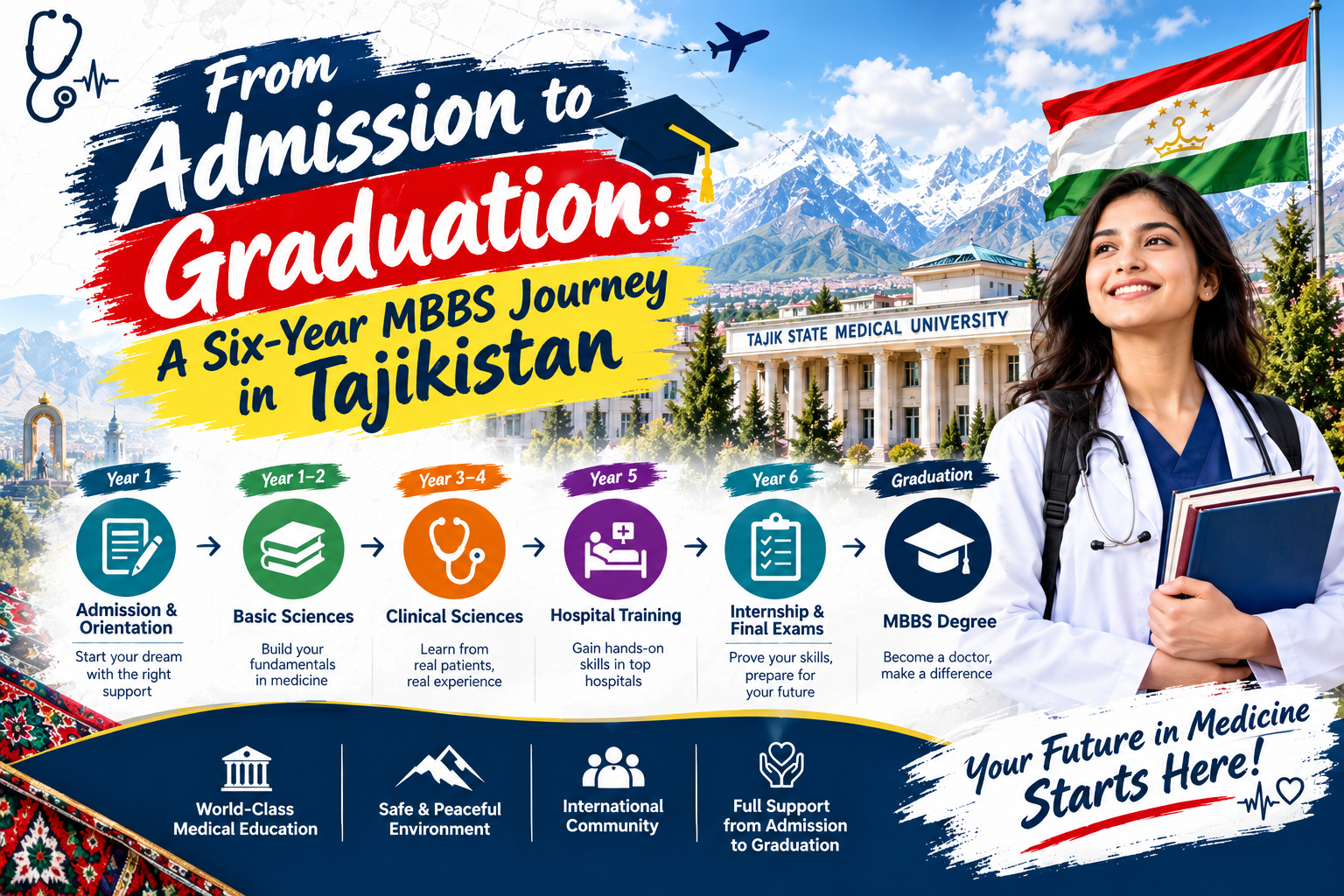
Six years on paper can hide several different arrangements. Some programmes are described as five academic years plus one year of internship or practical training, while other university documents may present a different structure. That wording matters. Students considering MBBS in Tajikistan should obtain the official semester-wise curriculum from the university and compare it with current National Medical Commission requirements. Under the Foreign Medical Graduate Licentiate Regulations, relevant conditions include the prescribed academic duration, internship, required subjects, English-medium instruction, clinical training, and eligibility for a medical licence in the country awarding the qualification.
A typical six-year journey may be understood like this:
|
Academic stage |
Main focus |
|
Year 1 |
Anatomy, physiology, biochemistry and basic medical sciences |
|
Year 2 |
Advanced pre-clinical subjects and early disease concepts |
|
Year 3 |
Pathology, pharmacology, microbiology and community medicine |
|
Year 4 |
Medicine, surgery and other clinical disciplines |
|
Year 5 |
Advanced clinical rotations and case-based learning |
|
Year 6 |
Internship, practical training or final clinical phase, depending on the university |
This is a broad outline. Exact subject placement and internship arrangements vary, so students must check the programme offered to their own intake.
Year One: Anatomy, Adjustment and Independence
The first year feels busy even before the difficult subjects settle in. Students are learning how to use local transport, manage money, share a hostel kitchen, attend classes on time, and understand teachers with unfamiliar accents. Then anatomy arrives. Anatomy, physiology, and biochemistry normally dominate the academic schedule. Students may attend lectures, laboratory sessions, oral assessments, practical demonstrations, and regular tests. The volume is substantial. Not impossible, but substantial.
A consistent routine works better than last-minute study:
- Review lectures within 24 hours.
- Prepare before anatomy practicals.
- Use one standard textbook with university notes.
- Revise diagrams and structures weekly.
- Solve a small set of topic-based MCQs.
- Keep Sundays for accumulated weak areas.
Daily life also needs adjustment. Tajik and Russian are widely used, so basic local-language learning should begin early. Even simple phrases help at shops, pharmacies, transport stops, and administrative offices. Honestly, students who spend the entire first year inside an Indian friend circle often regret it during hospital training.
Year Two: Moving From Normal Function to Disease
Something changes in the second year. The student no longer studies only how the body should work; disease mechanisms begin to enter the discussion. Subjects vary by curriculum, but students may encounter histology, medical genetics, immunology, early pathology, microbiology, pharmacology, and introductory clinical skills. The workload becomes more connected. A cardiovascular topic, for instance, may involve anatomy, physiology, pathology, and drug action in the same week. This is the right time to create short revision systems. Not giant notebooks. Use compact charts for bacterial characteristics, drug groups, metabolic disorders, and common pathological processes. During this phase of MBBS in Tajikistan, students should also improve their medical Russian or Tajik vocabulary. Classroom instruction may be offered in English for international batches, but patients generally won’t follow the university brochure. Language becomes a clinical skill.
Year Three: The Difficult Middle
Third year is where many students realise that memorising lecture slides isn’t enough. Pathology, pharmacology, microbiology, forensic medicine, and community-oriented subjects require understanding plus recall. Consider tuberculosis. A student must connect the organism, transmission, pathological changes, diagnostic tests, drug regimen, adverse effects, prevention, and public-health approach. Studying every subject in isolation makes that unnecessarily difficult. A system-based method is more effective. Complete respiratory pathology, then connect respiratory pharmacology, microbiology, imaging, and clinical findings. One organ system at a time. This is also a sensible stage to begin structured preparation for India’s licensing examination. Start with 75–100 MCQs per week, review incorrect answers, and maintain a mistake notebook. No need for daily eight-hour coaching sessions. Steady work is enough at this stage.
Year Four: Entering the Clinical World
Now the white coat actually begins to feel meaningful. Students spend more time in teaching hospitals and clinical departments, where they observe patients, discuss investigations, and learn examination techniques. The language issue becomes real here. A professor may explain a case in English, while the patient describes symptoms in Tajik or Russian. Students who learned basic communication during the first three years can participate. Others stand quietly and wait for translation.
A clinical day may include:
- Reporting to the assigned ward
- Observing or taking patient history
- Performing a supervised examination
- Reviewing laboratory and imaging results
- Presenting the case
- Discussing diagnosis and treatment
- Answering oral questions
Clinical exposure depends on the university, hospital, department, group size, and faculty. Ask whether students can take histories independently and practise basic skills under supervision. A busy hospital means little if 25 students are watching one patient from the doorway. Keep a personal clinical log. Record the patient’s main complaint, findings, probable diagnosis, investigations, and management. Short entries. Regularly.
Year Five: Serious Clinical Training and Exam Preparation
By fifth year, subjects such as internal medicine, surgery, paediatrics, obstetrics and gynaecology, psychiatry, ENT, ophthalmology, dermatology, anaesthesia, orthopaedics, and radiology become central, though exact scheduling differs. The student is expected to think clinically now. What is the likely diagnosis? Which investigation comes first? Is the patient stable? What treatment can’t wait? This year can feel crowded because university examinations and Indian licensing preparation begin competing for attention. The sensible solution is integration. If the hospital case is acute appendicitis, revise anatomy, symptoms, differential diagnosis, investigations, operative principles, and complications together. Students midway through MBBS in Tajikistan may use an online FMGE-oriented question bank or lecture programme, but one primary resource is enough. Buying multiple subscriptions usually creates guilt, not better preparation.
A practical weekly target might include:
- Five days of university-focused study
- 300–500 MCQs across the week
- One image-based revision session
- One older-subject revision block
- One clinical case discussion with classmates
Some weeks will go badly. Start again on Monday.
Year Six: Internship or Final Clinical Phase
The sixth year should turn textbook knowledge into supervised medical practice. Depending on the university’s official curriculum, it may be structured as an internship, advanced clinical rotations, or a combination of both. Students may rotate through medicine, surgery, paediatrics, obstetrics and gynaecology, emergency medicine, and other departments. The experience should involve attendance, case records, supervised duties, assessment, and documented completion. This is where regulatory details cannot remain vague. Indian students should confirm whether the internship meets the conditions applicable under NMC rules, whether it is completed in the required institution and country, and whether the qualification makes the graduate eligible for local registration or licensing.
Collect documents as each rotation finishes:
- Department-wise completion certificates
- Attendance records
- Internship logbook
- Rotation dates
- Supervisor signatures
- Clinical assessment results
- Final internship certificate
Don’t wait until last week. Department heads change, offices relocate, papers get misplaced. It happens.
Recognition Must Be Checked Throughout the Course
A university appearing in the World Directory of Medical Schools is relevant, but WDOMS states that a listing doesn’t itself amount to recognition, accreditation, or endorsement. It also doesn’t guarantee registration in India. The World Health Organization works on global public health; it doesn’t issue a personal “approval” that automatically makes an individual foreign degree valid for Indian practice. Marketing language often blurs this distinction.
For MBBS in Tajikistan, students should separately verify:
- Legal recognition of the university in Tajikistan
- Accreditation of the medical programme
- WDOMS directory information
- Programme compliance with NMC conditions
- Internship structure
- Eligibility for local medical registration
- Indian licensing requirements applicable after graduation
Save official curriculum and accreditation records from the year of admission. Websites can change over six years.
Tuition Fees and the Real Six-Year Budget
Here is the financial picture families actually need. Tuition for medical programmes in Tajikistan may fall roughly between USD 3,000 and USD 5,500 per year, depending on the university and intake. Avicenna Tajik State Medical University is among the best-known public institutions, but students must request its current international fee directly rather than relying on conflicting online quotations. Hostel charges may range from approximately USD 500 to USD 1,200 annually. Food and ordinary living costs can fall around USD 120–250 per month for a student with sensible habits.
|
Expense |
Approximate range |
|
Annual tuition |
USD 3,000–5,500 |
|
Hostel per year |
USD 500–1,200 |
|
Food and living per month |
USD 120–250 |
|
Insurance and medical tests |
Varies |
|
Visa and registration costs |
Varies |
|
Flights and local travel |
Depends on route and season |
|
Study materials and clothing |
USD 200–500 approximately |
A total six-year family budget might reach roughly ₹20–35 lakh or more after tuition, accommodation, food, travel, currency movement, documentation, and personal costs. This is a broad estimate. Get written 2026 figures from the university. Hidden costs often include annual registration, visa renewal, invitation processing, hostel deposits, medical insurance, mess charges, examination fees, winter clothing, and FMGE preparation. Ask for the full list. Preferably before paying.
Hostel Life, Food and the Personal Side
I’ve noticed that students remember their roommates almost as clearly as their professors. Hostel life can be noisy, funny, irritating, and unexpectedly supportive—sometimes all before dinner. Rooms may be shared. Kitchens and bathrooms can also be common. Indian mess services may be available near universities with larger student communities, while cooking remains the cheaper option. Rice, lentils, eggs, vegetables, chicken, bread, and basic spices cover most student meals. Homesickness tends to appear after the first excitement fades. Students miss festivals, family events, familiar food, and conversations that don’t require translation. Regular calls home help, but building a routine in Tajikistan matters too. Exercise. Sleep. Make friends outside your home state. Ask for support if anxiety or low mood continues. Medical students are still people, even if they pretend otherwise.
Preparing for FMGE or NExT
The degree ceremony isn’t the end of the process for an Indian graduate. Eligible foreign medical graduates must follow the licensing and registration pathway applicable in India at that time. FMGE continues to be relevant in 2026, while the NExT framework has been notified and its implementation status should be checked through official notices. A student starting now may graduate under different procedures, so predicting the exact examination six years early isn’t sensible.
Prepare for both possibilities by building concepts, solving clinical MCQs, reviewing Indian treatment guidelines, practising images, and taking full-length tests. A useful timeline is:
- Years 1–2: strong basic sciences
- Year 3: subject-wise MCQs
- Year 4: clinical integration
- Year 5: regular mixed tests
- Year 6: repeated revision and full-length papers
Passing depends far more on consistent study than a final three-month panic.
Advantages and Challenges of the Journey
The advantages are clear: relatively low tuition, lower living costs, international exposure, and access to medical education for students unable to afford many private Indian colleges. The challenges are equally real. Local-language communication, variable programme structures, changing regulatory requirements, limited direct flights, adjustment to a new culture, and the need for independent FMGE preparation all deserve attention. MBBS in Tajikistan can suit a disciplined student who verifies the university carefully, learns the local language, manages money sensibly, and studies without constant supervision. It won’t suit someone selecting a college only because the first-year package looks cheap.
Frequently Asked Questions
Is the medical course in Tajikistan six years long?
Many programmes are promoted as five academic years followed by one year of internship or clinical training. Structures can vary, so students should verify the exact duration and internship arrangement in official university documents.
Is NEET compulsory for Indian students?
Indian students seeking foreign medical admission and intending to pursue registration in India generally need to qualify NEET under applicable regulations. Check current NTA and NMC instructions before admission.
Is the course taught in English?
Selected universities offer English-medium medical programmes for international students. Still, Tajik or Russian is commonly needed for patient communication during hospital training.
What is the approximate total cost?
A broad six-year estimate may range from ₹20 lakh to ₹35 lakh or more, depending on tuition, hostel, food, flights, exchange rates, and personal spending. Obtain the current university fee schedule before making a decision.
Can graduates practise in India?
Eligible graduates can pursue the Indian licensing pathway if their qualification, course, internship, and admission satisfy current NMC conditions. They must also complete the examination and registration requirements in force at the time.
When should FMGE preparation begin?
Light subject-wise MCQ practice can begin in the first or second year. More structured preparation should start by the third or fourth year, followed by intensive revision during the final clinical phase.
Conclusion
Admission feels like the biggest step until first-year anatomy begins. Then clinical postings feel bigger. Later, internship paperwork and licensing preparation take over. That’s medical school—one major concern replacing another. The journey can still be rewarding. Students grow academically, become independent, learn to communicate across cultures, and return with experiences that go far beyond a classroom. Before choosing MBBS in Tajikistan, verify the complete six-year structure, internship, clinical hospitals, fees, local registration eligibility, and current NMC conditions. Choose slowly. Study consistently. Keep every document. Graduation is six years away, but preparing for it begins with the first decision.