
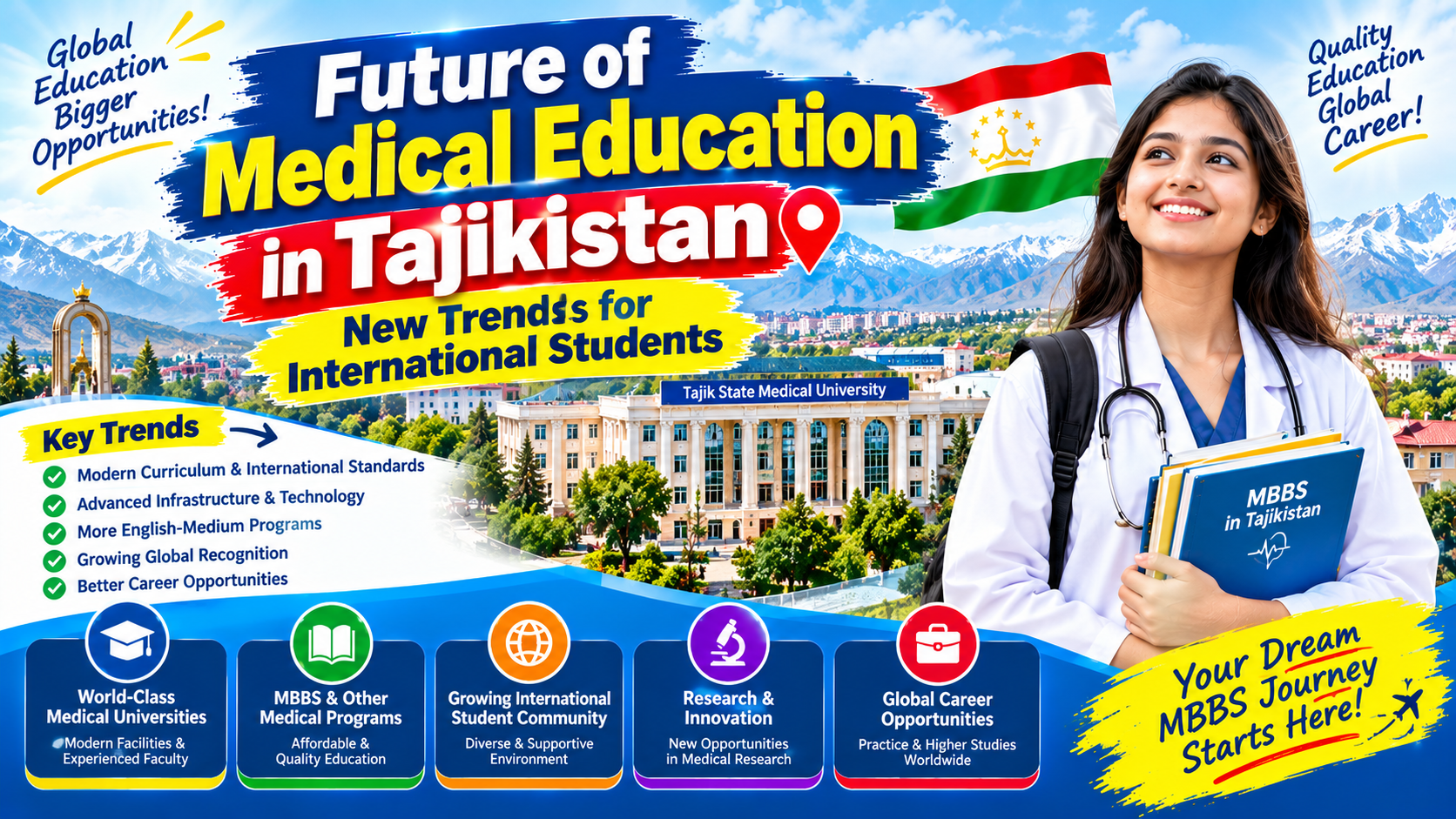
A medical classroom in Tajikistan may look quite different five years from now. Less time spent copying long notes. More case discussion, simulation practice, digital assessment, and early clinical exposure. That is the direction many medical-education systems are moving toward, and Tajikistan has reasons to move with them. For students considering MBBS in Tajikistan, the future is not simply about new buildings or electronic screens in lecture halls. The meaningful changes will involve how students are assessed, how soon they meet patients, whether English-medium teaching becomes more consistent, and how well their programme aligns with international licensing requirements. Some developments are already visible. Others remain emerging trends rather than guaranteed features at every university. So, a little caution. A university should be judged by what it currently provides—not only by what it promises to introduce.
Competency-Based Learning Is Gaining Attention
What does a competent medical graduate need to do? Diagnose common illnesses, communicate with patients, identify emergencies, choose appropriate investigations, understand treatment principles, and behave professionally. Knowing facts is necessary. Using them is the harder part. Medical-education reform work in Tajikistan has placed attention on competency-based training, particularly within family medicine and health-workforce development. This approach measures whether students can apply knowledge instead of rewarding memorisation alone.
For international students, that could mean greater use of:
- Clinical case discussions
- Structured skills checklists
- Practical demonstrations
- Communication assessments
- Logbooks and learning portfolios
- Workplace-based evaluation
- Objective clinical examinations
This transition won’t happen identically across every institution. Older teaching styles may remain alongside newer methods for years. Still, students should ask whether assessments include clinical reasoning and observed skills—not only written theory papers.
Earlier Clinical Exposure May Become More Common
Traditionally, many medical courses keep students in classrooms and laboratories for the first few years, then introduce serious hospital training later. That separation is gradually being questioned. Anatomy makes more sense when connected with an examination finding. Pharmacology becomes easier to remember when the student has seen the condition being treated. Simple, really. Future programmes may introduce students to clinical settings earlier through hospital observation, community visits, simulated patient interviews, and basic examination practice. Regular ward responsibility would still come later, but the clinical connection could begin during the basic-science years.
Students choosing MBBS in Tajikistan should ask:
- From which year do hospital visits begin?
- When can students take supervised patient histories?
- Are basic clinical skills taught during the first two years?
- Is early exposure included in the official timetable?
- How are these activities assessed?
A five-minute hospital tour during orientation doesn’t count as early clinical exposure. The activity should be structured, repeated, and supervised.
Simulation-Based Training Is Likely to Expand
Medical students cannot practise every procedure first on a real patient. Simulation laboratories provide a safer place to learn basic life support, injection techniques, examination sequences, emergency response, and patient communication. A simulation room may include mannequins, task trainers, monitors, resuscitation equipment, or computer-based clinical scenarios. The quality varies. One mannequin and a poster should not be marketed as a complete simulation centre. The useful question is how frequently students actually use the facility.
Future medical colleges in Tajikistan may invest more in:
- Basic and advanced life-support practice
- Obstetric and neonatal emergency simulation
- Suturing and procedural trainers
- Virtual anatomy tools
- ECG and imaging interpretation stations
- Structured clinical examination rooms
- Simulated patient interviews
Honestly, equipment alone changes nothing. A locked simulation lab is just an expensive room. Faculty training, scheduled sessions, feedback, and repeated practice determine whether students benefit.
Digital Learning Digital Learning Will Support the Classroom
The country has placed wider attention on digital-economy development and innovation for the 2025–2030 period. Medical universities are likely to participate in this broader shift through online academic portals, digital libraries, attendance systems, and computer-based assessments. That doesn’t mean lectures should move entirely online. Medicine needs laboratories, cadavers, patients, and supervised clinical work. Screens can support those experiences; they cannot replace them.
Useful digital features may include:
- Recorded revision lectures
- Learning-management systems
- Electronic assignment submission
- Online quizzes
- Virtual microscopy
- Digital radiology libraries
- Remote academic mentoring
- Electronic clinical logbooks
International students may find these tools especially helpful when revising unfamiliar terminology or preparing for licensing examinations. Still, students should check internet reliability, platform access, and whether digital resources are included in tuition. More technology does not automatically mean better teaching. Sometimes it just means more passwords.
English-Medium Programmes May Become More Structured
International enrolment creates pressure for clearer English-medium instruction. Universities hoping to attract students from India and other countries need faculty who can teach, assess, and explain clinical material consistently in English. The future may bring better English-language support, separate international cohorts, bilingual clinical teaching, and more standardised learning materials. Yet students should verify the present situation carefully.
Ask current students:
- Are all core lectures actually conducted in English?
- Are practical instructions translated properly?
- Are examinations written in English?
- Can faculty answer questions comfortably?
- Are English textbooks and library resources available?
- Does the language of teaching change in later years?
Patients in Tajikistan will still commonly speak Tajik or Russian. Therefore, stronger English teaching should be paired with organised local-language education. A student needs English for academics and local communication for clinical work. Both. Not one or the other.
Local-Language Training Will Become More Clinically Focused
I’ve seen students treat language classes as an easy attendance subject during the first year. Then hospital postings begin, and suddenly the vocabulary matters. Future programmes serving international students may shift from general grammar toward practical medical communication. Instead of memorising unrelated phrases, students could learn how to ask about pain, fever, medication, allergies, previous surgery, and family history.
A clinically useful language course should include:
- Patient greetings and consent
- Symptom-based questioning
- Numbers, dates, and duration
- Basic examination instructions
- Emergency phrases
- Common medical terminology
- Case-record vocabulary
This would directly improve bedside participation. For students pursuing MBBS in Tajikistan, local-language ability could remain one of the clearest differences between merely attending hospital rotations and genuinely learning from patients.
Family Medicine and Primary Care May Receive More Focus
Tajikistan’s medical-education reforms have included attention to family medicine, nursing education, and health-workforce training. That fits the wider need for accessible primary healthcare, particularly outside major urban centres. The World Health Organization has also reported recent steps in Tajikistan connected with health financing and progress toward universal health coverage. As the healthcare system changes, medical training may place more weight on prevention, community medicine, continuity of care, and management of common chronic diseases.
International students could see greater exposure to:
- Primary-care clinics
- Maternal and child health
- Vaccination programmes
- Hypertension and diabetes management
- Infectious-disease control
- Rural healthcare
- Health education
- Preventive screening
This type of training isn’t less prestigious than tertiary hospital work. Most doctors spend a large part of their careers dealing with common conditions. Common doesn’t mean simple.
Research Skills May Enter the Undergraduate Curriculum Earlier
Medical research is no longer reserved for postgraduate students and professors. Undergraduates increasingly need to understand study design, statistics, evidence appraisal, research ethics, and scientific writing. Tajikistan medical colleges seeking stronger academic connections may encourage student research groups, poster presentations, small clinical audits, and collaboration with teaching hospitals. Some institutions may develop more visible journals or conferences for young researchers.
Students should look for practical evidence:
- Is research methodology included in the curriculum?
- Are students assigned faculty mentors?
- Does the university have an ethics committee?
- Can undergraduates participate in audits?
- Are published projects available for review?
- Are research claims tied to genuine indexed work?
Be cautious here. A certificate from a one-day event is not the same as research experience.
Assessment Could Become More Practical and Continuous
One large final examination can test memory, but it may not show whether a student communicates safely or performs a clinical examination correctly. Continuous assessment tries to capture progress across the year.
Future assessment models may use a combination of:
|
Assessment Method |
What It Can Measure |
|
Written examinations |
Subject knowledge |
|
Case-based questions |
Clinical reasoning |
|
OSCE-style stations |
Structured practical skills |
|
Viva examinations |
Explanation and decision-making |
|
Logbooks |
Clinical attendance and exposure |
|
Mini clinical evaluations |
Bedside performance |
|
Portfolios |
Development over time |
|
Online quizzes |
Regular recall and feedback |
Students shouldn’t assume that more tests automatically improve education. Assessments need clear standards and useful feedback. Otherwise, they become paperwork with marks attached.
International Licensing Alignment Will Matter More
Medical students are increasingly planning careers across borders. Universities recruiting international batches will face pressure to explain how their programme fits the regulations of students’ home countries. For Indian students, the requirements of the National Medical Commission remain central. Depending on the rules applicable to the admission batch, the foreign programme may need to satisfy conditions involving course duration, compulsory subjects, English-medium teaching, clinical training, a 12-month foreign internship, and eligibility for medical registration in the country awarding the degree.
Future international programmes may provide clearer documentation packages, including:
- Detailed transcripts
- Rotation records
- Internship logbooks
- Medium-of-instruction certificates
- Clinical-hours statements
- Local licensing-eligibility documents
- Authenticated degree records
This would help graduates during licensing applications. But students shouldn’t wait for universities to become better organised. Save every record from the first semester.
WDOMS Verification Will Remain Essential
Digital recruitment may increase, but basic verification will still matter. Students should search the exact institution and campus in the World Directory of Medical Schools. WDOMS listing is useful for checking medical-school information. It does not guarantee Indian registration, licensing-exam eligibility, or the quality of clinical training. As new faculties or programmes appear, students must avoid assuming that a branch campus shares the same status as the parent university. Check the precise degree-awarding institution. This is especially relevant as MBBS in Tajikistan attracts more international applicants. More demand usually brings more marketing. Not every claim ages well.
NEET and Admission Standards Will Still Apply
New teaching technology won’t remove basic eligibility requirements. Indian students covered by the applicable rules must qualify NEET-UG before taking admission abroad if they plan to seek medical registration in India. The qualifying score changes annually because it is percentile-based. Students should use the official NEET website for current bulletins, results, and notices. Tajikistan universities may also become more selective as international demand grows. Admission could involve document scrutiny, science-subject requirements, interviews, or internal assessments at particular institutions. Students should prepare original and authenticated documents early. Last-minute applications tend to produce rushed decisions. And rushed decisions love hidden problems.
Fees May Rise as Facilities Improve
Modern laboratories, simulation equipment, trained English-speaking faculty, and hospital partnerships cost money. If universities expand these services, tuition may gradually increase. Current annual tuition can broadly range from about USD 3,000 to USD 5,500 at some institutions, while particular programmes may charge more. Hostel fees may sit around USD 500–1,200 annually. Students must verify the latest official quotation because online estimates can become outdated.
Possible future expenses include:
- Simulation-lab charges
- Digital-platform subscriptions
- Clinical equipment
- Health insurance
- Residence documentation
- Electronic examinations
- Licensing-preparation resources
The cheapest programme may offer fewer facilities. The highest fee, however, does not prove higher quality. Compare what students actually receive.
FMGE and NExT Preparation May Become Integrated
International students often use separate coaching after graduation because their university teaching and Indian licensing preparation are not fully aligned. Future programmes may respond by adding structured MCQ practice, Indian guest faculty, integrated case discussions, or licensing-oriented revision support. FMGE has traditionally assessed broad knowledge through 300 questions, with 150 marks required to qualify, subject to the current examination bulletin. NExT has been proposed for licensing and postgraduate-admission purposes, but implementation and applicability must be confirmed through official notifications. Students choosing MBBS in Tajikistan should not select a university solely because someone claims it has the “highest pass rate.” Ask for the source, examination session, number of candidates, and official result basis. Unverified percentages are advertising, not evidence.
Greater Student Support Could Improve the International Experience
Moving abroad at 17 or 18 can be difficult even when academics go well. Universities competing for international students may provide stronger orientation, counselling, academic mentoring, language support, and emergency assistance.
Useful support systems include:
- Airport and arrival guidance
- Transparent hostel allocation
- Anti-ragging and grievance channels
- Mental-health counselling
- Academic advisers
- Emergency medical support
- International student offices
- Parent communication procedures
A contact number printed in a brochure doesn’t prove support exists. Ask current students what happened when they actually needed help.
What Students Should Check Before Admission
Future promises are interesting. Current evidence is better.
Before applying, verify:
- Exact WDOMS entry
- National accreditation
- Six-year course structure
- Required foreign internship
- Hospital affiliations
- English-medium teaching
- Local-language training
- Clinical group size
- Simulation access
- Research opportunities
- Local licensing eligibility
- NMC compliance
- Complete six-year cost
- Student-support arrangements
Ask for documents, not only phone explanations. A serious university should be able to describe its own programme clearly.
FAQs
Is medical education in Tajikistan becoming more technology-based?
Digital platforms, online resources, simulation, and electronic assessment are likely to expand, but availability will differ by institution. Students should verify existing facilities before admission.
Will online learning replace hospital training?
It shouldn’t. Digital learning can support theory and revision, but medical education still requires in-person laboratories, supervised clinical training, and real patient interaction.
Is English-medium teaching likely to improve?
Growing international enrolment may encourage more structured English-medium programmes. Students must still confirm the actual classroom language with current batches.
Will Tajik or Russian remain necessary?
Yes, especially during hospital postings. Patients commonly communicate in local languages, so basic medical communication remains valuable even in an English-medium programme.
Can graduates still apply for Indian licensing examinations?
Eligible graduates may apply under the rules in force at that time, provided their qualification, course, internship, clinical training, and documents satisfy applicable requirements.
Will studying medicine in Tajikistan remain affordable?
It may remain less expensive than many private medical options, but fees could rise as facilities and international services expand. Always verify current tuition and living costs.
Conclusion
Tajikistan’s medical education may move toward competency-based teaching, earlier clinical exposure, simulation, digital resources, family medicine, and better support for international students. These changes could make training more practical and globally relevant. Still, a trend is not a guarantee. One university may adopt modern assessment quickly while another continues with older methods. Students exploring MBBS in Tajikistan should compare present facilities, hospital access, faculty communication, internship arrangements, and regulatory compliance before trusting future plans. New technology is useful. Strong clinical training, proper documentation, and a valid licensing pathway matter far more.