Every year, millions of Indian aspiring medical students register for NEET, India’s national unified medical entrance exam. Public medical school seats in the country are extremely scarce, while tuition fees at private medical institutions far exceed the affordability of ordinary middle-class families. This core pain point has driven up demand among Indian students to pursue medical degrees overseas. In 2026, MBBS study programs in Tajikistan and Kyrgyzstan continue to grow in popularity. This paper conducts a comprehensive comparative analysis of the study-abroad value of these two countries, to help prospective students select the optimal option that best matches their personal needs.
Common Advantages of Tajikistan and Kyrgyzstan
As two popular destinations for international medical study that have risen to prominence in recent years, these two Central Asian countries share a number of core common advantages: affordable tuition, all their host medical universities hold international medical accreditation, courses are taught in English, and daily living costs are far lower than those in Western European and North American countries. Most of their universities are also listed in the World Directory of Medical Schools (WDOMS), and graduates can apply for medical practice licenses in various countries in line with local regulations.
Both countries uniformly adopt a 6-year MBBSin Tajikistan curriculum framework, which covers pre-medical education, basic medical studies, clinical training, hospital rotations, and internship placements. Since each country has its own strengths and weaknesses, international students must make their choices after assessing seven core dimensions: tuition fees, education quality, clinical resources, daily life as an international student, preparation for medical licensing exams, infrastructure, and long-term career goals.
MBBS in Tajikistan
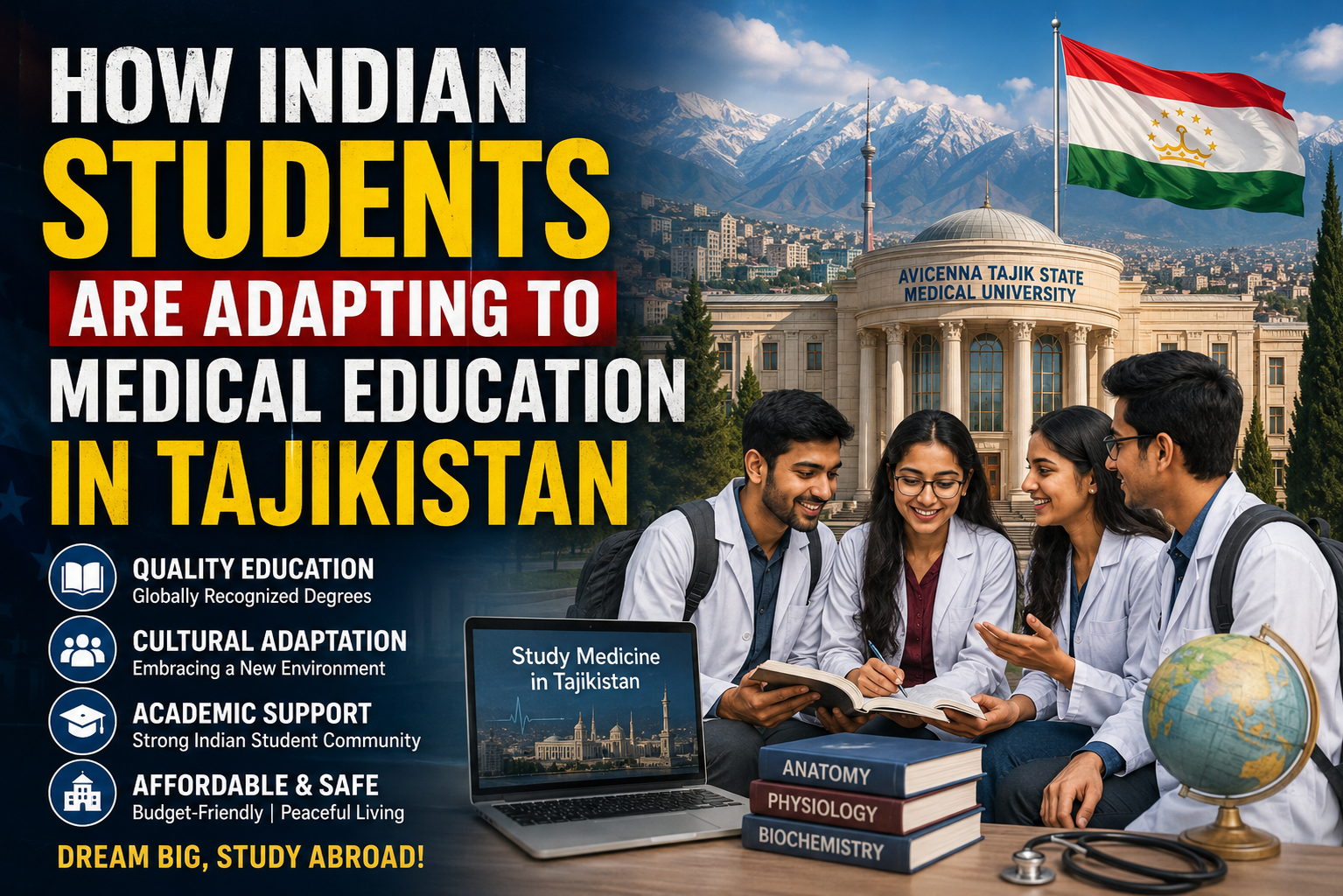
As a landlocked mountainous country in Central Asia, Tajikistan’s programs for MBBS in Tajikistan have drawn large numbers of Indian international students over the past decade, thanks to their high cost-effectiveness and continuously upgraded educational infrastructure.
Major Medical Universities in Tajikistan
Currently, Tajikistan has three core medical universities:
- Tajik National University
- Avicenna Tajik State Medical University
- Tajik State Medical University
Its student body includes students from India, Nepal, Bangladesh, and multiple African countries. The Tajik government has also made dedicated investments to upgrade education quality and expand international cooperation, further lifting the overall popularity of its MBBS programs.
MBBS in Kyrgyzstan
Kyrgyzstan is a long-standing overseas study destination for Indian students pursuing MBBS degrees.
Major Medical Universities in Kyrgyzstan
The country hosts four internationally accredited medical universities:
- Kyrgyz State Medical Academy
- Osh State University
- Jalal-Abad State University
- International School of Medicine
These universities also provide exclusive support services for Indian students, including Indian meal facilities, dedicated dormitories for international students, a full English-medium instruction system, and targeted academic support aligned with the FMGE/NExT exams. To date, thousands of Indian medical students are enrolled at these institutions.
Comparative Analysis: Four Core Dimensions
Next, this analysis conducts a point-by-point comparison of relevant conditions in Kyrgyzstan and Tajikistan across four core dimensions that international students prioritize: tuition fees, cost of living, accommodation facilities, and education quality.
1. Tuition Fees
First, the tuition dimension:
- Tajikistan charges annual tuition of 3,500–5,000 USD, with total tuition for the full degree program amounting to 20,000–28,000 USD.
- Kyrgyzstan charges annual tuition of 3,000–6,000 USD, with total tuition ranging from 18,000 to 30,000 USD.
Final Ruling: The two countries perform equally on this dimension.
2. Cost of Living
Second, the cost of living dimension:
- In Tajikistan, an average monthly expenditure of 150–300 USD covers all basic needs including food, clothing, housing, and transportation.
- Its capital Dushanbe is a low-cost capital in Central Asia.
- In Kyrgyzstan, average monthly expenditure ranges from 180 to 350 USD, fluctuating based on the host city, personal lifestyle, and accommodation type, with slightly higher costs in its capital Bishkek.
Final Ruling: Tajikistan outperforms Kyrgyzstan on this dimension.
3. Accommodation Conditions
Third, the accommodation conditions dimension:
Tajikistan
- Furnished dormitory rooms
- Wi-Fi facilities
- Security services
- Shared kitchens
- Laundry rooms
- Annual accommodation fees of 500–700 USD
Kyrgyzstan
- Modern dormitory facilities
- Exclusive zones for international students
- Leisure areas
- Self-study rooms
- Indian canteen
- Annual accommodation fees of 600–1,000 USD
Final Ruling: Kyrgyzstan outperforms Tajikistan on this dimension.
4. Education Quality
Fourth, the education quality dimension:
- Tajikistan’s medical universities follow international medical education standards.
- Curricula focus on basic sciences, clinical medicine, and scientific research.
- Small-class teaching is widely adopted.
- The national government continues to invest resources in higher education.
Kyrgyzstan’s partner medical universities all meet international medical education accreditation requirements, and their overall educational strengths are comparable.
Seven-Dimension Comparative Assessment
If you are an Indian international student planning to pursue a Bachelor of Medicine, Bachelor of Surgery (MBBS) in Central Asia, this analysis adopts a unified structure of “dimension introduction – country-specific overview – final ruling” to conduct an item-by-item comparison of the core study-abroad conditions of Kyrgyzstan and Tajikistan.
1. Educational Foundation and International Reputation
Kyrgyzstan has a longer history of hosting international medical students, with more complete supporting arrangements including international program layouts, cross-border faculty networks, global exposure, and a mature teaching system.
Winner: Kyrgyzstan
2. Clinical Practical Training
Kyrgyzstan has more comprehensive clinical infrastructure, which can provide medical students with full-scenario training support such as:
- Real ward rounds
- Multidisciplinary case discussions
- Professional practical workshops
- Simulated case learning
Winner: Kyrgyzstan
3. Academic Qualification Certification
Medical schools in both countries are listed in the World Directory of Medical Schools (WDOMS) and meet the relevant framework requirements of India’s National Medical Commission (NMC).
We strongly recommend that all applicants verify the latest qualification status of their target institution via official channels on their own.
Winner: Tie
4. English-Medium Instruction Provision
Kyrgyzstan built its full English-medium instruction system earlier, and the system operates more maturely and stably.
Winner: Kyrgyzstan
5. Community Support for Indian Students
Kyrgyzstan hosts Central Asia’s largest Indian student population, with a complete supporting ecosystem including:
- Indian restaurants
- Local grocery stores
- Dedicated student dormitories
- Indian student self-governance organizations
Winner: Kyrgyzstan
6. Dietary and Daily Life Convenience
- Indian food is much easier to access in Kyrgyzstan.
- Most institutions’ dedicated dormitories are equipped with independent Indian dining zones.
Winner: Kyrgyzstan
7. Safety and Welfare
Both countries have a good overall public security record.
All institutions that accept international students are equipped with:
- Professional security systems
- Dedicated international student offices
- Full-process student support services
We remind all applicants to strictly comply with local laws and regulations.
Final Ruling: No separate ruling is issued for this dimension for the time being.
Standardized Assessment Framework
As a neutral creator of study abroad guides, we centered this work on the core needs of Indian medical students selecting overseas MBBS programs. We adopted a standardized assessment framework to carry out a multi-dimensional evaluation of relevant 2026 study abroad programs in Tajikistan and Kyrgyzstan, to provide clear school selection guidance for prospective students.
This assessment strictly adheres to the compliance requirements of India’s National Medical Commission (NMC) and the UK’s General Medical Council (GMC).
All institutions included in the comparison have passed official certification status verification through the World Directory of Medical Schools (WDOMS).
Final Three-Dimension Evaluation
1. Licensing Examination Preparation
Partner institutions in Tajikistan only emphasize the importance of exam preparation, requiring students to independently arrange external tutoring to supplement their study resources.
In comparison, multiple institutions in Kyrgyzstan have built dedicated exam preparation support systems.
Final Ruling: Kyrgyzstan outperforms Tajikistan.
2. Future Career Opportunities
Graduates of programs in both countries can access four development paths:
- Practicing medicine in India
- Pursuing postgraduate studies
- Advancing in scientific research
- Applying for international medical practice licenses
Core career outcomes depend on:
- Academic performance
- Licensing exam results
- Clinical skills
- Specialized field of study
Final Ruling: Tie
3. Overall Value of 2026 Programs
Tajikistan Meets Five Categories of Student Needs
- Low cost of living
- Small student cohort size
- Growing educational infrastructure
- Low total program cost
- Developing international learning environment
Kyrgyzstan Meets Five Categories of Student Needs
- Well-established medical schools
- Large Indian student community
- Complete international infrastructure
- High clinical exposure
- Fully resourced student support system
Final Ruling: Students must choose based on their personal priorities.
Essential Verification Steps Before Applying
Prospective students must complete four verification steps:
- Research details of their target institution.
- Confirm the institution’s certification status via WDOMS.
- Review the latest NMC regulations.
- Ensure the institution aligns with their personal career plan.