
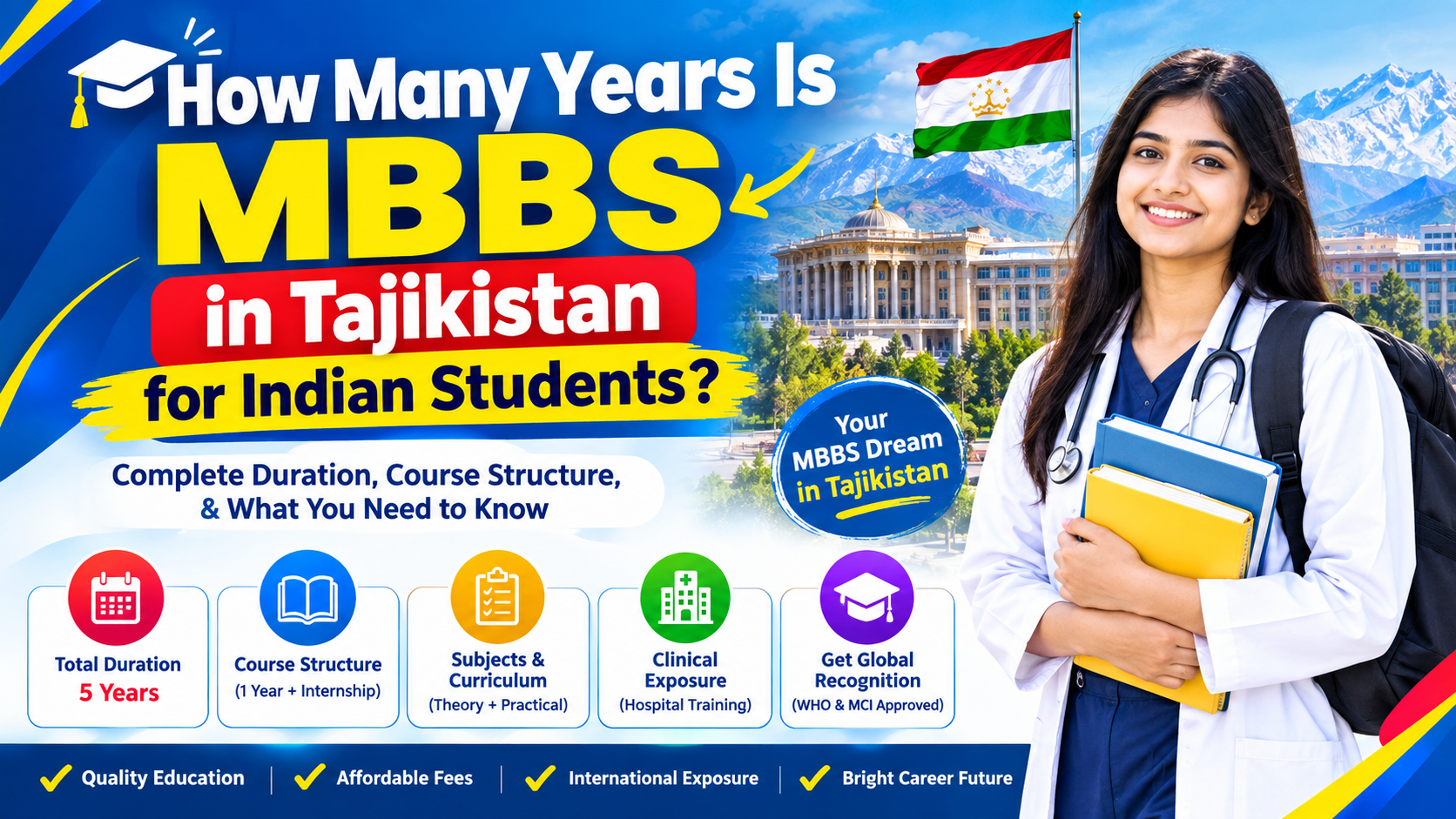
A student hears “six-year medical course” and assumes the calculation is simple: join university, study for six years, receive the degree, return to India. Not quite.For an Indian student, the duration of MBBS in Tajikistan needs to be understood in two different ways. First, how long you actually study and complete the required internship in Tajikistan. Second, how much additional time may be required after returning to India before you can obtain registration and start practising.The commonly advertised duration is around 6 years, generally covering academic medical education plus the required internship or clinical training structure. But there is a detail that matters much more than the number printed in a university brochure: the course must satisfy the applicable National Medical Commission requirements if your eventual plan is medical registration in India. Under the FMGL framework applicable to students admitted after 18 November 2021, NMC requires at least 54 months of medical education and a 12-month internship in the same foreign medical institution, among other conditions.So yes, six years is the short answer. The useful answer needs a little more explanation.
What Is the Actual Duration of MBBS in Tajikistan?
Start with the basic calculation. For Indian students planning MBBS in Tajikistan, you should look for a medical program structured to meet at least 54 months of study plus 12 months of internship, rather than trusting a vague “5-year” or “6-year” advertisement.That distinction isn't paperwork trivia.The NMC's Foreign Medical Graduate Licentiate Regulations specify a minimum 54-month medical course and a minimum 12-month internship at the same foreign medical institution. The internship is separate from the clinical postings and practical training included during those 54 months.
A simple way to understand it:
|
Component |
Expected Duration |
|
Academic medical education |
Minimum 54 months |
|
Internship in foreign institution |
Minimum 12 months |
|
Total foreign medical education pathway |
At least 66 months under NMC framework |
|
Indian CRMI for applicable FMGs |
12 months |
|
Licensing/screening requirement |
Depends on applicable Indian rules |
This is exactly why students shouldn't choose a university just because an agent says, “Course six years ka hai.” The structure inside those years matters.
And frankly, this is where many families make their first mistake.
Why Do Some Websites Say 5 Years and Others Say 6 Years?
Different universities, countries and admission portals sometimes describe medical course duration differently. One may count only classroom and clinical study. Another includes an internship. Someone else may use “MBBS duration” as a convenient marketing label for the entire program.Don't rely on that label.Before taking admission, ask the university for written confirmation of the exact academic duration, internship duration, medium of instruction, clinical-training location and licensing eligibility in Tajikistan. NMC has specifically warned students studying medicine abroad to check course duration, curriculum, clinical training, internship arrangements and medium of instruction before admission.For an Indian student, therefore, the better question isn't simply “Is this a six-year course?”Ask this instead: Does this exact program satisfy every current NMC requirement applicable to my admission batch?A much safer question.
How Are the Medical Years Usually Structured?
The early part of medical education is generally dominated by basic and pre-clinical subjects, while later years move toward clinical subjects, hospital exposure and patient-based learning. The exact semester allocation can differ by university, so don't assume every Tajik medical school follows an identical year-wise timetable.Broadly, students can expect subjects around Anatomy, Physiology, Biochemistry and related foundational sciences first, followed later by areas such as Pathology, Pharmacology, Microbiology, Medicine, Surgery, Paediatrics, Obstetrics and Gynaecology and other clinical disciplines.Clinical exposure becomes especially important in the later stages. And not just for passing university examinations.NMC regulations require the foreign course to cover prescribed subjects and clinical training comparable to Indian undergraduate medical education requirements. They also require the entire course, training and internship/clerkship to be completed in the same foreign medical institution and country under the applicable framework.
So a university offering an attractive fee but weak or unclear hospital training deserves a second look. Cheap isn't automatically bad. But cheap plus unclear clinical arrangements? That's different.
Is the Internship Included in the Tajikistan MBBS Duration?
Here's the part students should read twice.For Indian students governed by the current FMGL regulations, the foreign medical pathway must include at least 12 months of internship in the same foreign medical institution where the primary medical qualification is obtained. This internship comes in addition to the minimum 54-month medical course.The internship should involve hands-on clinical training across relevant medical disciplines. Simply completing theory semesters and returning to India without satisfying the foreign internship requirement can create serious registration problems later.Honestly, this doesn't get discussed enough during admission counselling.Ask the university to explain exactly where the internship takes place, whether international students are permitted meaningful clinical participation, what language is used with patients and whether the internship forms part of the qualification/licensing pathway for local graduates.Get those answers before paying. Not after fifth year.
What Happens After Completing the Medical Degree?
Finishing university abroad doesn't automatically give an Indian citizen unrestricted permission to practise medicine in India.Foreign medical graduates have to meet the registration rules applicable to their batch. Under the FMGL framework, graduates must satisfy requirements concerning course duration, internship, curriculum, English-medium instruction, local registration/licensing eligibility and the prescribed screening or licensing examination.There is another time component too.NMC's 2026 clarification states that students who took admission on or after 18 November 2021 and fall under the FMGL/CRMI framework are required to undergo one year of Compulsory Rotating Medical Internship in India after qualifying the applicable Foreign Medical Graduate Licentiate Examination.That means families shouldn't calculate the career timeline as only the number of years spent in Tajikistan.Foreign study. Internship. Licensing examination. Indian internship where applicable. Registration.That's the fuller picture.
FMGE or NExT: What Should Students Prepare For?
This area can change, so don't build a six-year plan around rumours circulating in student groups.NMC's FMGL FAQs state that foreign medical graduates must clear the National Exit Test or another test/tests mandated by NMC. Current students should therefore follow the latest official notification applicable at the time they graduate rather than assuming today's examination arrangement will remain unchanged several years later.Your university selection should prepare you for medicine itself — concepts, clinical reasoning, practical exposure and patient interaction — rather than merely promising “FMGE coaching.”An entrance consultant can disappear after admission. Your medical foundation won't.
Is NEET Required for MBBS in Tajikistan?
For Indian students intending to pursue an overseas medical qualification and later seek registration in India, NEET eligibility is a critical part of the process. Students should check the current eligibility rules and their result directly through the official NEET website rather than depending on screenshots or forwarded admission messages.NEET qualification isn't the same thing as getting a government MBBS seat in India. That confusion comes up surprisingly often.Your score may not be enough for your preferred Indian college, while still meeting the applicable qualifying requirement for pursuing medicine abroad. But qualifying NEET alone doesn't make every foreign university suitable. The university and program still need to satisfy the regulations relevant to future Indian registration.For admission planning, students generally need Class 10 and 12 records, a valid passport, NEET documentation, medical documents and other university/visa paperwork. The Tajikistan admission portal currently indicates a main application period around July-August, followed by visa processing and classes around September, although dates can change by university and intake.
What Eligibility Should Indian Students Check?
Eligibility looks simple on an admission poster. Real compliance has more layers.Students will generally need Physics, Chemistry, Biology/Biotechnology and English at the qualifying-school level as required under the applicable Indian eligibility framework, along with NEET qualification and the university's own admission conditions. Age and document requirements must also be checked for the particular admission year.But don't stop there.
Before enrolling for MBBS in Tajikistan, verify these points directly:
- Exact duration of academic study
- Minimum 12-month foreign internship arrangement
- English as the medium of instruction
- Full clinical training in Tajikistan
- No split-country clinical or internship arrangement
- Subjects matching applicable NMC requirements
- Eligibility for registration/licensing in Tajikistan on terms required by NMC
- University and medical program details in World Directory of Medical Schools
- Current NMC regulations for your admission batch
One warning here: a medical school appearing in WDOMS doesn't, by itself, mean that NMC has “approved” that particular course for every Indian student. For example, WDOMS currently lists Avicenna Tajik State Medical University in Dushanbe as an operational public medical school offering General Medicine programs.Directory listing and Indian registration eligibility are two separate checks.
How Much Can Six Years in Tajikistan Cost?
Duration and cost go together. A family shouldn't calculate tuition for the first year and multiply blindly.Recent estimates for MBBS in Tajikistan put tuition broadly around ₹2.5 lakh to ₹4.5 lakh per year, while hostel/accommodation may fall around ₹40,000 to ₹1 lakh annually and food/personal expenses around ₹60,000 to ₹1.2 lakh. Visa, registration, insurance, flights, books and miscellaneous university expenses add more. These are approximate figures, not guaranteed university quotations.One current published fee table, for example, lists Tajik National University's medical tuition around US$3,800 per year and Avicenna Tajik State Medical University around US$4,500 per year, with accommodation varying separately.Exchange rates move. University charges change too.For that reason, a realistic annual budget can sit around ₹4-7 lakh, depending heavily on the university, accommodation, lifestyle, airfare and currency movement.Students comparing universities can check updated admission and cost information through MBBS in Tajikistan, but final fees should still be confirmed directly with the university before payment.
Hidden Costs Become Bigger Over a Long Medical Course
Six years is long enough for small annual expenses to become a serious number.Suppose personal expenses exceed your original estimate by ₹5,000 per month. That doesn't sound dramatic. Over several years, though, it adds up quickly. Add annual flights to India, winter clothing, residence registration, medical insurance, books, local transport, mobile plans, food outside the hostel and examination-related charges.Then there is currency fluctuation.A tuition fee quoted in US dollars may remain unchanged while its rupee equivalent rises. Families planning MBBS in Tajikistan should therefore keep a buffer rather than arranging exactly the amount shown in an admission quotation.A 10-15% contingency fund isn't unreasonable for a multi-year overseas course.
Does WHO Recognition Decide Whether the Degree Is Valid in India?
This phrase — “WHO-approved university” — gets used far too casually.The World Health Organization is an international public-health body. Students should not treat a vague “WHO approved” claim as proof that a foreign medical degree automatically qualifies them for Indian registration.For practical university verification, check the medical school and program through WDOMS, examine the university's official documentation, and then compare the course against NMC's requirements.The last part matters most for an Indian student.A brochure logo doesn't decide your registration eligibility. Regulations do.
Is Studying Medicine in Tajikistan Worth Six Years?
That depends on what you're comparing it with.The attraction is fairly obvious. Tuition can be considerably lower than at many expensive private medical options, and students can pursue medical education overseas without the extremely high budgets associated with some destinations. Dushanbe also has established institutions such as Avicenna Tajik State Medical University.But there are trade-offs. Students may need to learn enough local language for patient interaction, adapt to a different academic system, live away from family for years and prepare seriously for India's licensing pathway.And six years abroad isn't a holiday.You will spend birthdays there. Festivals too. There will be difficult exams, unfamiliar food days, freezing mornings, clinical postings where communication initially feels awkward. That side rarely fits into a glossy admission reel.For a disciplined student at the right university, the route can make sense. For someone choosing only because the first-year fee looks cheap, maybe not.
How Can You Avoid Losing an Extra Year?
Most delays aren't planned. Failed subjects, document issues, incomplete clinical requirements or an internship that doesn't meet regulatory standards can stretch the timeline.NMC's rules also state that the foreign medical course must be completed within 10 years from the date of joining.The better approach is boring but effective: verify everything early.Keep semester transcripts and clinical records. Maintain internship documentation. Don't ignore attendance. Start licensing-exam preparation alongside university studies rather than after graduation. Most importantly, don't transfer institutions, countries or clinical-training locations based on someone's verbal assurance without checking the regulatory consequences first.
One bad shortcut can cost more time than it saves.
FAQs About MBBS Duration in Tajikistan
Is MBBS in Tajikistan 5 years or 6 years?
Students will commonly see programs described around the six-year range, but Indian students shouldn't select a course purely by that label. Under the NMC FMGL framework, the relevant foreign medical education must include at least 54 months of study plus a separate 12-month internship at the same foreign medical institution. Always obtain the exact structure from the university in writing.
Is a one-year internship compulsory after studying in Tajikistan?
Yes, for students governed by the FMGL 2021 framework, NMC requires a minimum 12-month internship in the same foreign medical institution in addition to the minimum 54-month course. Applicable FMGs also have an Indian CRMI requirement under current rules.
Can I return to India immediately after completing my academic classes?
You can physically return, obviously, but don't confuse completing classroom semesters with satisfying the requirements for Indian medical registration. Your foreign internship, degree, licensing eligibility, prescribed examination and Indian internship requirements must be handled according to the rules applicable to your batch.
Is NEET compulsory before taking admission?
Indian students planning to obtain a foreign medical qualification and subsequently seek medical registration in India should satisfy the applicable NEET requirement before admission. Check the latest year's eligibility conditions directly on the official NEET and NMC portals rather than relying on old admission guidelines.
Can I complete the Tajikistan internship in India?
Under the FMGL requirements for applicable students, the required foreign internship must be completed at the same foreign medical institution. NMC specifically distinguishes this foreign internship from the supervised internship/CRMI subsequently required in India.
So how much time should an Indian student realistically plan?
Don't plan only around the advertised university duration. Budget for at least 54 months of medical education plus 12 months of foreign internship, followed by the applicable licensing examination process and the required Indian internship under current rules. Examination schedules, results and individual progress can affect the final timeline.
Conclusion
The question “How many years is MBBS in Tajikistan?” sounds simple. The answer isn't complicated, but it needs to be understood correctly.For an Indian student, the safer benchmark under the current NMC framework is minimum 54 months of medical education plus a 12-month internship in the same foreign institution. After returning home, applicable graduates must also complete India's licensing and internship requirements before registration. That makes the overall journey longer than the number printed beside “course duration” on an admission brochure.So while comparing universities for MBBS in Tajikistan , don't start with “Which one is cheapest?” Start with duration, internship, clinical training, English-medium instruction, local licensing eligibility and NMC compliance. Then compare fees.That order can save you a lot of trouble later.