
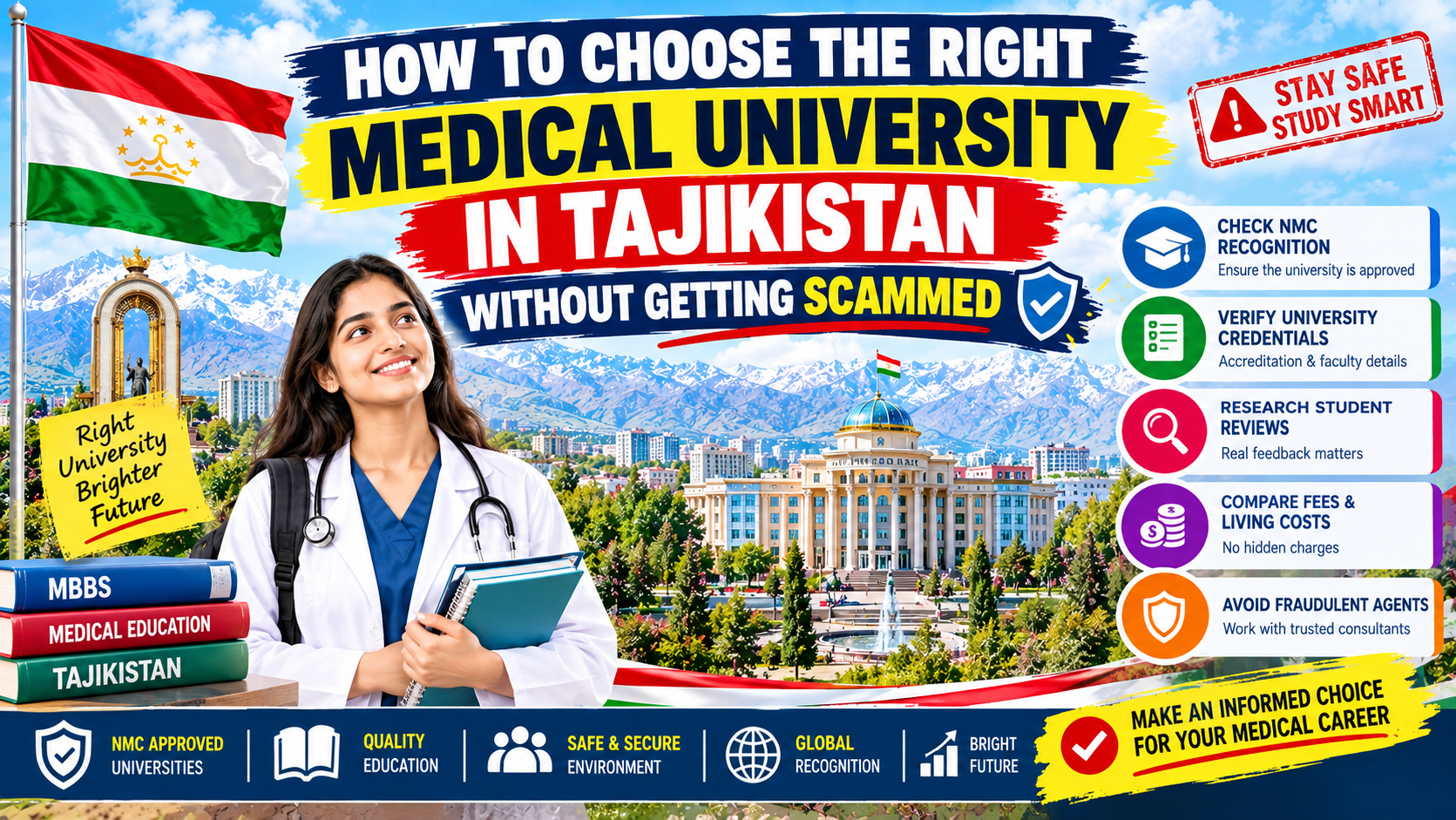
Choosing a medical university abroad sounds simple until the calls start. One consultant says, “This is the best university.” Another promises guaranteed admission, an unbelievable scholarship, no entrance issues, and sometimes even a “100% FMGE result.” Then comes the pressure — pay the booking amount today or the seat will disappear. That’s exactly where students need to slow down. MBBS in Tajikistan can be a practical option for Indian students looking for comparatively affordable medical education, but choosing the wrong university, or worse, dealing with the wrong intermediary, can create problems that continue for years. A genuine university choice should be based on recognition, course structure, clinical training, medium of instruction, total cost and eligibility for medical registration in India. Not WhatsApp promises. Students should independently verify information through official sources such as the National Medical Commission and university documents before paying anything. A little checking before admission can save lakhs of rupees later.
First Rule: Don't Choose a University Just Because Someone Says It Is “NMC Approved”
Here is where many students get confused. Consultants often use phrases such as “NMC-approved university,” “MCI-approved college,” or “100% valid in India” because they sound reassuring. But Indian students need to understand the actual rules applicable to foreign medical graduates rather than relying on a label printed on a brochure. Check the latest Foreign Medical Graduate regulations and notices directly through the National Medical Commission. The foreign medical programme should satisfy the applicable requirements regarding course duration, internship or clinical training, medium of instruction, subjects studied and eligibility for professional registration/licensure in the country where the degree is awarded. Rules can change, so verify the current version before admission. Seriously. A university being popular among Indian students doesn't automatically prove that its programme meets every requirement applicable to your batch.
Check the University on WDOMS Yourself
Don't ask an agent to send you a screenshot. Open the source yourself. The World Directory of Medical Schools is one of the first places students should check while researching a medical school abroad. Search the exact official university or medical-school name and carefully read its listing. Names matter because similarly named institutions, faculties and branches can cause confusion. Also remember one crucial point: a WDOMS listing by itself isn't an endorsement, accreditation certificate or guarantee that a graduate will automatically be eligible to practise in India. Treat it as one verification step, not the entire verification process. If a counsellor refuses to give you the exact official university name before collecting money, that's already a reason to be cautious.
WHO Mentioned? Understand What That Actually Means
You may hear the phrase “WHO recognised” repeatedly during counselling. It sounds impressive. But don't stop there. The World Health Organization should not be treated as a shortcut for determining whether a particular foreign MBBS programme satisfies Indian licensing requirements. Students should verify the university, the relevant national accreditation or regulatory position in Tajikistan, and Indian regulations separately. Honestly, this is where marketing language often creates more confusion than clarity. If someone is using a WHO logo on a brochure as the main reason you should pay a deposit, ask for the actual regulatory basis behind the claim.
NEET Qualification Still Matters for Indian Students
“Can I go without NEET?” is one of the most common questions. If you're an Indian citizen or OCI intending to obtain a primary medical qualification abroad and later pursue the Indian registration route, don't assume foreign admission means NEET can simply be ignored. Check the latest eligibility rules and your result through the official NEET website and NMC notifications applicable to your admission year. The qualifying percentile and corresponding marks can change from one examination cycle to another, so don't trust an old cutoff screenshot. A consultant offering “MBBS abroad without NEET, valid for India” should immediately trigger further verification.
Compare the Course Structure, Not Just the University Name
A famous name isn't enough. What exactly will you study? Students considering MBBS in Tajikistan should obtain the written curriculum before paying the first major instalment and check the total academic and clinical duration, internship arrangement, teaching language, hospital rotations and licensing eligibility in the country of study. For Indian students, compliance with the current NMC framework matters much more than a colourful ranking graphic. Ask the university whether the complete medical programme and required clinical training are delivered in the same country and how the internship is structured. Ask another question too: after completing the degree, are local graduates eligible for the licence or registration pathway required to practise medicine there? Get the answer in writing where possible.
A Cheap Fee Quote Can Become Expensive Very Quickly
This happens all the time. A student hears “MBBS for ₹15 lakh” and assumes ₹15 lakh is the complete budget. Usually, it isn't that simple. Tuition is only one part of the calculation. Depending on the university, city, exchange rate and accommodation arrangement, students may also pay hostel charges, food, medical insurance, visa or registration-related expenses, residence documentation, books, local transport, university administrative charges and airfare. Consultancy or service charges can add another layer. For MBBS in Tajikistan, published tuition and hostel amounts vary by institution and intake, so rather than trusting a single generic figure, request the latest official fee letter for your chosen university. As a planning estimate, students should keep a buffer beyond the quoted tuition because currency conversion and living expenses won't remain perfectly fixed for the entire course.
|
Cost Head |
What You Should Verify |
|
Tuition fee |
Official annual fee and whether it can change |
|
Hostel |
Annual charge, room sharing and compulsory duration |
|
Food |
Included or separate |
|
Insurance |
Annual or one-time |
|
Visa/residence formalities |
Who pays and how often |
|
University registration |
Included in tuition or additional |
|
Airfare |
Usually separate |
|
Consultancy/service fee |
Exact amount and refund terms |
|
Clinical/internship charges |
Whether any additional payment applies |
Get the complete year-wise cost sheet. Not just the first-year offer.
Look Closely at Clinical Exposure
Here’s a question students sometimes ask too late: “Which hospital will I actually train in?” A medical degree isn't only lectures, PowerPoint slides and anatomy labs. Clinical exposure matters enormously. Before selecting a university, find out which teaching hospitals are formally associated with it, when bedside clinical training begins, approximately how much patient exposure students receive and whether international students participate properly in clinical rotations. Language matters here too. Even if classroom instruction is advertised as English-medium, patients in hospitals may primarily communicate in Tajik or Russian. Ask current senior students how they manage patient interaction. Their answers are usually far more useful than a promotional video.
English-Medium Claims Need Verification
“100% English medium.” Easy sentence to print. Harder to verify. Ask for an official letter or programme information confirming the medium of instruction for the full medical course. Then speak independently with students from second, third, fourth and later years. Why different years? Because first-year students may only know classroom teaching; senior students can tell you what happens during clinical subjects and hospital rotations. If lectures are technically in English but major explanations, examinations or practical teaching routinely shift to another language, you should know before joining.
Talk to Current Indian Students — Without the Consultant Sitting There
This one is simple and surprisingly effective. Ask for contact details of several Indian students already studying at the university, but don't depend exclusively on contacts selected by an admission agency. Search student communities and alumni independently as well. Ask practical questions: Did your fee increase? Is the hostel actually available? Are classes conducted regularly? How many Indian students are there? What happens during hospital rotations? Are there unexpected annual charges? How responsive is the university administration? Would you choose the same university again? That final question can reveal a lot. Students researching MBBS in Tajikistan should compare multiple universities rather than allowing one counsellor to make the entire decision for them.
Never Transfer University Fees to a Random Personal Account
Yahan—well, this is the point where maximum caution is needed. If someone asks you to transfer several lakh rupees to an individual's savings account and says, “Don't worry, we'll adjust it with the university later,” stop. Ask why. Ideally, tuition payments should follow the university's officially documented payment procedure. Verify beneficiary name, bank details, invoice, amount, payment purpose and refund terms before transferring money. If an authorised representative is legitimately collecting a service fee, that should also be supported by proper documentation and a receipt. Cash without paperwork? Avoid it.
Admission Letter vs Offer Letter: Read Every Line
An impressive PDF isn't automatically genuine. Fraudulent or misleading admission documents can contain copied logos, unofficial email addresses, incorrect programme names or payment instructions unrelated to the institution. Once you receive an offer or admission document, contact the university through contact information independently obtained from its official channel and confirm your application or admission status. Check your full name, passport details, programme, academic year, tuition amount, campus and issuing authority. Don't verify a document by calling the same person who originally sent it. That proves almost nothing.
Watch for These Scam Red Flags
Some warning signs are obvious once you know what to look for:
- “Guaranteed FMGE/NExT pass.”
- “Pay today or your seat is permanently gone.”
- Refusal to provide an official university fee document.
- Payment requested only through a personal bank account.
- No written refund policy.
- Different university names on receipt and admission letter.
- Claims that NEET or Indian regulations “don't matter.”
- Refusal to connect you with current students.
- Huge scholarship promised verbally but absent from official documents.
- “NMC approved” used without explaining the actual applicable regulations.
- Passport requested without explaining why it is needed.
- Hostel, food and insurance described as “free” without written confirmation.
One red flag may have an explanation. Four or five together? Walk away.
Don't Select a University Only by FMGE Numbers
FMGE performance deserves attention, but it shouldn't become the sole university-selection criterion. Results can vary substantially between batches and depend on student preparation, curriculum quality, clinical exposure and many other factors. If an agency advertises an unusually high FMGE percentage, ask for the source and the exact examination period. Students planning MBBS in Tajikistan should also remember that India's foreign-graduate licensing framework can change during a multi-year medical course. Follow official NMC announcements rather than assuming the examination pathway at admission will necessarily remain unchanged until graduation.
A Practical Verification Process Before Paying Anything
Do the checks in an order. First, confirm your NEET and Indian eligibility position. Second, identify the exact medical school and verify its WDOMS information. Third, study the current NMC requirements for foreign medical graduates. Fourth, obtain the official curriculum, duration, internship structure and medium-of-instruction details. Fifth, request the complete fee sheet and refund policy. Sixth, verify teaching hospitals and speak with existing students independently. Seventh, confirm the admission letter directly with the institution. Only after these checks should a major payment be considered. It may take two or three extra days. Take them. An MBBS degree is a six-year-scale decision, not an online flash sale.
Pros and Cons of Studying MBBS in Tajikistan
The attraction is understandable. MBBS in Tajikistan may offer comparatively manageable tuition, international exposure and an alternative for students who cannot secure a suitable medical seat in India. Some students may also find the overall living budget manageable compared with more expensive study destinations. But there are trade-offs: adapting to a new country, local language requirements during patient interaction, weather and food adjustment, variable university quality, licensing requirements and the need to prepare seriously for the pathway required to practise in India. The country isn't automatically “good” or “bad” for MBBS. The specific university and programme matter much more.
FAQs
Is MBBS in Tajikistan valid in India?
A foreign medical degree does not become automatically valid for independent medical practice in India simply because a student has completed it. Indian graduates of foreign medical programmes need to satisfy the NMC rules, eligibility conditions, registration requirements and applicable licensing examination pathway in force for them. Check the NMC before admission and keep checking during your course.
How can I check whether a Tajikistan medical university is genuine?
Start by checking the institution's official information, its status with the relevant authorities in Tajikistan and its entry in WDOMS. Then independently confirm the curriculum, teaching hospital, programme duration, medium of instruction and local licensure eligibility. Don't use a consultant's brochure as your primary evidence.
How much does MBBS in Tajikistan cost?
There isn't one universal fee. Tuition, hostel and living costs vary by institution, city, intake and exchange rate. Ask for an official university-wise fee sheet and calculate the complete course budget rather than multiplying an advertised first-year fee. For current university information and comparisons, students can also research MBBS in Tajikistan before shortlisting.
Is NEET compulsory for Indian students going to Tajikistan?
Students who intend to follow the Indian registration pathway after obtaining their primary medical qualification abroad should verify the current NEET eligibility requirements applicable to their admission year. Use the official NEET portal and NMC regulations rather than relying on verbal assurances from an admission representative.
Can a consultant guarantee that I will clear FMGE or NExT?
No legitimate consultant can guarantee your future examination result. Exam performance depends on preparation and many academic factors. Also, the applicable licensing framework may change, so follow official NMC notifications throughout your medical education.
What should I verify immediately before paying the university fee?
Confirm the admission letter, official beneficiary account, exact tuition amount, refund terms, university identity, programme structure and your eligibility under current Indian rules. Save invoices, receipts, emails and payment confirmations. Everything. You'll be glad you did if any disagreement appears later.
Conclusion
The safest way to choose MBBS in Tajikistan isn't finding the consultant with the biggest promises. It is removing uncertainty one document at a time. Verify the medical school, check WDOMS, read current NMC regulations, understand NEET eligibility, examine clinical training, calculate the full cost and speak privately with students already studying there. Most importantly, don't allow “last seat” pressure to rush a six-year career decision. A genuine university and a genuine admission process should survive basic verification. Before finalising your shortlist, compare current university options, fees and admission information through MBBS in Tajikistan and cross-check every regulatory claim against official sources.