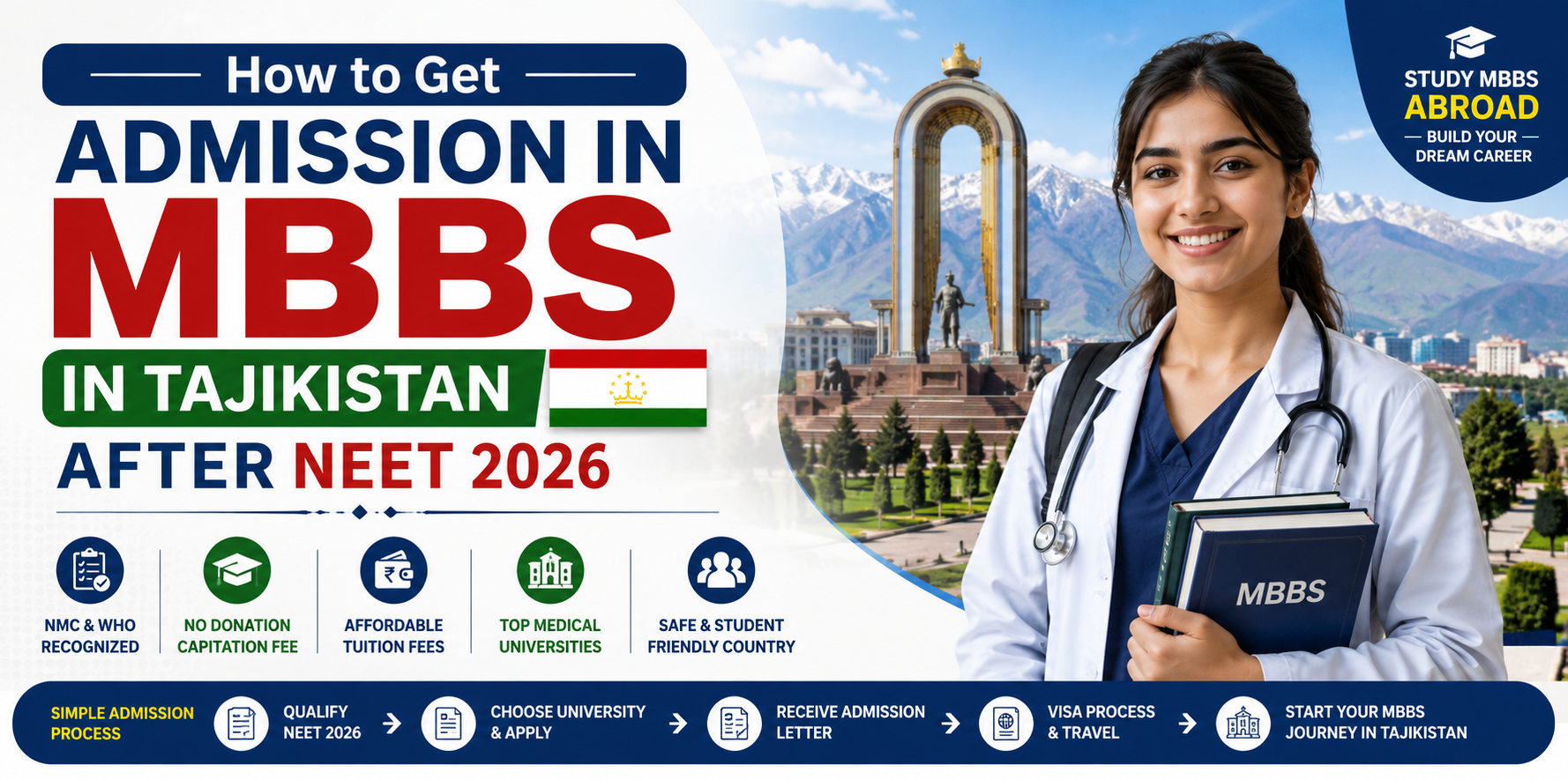
Determining which medical school to attend is one of the most important decisions on the path to becoming a doctor. For many Indian students, the most significant first step is to qualify the NEET exam, but obtaining a medical seat within India is extremely competitive. Because of this, many students are considering new countries with quality and cost-effective medical education. Tajikistan is one of the prime contenting countries.
Tajikistan is an attractive country for medical students because of its several quality universities, low tuition, and good modern pedagogy techniques. These coupled with its student friendly culture and environmental conditions, make it a ‘go to’ country for medical studies. Those students who qualify NEET 2026 now have an opportunity to apply for one of the medical courses in Tajikistan.
This guide provides all the information Indian students require regarding admission to MBBS in Tajikistan after NEET 2026.
Why Tajikistan for MBBS?
Tajikistan is an affordable country that has quality education. Medical universities in Tajikistan value practical learning, offer robust clinical exposure, and teaching of an international standard.
Among the many benefits, are:
- Medical education is affordable.
- English is the primary language of instruction.
- The teaching faculty are qualified and experienced.
- Modern research facilities and laboratories.
- Medical degrees are internationally recognized.
- Comfortable and safe hostels.
- The environment is student friendly and safe.
- Living costs lower than most other study abroad countries.
Students looking to study MBBS in Tajikistan can take advantage of medical MBBS programs offered at a fraction of the cost charged by universities in the West.
Is NEET 2026 Required for MBBS in Tajikistan?
Yes, the NEET exam is compulsory for Indian students wishing to study MBBS in foreign countries, and who intend to practice in India.
The National Medical Commission (NMC) stipulates that Indian students must clear the NEET exam if they are planning to study at any foreign medical college. NEET is considered proof of the eligibility to study medicine and is also required for licensing in India.
Students must also have a valid NEET score, even if the medical college in Tajikistan has no entrance exam.
Eligibility Criteria for Admission
Before students start applying, they need to check whether they meet all the basic eligibility requirements.
Academic Requirements
Students need to have the following:
Subjects in Higher Secondary School:
- Physics
- Chemistry
- Biology
- English
Minimum Marks:
- General: 50% in PCB
- Reserved: 40% in PCB
Age Criteria
Students must be 17, or turning 17 by 31st December 2026.
NEET Qualification
Students must have qualified NEET 2026.
If students meet all these requirements, they are eligible to apply for MBBS in Tajikistan for Indian Students.
Step 1: Shortlist Approved Medical Universities
The first step for students after qualifying NEET is to select an approved medical university.
Students should assess the following:
- Recognition status
- Academic reputation
- Infrastructure
- Faculty qualification
- Clinical training
- Student support services
- Hostel services
- Tuition cost
It is crucial to check that the medical school is listed in the World Directory of Medical Schools (WDOMS).
WDOMS is a global tool that enables students to substantiate a medical school in any country. Choosing a medical school that is listed in the WDOMS is choosing a school that is clear and credible.
Step 2: Collect Important Documents
Having your documents ready early will help streamline the application process.
The documents you will need are:
- Class 10 Certificate
- Class 12 Certificate
- NEET 2026 Certificate
- Passport
- Passport size photographs
- Birth Certificate
- Medical Fitness Certificate
- Migration Certificate
It is important that all documents are presented clearly in both physical and digital formats.
Step 3: Submit Application
When all documents are ready, students can apply to their selected school.
The majority of schools have a thrust online application process in which students are required to:
- Fill the application form
- Upload respective academic documents
- Provide information on their passport
- Upload respective photographs
Once submitted, the school will evaluate the application for eligibility.
MBBS Admission in Tajikistan is a very competitive process, so all applicants are encouraged to review their information before submitting the application for the first time.
Step 4: Admission Acceptance
If the application has been successfully evaluated, an acceptance letter is issued.
This letter contains:
- Details of the student
- Details on the course
- Details of the school
- Details on the session
Being accepted for admission allows students to take the next step and apply for their visa and book their travel.
Step 5: Receive the Official Invitation Letter
After admission is granted, the university will issue an invitation letter.
Invitation letters act as official documents stating that the student has a purpose to travel and study.
They are generally written after the university has verified enrollment and checked that all records have been submitted.
Students should keep this document in both digital and hard copies.
Step 6: Apply for the Student Visa
The next step is applying for the student visa.
The components of the student visa application generally include:
- Passport
- Admission Letter
- Invitation Letter
- Passport Size Photos
- Visa Application Form
- Medical History
Students are encouraged to initiate the Visa application process early to avoid the Visa application backlog that occurs in the peak admission session.
Step 7: Pay the Required University Fees
After admission is granted, students are required to pay the tuition/enrollment fee.
Before payments are made:
- Confirm that the account details are for the official university account.
- Request the confirmation receipt for the payment.
- Keep copies of all payment receipts.
Many students that are researching the MBBS Tajikistan Fees find that the total cost of medical courses is lower in comparison to the private medical colleges in India.
Step 8: Make Travel Plans
Post Visa approval, students should make preparations for travel.
Some preparations include:
- Booking Flights
- Buying Foreign Currency
- Travel Insurance
- Hostel Preparation
- Travel Documents
Students should also prepare for the laws and customs of the region, as well as the weather and university rules and policies in Tajikistan.
Step 9: Register Upon Arrival
When students arrive in Tajikistan, they are required to register at the University.
These may involve:
- Verification of passport
- Verification of visa
- Registration at hostel
- Medical Check-up
- Formalities of enrollment
Assistance is often available at this stage from the majority of universities for international students.
Step 10: Seek Medical Education
Once the above-mentioned formalities are completed, students are eligible to pursue their MBBS.
The subjects included in the program will be:
- Human Anatomy
- Physiology
- Biochemistry
- Pharmacology
- Pathology
- Microbiology
- Community Medicine
- Internal Medicine
- Surgery
- Pediatrics
Medical education builds several skills and competencies through professional training and clinical practice.
NMC Guidelines for Students Seeking Admission
There are several regulations established by the National Medical Commission (NMC) of India that students must familiarize themselves with if they are planning to practice in India.
The NMC has outlined regulations pertaining to:
- Course Duration
- Internship
- Clinical Training
- Eligibility for Licensing
- Foreign Medical Graduates
It is useful for students to understand the above-mentioned regulations prior to seeking admission to avoid complications related to Medical Licensing in India.
WDOMS Verification
When students are selecting a university, the most common focus is on the tuition fee. However, medical degree recognition is just as important.
The World Directory of Medical Schools (WDOMS) allows students to check if a particular medical university is listed in the international directory.
Verification through WDOMS ensures that the medical school is not only recognized, but is part of the global medical educational system.
WHO’s Role in Global Medical Education
During the process of searching for a medical school, students often come across references to the World Health Organization (WHO).
Since the WHO helps standardize medical care and research, and advances global public health, it is essential to future healthcare professionals. While assessing university recognition and licensing, a WHO-related healthcare resource will show how global healthcare and medical practices will evolve.
Integrating information from the WHO, WDOMS, and NMC gives students a better understanding of global medical education.
What Mistakes Should Be Avoided
There are several mistakes pertaining to the admission process students would do well to avoid:
- Not checking university recognition of university.
- Not following NMC.
- Applying at the last moment.
- Inadequate documentation.
- Payment through unauthorized means.
- Not fulfilling visa requirements.
- Not checking WDOMS.
The less of these mistakes the more secure admission will be.
Conclusion
The medical options that will be available following acquiring the NEET at the 2026 level, give ample opportunity to consider studying in Tajikistan. With reasonable fees and good medical education, Tajikistan is a good option for Indian students to qualify as a doctor.
Students intending to qualify as MBBS in Tajikistan must begin these plans early, NMC must be satisfied, university checking is mandatory against WDOMS, and WHO guidelines must be followed.
With the right plans, and right university, MBBS in Tajikistan may well be the start of a successful medical career.