There has been a noticeable increase in the number of students wishing to pursue MBBS abroad. One of the reasons is the fierce competition for seats in Indian government medical colleges. Among the many countries offered, Tajikistan is the top choice for many students because of the low-cost MBBS, high-quality education, medical universities with modern infrastructure, and recognition of medical degrees across the globe.
There is a trend of Indian students going for MBBS in Tajikistan as the country has a successful and affordable route to acquire a medical degree. International Country Standards for Education are met. Understanding the complete admission process, eligibility requirements, documentation, and visa procedures is important.
This guide provides all the information needed to pursue your MBBS in Tajikistan.
Why do Indian Students Prefer Tajikistan for MBBS?
There are many reasons Tajikistan is appealing to international medical students. Recognition of quality education in medical universities, modern medical education, and higher standards in medical curriculum and medical training are a few reasons. Indian students are ensured educational and cultural satisfaction with the English-speaking environment.
There are many advantages pursuing medical studies in Tajikistan; these are:
- Affordable tuition fees and living expenses
- Globally recognized medical degrees
- English-medium MBBS programs
- Safe environment for international students
- Indian food and hostel facilities
- Practical training opportunities
Explore all the benefits and opportunities for pursuing Medical Studies in Tajikistan; this country is a great balanced choice between quality education and affordability.
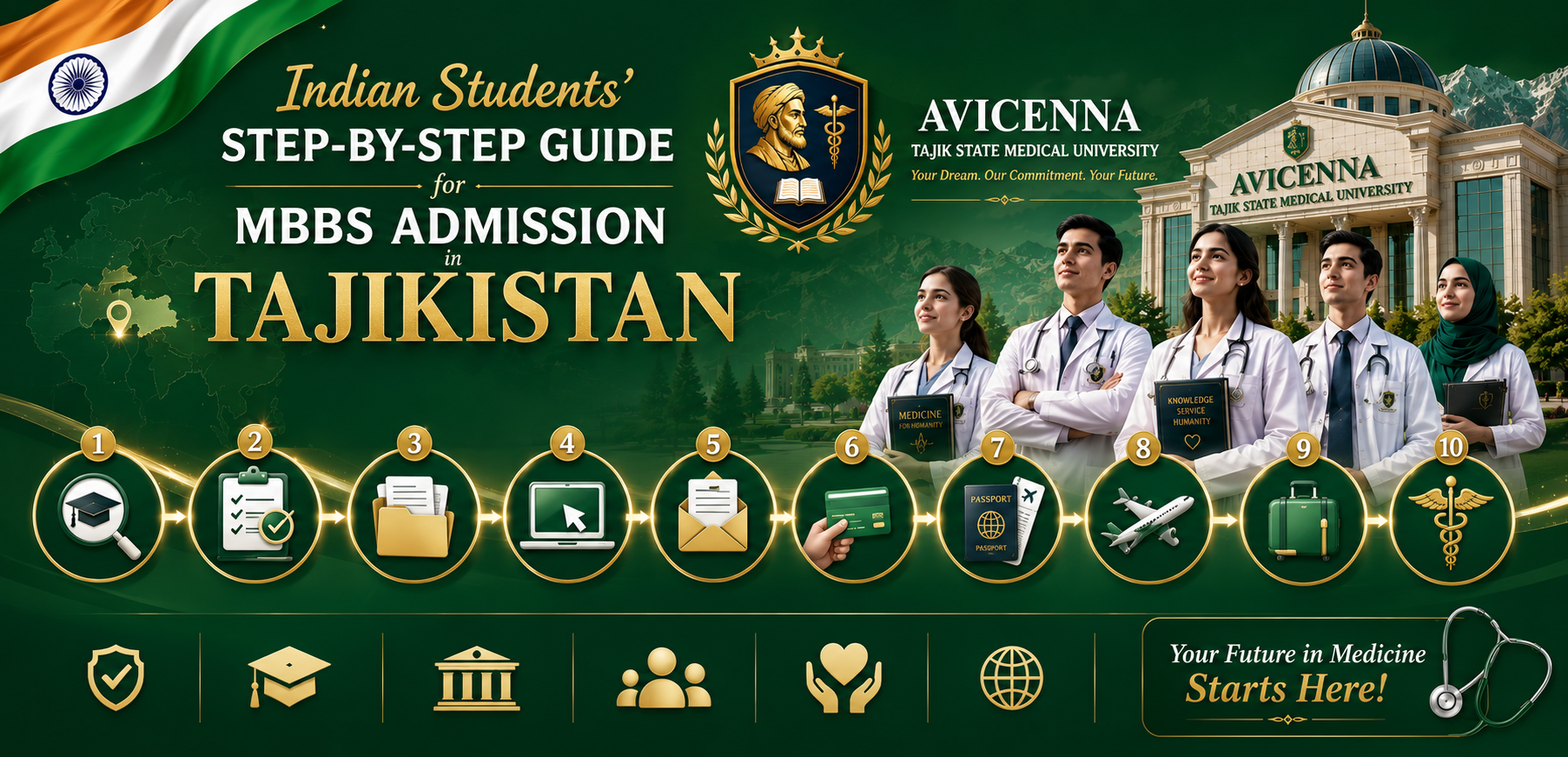
Step 1: Check Your Eligibility
Before anything else, ensure that you meet the eligibility criteria established by the government of India and the university for MBBS admissions in Tajikistan.
Academic Qualification
The minimum academic qualification for MBBS is higher secondary education or its equivalent (10+2) with the following subjects:
- Physics
- Chemistry
- Biology
- English
Generally, for General Category students, the minimum requirement is 50% in aggregate in the subjects of Physics, Chemistry and Biology. Reserved Category students are required to have a minimum of 40% in the same subjects.
Age Requirement
For those applying, the university requires you to be at least 17 years of age by 31st December of the year of admission.
NEET Qualification
As per the guidelines of the National Medical Commission (NMC), it is mandatory for Indian students to qualify the NEET examination.
Therefore, aspirants of MBBS in Tajikistan for Indian Students should ensure that they have undergone the NEET examination prior to applying for admissions.
Step 2: Research and Select the Right Medical University
One of the most critical decisions in your medical career is choosing the right university.
The following factors should be evaluated by students prior to applying:
- Recognition of the university
- Reputation and ranking
- Facilities and infrastructure
- Clinical training
- Hostels
- Fees
- Support services
- Assistance with FMGE/NExT
Before selecting a university, students should visit the World Directory of Medical Schools (WDOMS) and confirm the listing of the medical school.
The medical schools can be verified from the official website of the World Directory of Medical Schools.
Students can also refer to the National Medical Commission for the latest updates.
Selecting a recognized university helps ensure a smoother licensing process after graduation.
Step 3: Submit Your Application
Now that you have selected the university, the next step is to apply for admissions.
Application Process Includes
- The online application form.
- Educational documents.
- Passport details.
- Photographs.
Most universities in Tajikistan have an online admission process that is easy to complete from India.
Students wanting MBBS Admission in Tajikistan are expected to verify the information and steps.
Step 4: Gather the Documents
Documents are an essential component of university admission.
Students commonly require:
- 10th Marksheet
- 12th Marksheet
- NEET Scorecard
- Passport
- Passport-size Photographs
- Birth Certificate
- Medical Fitness Certificate
- Migration Certificate
- Admission Application Form
Documents should be clear and the latest. Attestation should be done carefully.
It is best to keep the documents in a good condition and to have other copies in a better condition.
Step 5: Admission Confirmation
Documents are checked by the university and eligible students are sent admission letters.
The admission letter contains:
- Student name
- Course details
- Name of the University
- Academic session
- Enrollment details
Students should check the admission letter for any errors and report them.
Step 6: Expect an Invitation Letter
University admission is confirmed after a letter is issued. The letter is the first step in the visa process.
Admission letters are an acceptance to travel and are verified by the government.
Step 7: Student Visa Application Process
The invitation letter starts the visa application process.
Required Documents
- Original Passport
- Admission Letter
- Invitation Letter
- Visa Application
- Photos
- Medical Certificate
- Proof of Funds
Students should start the process early to avoid any issues that come with waiting close to the start of classes.
Step 8: Pay the Initial University Fees
Before arriving at the university many schools require students to pay a part of their tuition.
Payment methods may include:
- International bank transfer
- Payment portal
- Authorized representatives
Students should check the receiving bank is the university's before making payments.
Many students compare MBBS in Tajikistan Fees before deciding on a university.
Step 9: Preparation for Travel
Visa approval means students are ready to purchase travel tickets and make other travel plans.
Some other travel arrangements include:
- Hotel bookings
- Travel Insurance
- Currency
Step 10: Arrival in Tajikistan
University representatives often assist international students with airport pickup and accommodation arrangements.
Students are required to complete:
- Passport Verification
- Visa Registration
- University Enrollment
- Hostel Registration
- Medical Examination
Step 11: Attend Orientation Programs
Most medical universities organize orientation sessions for newly admitted students.
Step 12: Beginning MBBS Course
Once students finish the paperwork, they can start their education.
The subjects offered include:
- Anatomy
- Physiology
- Biochemistry
- Pathology
- Pharmacology
- Microbiology
- Community Medicine
- Internal Medicine
- Surgery
- Pediatrics
- Obstetrics and Gynecology
Students learn via theory and practice through lectures and clinical training.
NMC Guidelines And Indian Students
It is essential for students to understand the new NMC guidelines before studying overseas.
NMC has specific guidelines on:
- Course length
- Clinical training
- Internship
- Eligibility to get a license
- Regulations for foreign medical graduates
The official NMC guidelines can be found on the NMC website.
Following these guidelines helps students have the opportunity to practice in India.
Why Be Listed in WDOMS
One of the first checks to see whether a university has international recognition should be looking for the university in the World Directory of Medical Schools.
WDOMS database is a means for students to find and verify medical schools.
The official webpage is the WDOMS website.
If a university is listed in WDOMS, they have a greater obligation to transparency regarding their medical programs.
WHO and Global Standards
Students also have the need to find universities that have a global standard of education.
The World Health Organization (WHO) is a major player in the global health care and medical services.
Students can find health care related topics and international medical services through WHO resources.
When students evaluate a university, they should always use the WHO reference, check WDOMS, and the NMC guidelines.
Common Mistakes to Avoid During Admission
Students should avoid making the following mistakes during the admission process:
- Conducting applications without NEET.
- Selecting universities that are not recognized.
- Not complying with NMC.
- Not submitting complete documents.
- Submitting visa applications late.
- Paying fees to illegal commissions.
- Not checking if the university is recognized.
If applicants plan better, the most complex parts of the admission process can be simplified.
Conclusion
Indian students have started looking to Tajikistan as a good option to get affordable and high-quality medical education. While the admission process is fairly simple, students should take all steps (i.e. check eligibility, choose a recognized university, apply for a visa, and enroll) seriously.
Students pursuing MBBS in Tajikistan should begin the initial process early, take and pass the NEET exam, check the recognition of the selected universities in WDOMS, and the guidelines of the NMC, to choose the university that best fits their needs.
Studying the MBBS in Tajikistan can be the beginning of a successful medical career with the right choices.