
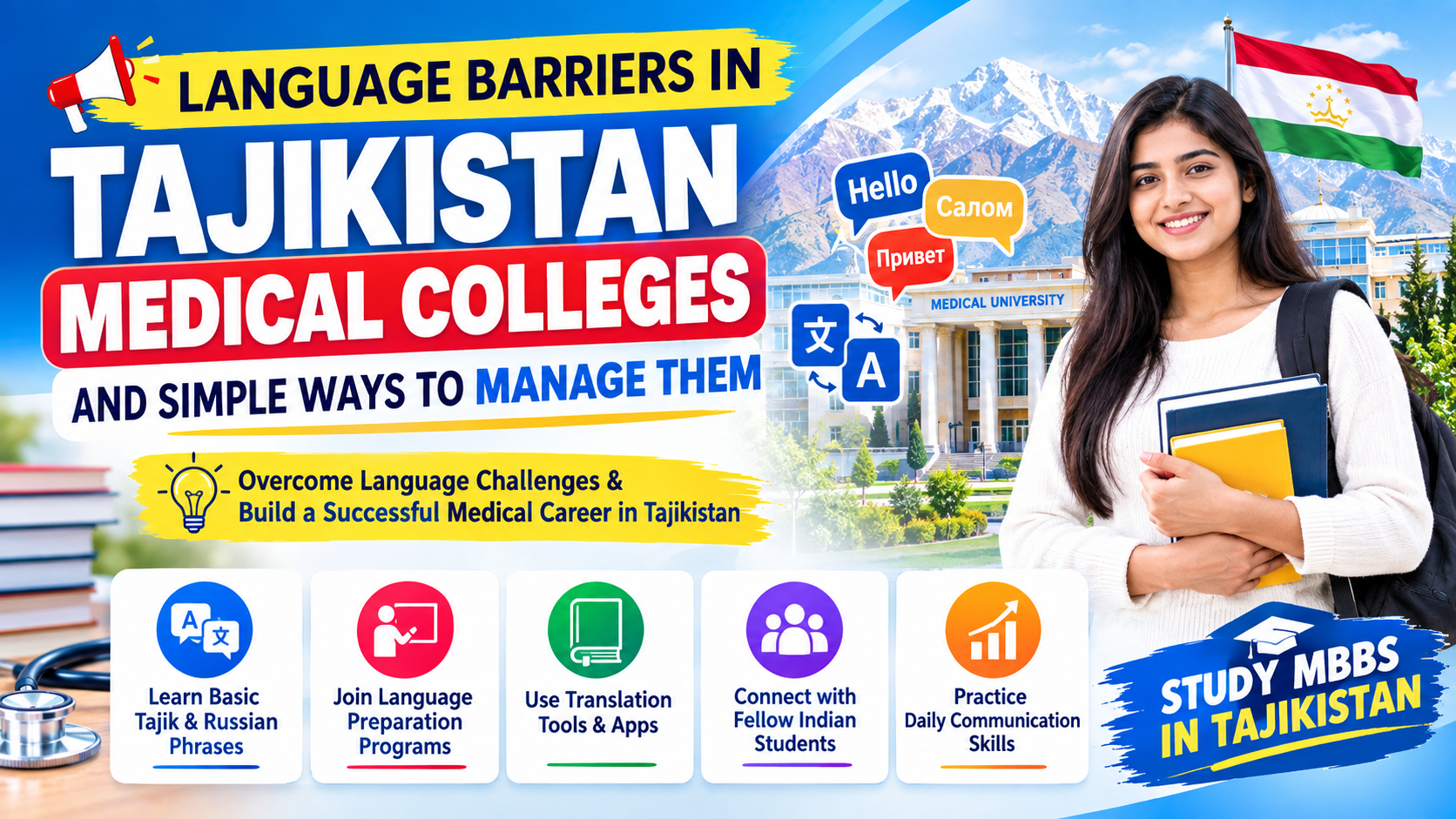
For an Indian student planning MBBS in Tajikistan, the first language-related question is usually simple: “If my medical course is taught in English, why should I learn Tajik or Russian at all?” Fair question. Inside a classroom, English may be enough at a suitable university. Outside that classroom, things change. A patient in a teaching hospital may explain symptoms in Tajik. A shopkeeper may be more comfortable with Tajik or Russian. Taxi drivers, hostel staff, elderly patients, local hospital workers—English proficiency can vary a lot. That doesn't mean language becomes a reason to reject Tajikistan. It simply means students should understand the difference between English-medium medical education and everyday communication before taking admission. Tajik is the state language of Tajikistan, while Russian is constitutionally recognized as the language of communication between nationalities. For Indian medical students, therefore, basic local-language ability isn't just about ordering food or finding an address. By the clinical years, it can directly affect patient interaction. Honestly, this part of studying abroad doesn't get discussed enough. The good news? You don't need to become fluent before boarding your flight. A practical vocabulary, regular exposure and some willingness to speak badly at first can take you surprisingly far.
What Language Is Actually Used in Tajikistan?
Here is the first thing to understand. Tajikistan isn't an English-speaking country, even if a university offers its medical program to international students in English. Tajik is the country's state language, while Russian remains an important language for communication between different nationalities. This creates a slightly unusual situation for Indian medical students. Your textbook might be English. Your lecture may be in English. Your professor may explain anatomy or pathology in English. Then you leave the university and suddenly the conversation around you changes to Tajik or Russian. That's where the adjustment begins. Students researching MBBS in Tajikistan should therefore ask the university specifically about the language of lectures, practical sessions, examinations and clinical training rather than assuming that “English-medium” covers every interaction throughout the degree.
Is MBBS in Tajikistan Really Taught in English?
“English-medium” sounds straightforward. In practice, students should verify exactly what a particular university means by it before paying the first-year fee. For an Indian student who eventually wants registration to practise medicine in India, this isn't a minor admission detail either. The National Medical Commission states under its Foreign Medical Graduate Licentiate framework that the medium of instruction for the foreign medical course must be English. Its published FAQ also specifies a minimum course duration of 54 months and English as the required medium of instruction. So don't depend only on a consultant's brochure or a WhatsApp message saying “100% English medium.” Ask for written confirmation from the university. Check the curriculum. Ask whether theory classes, internal assessments, examinations, practical instruction and academic materials are provided in English. Yahan—well, this is exactly where students need to be careful: a university offering some English classes isn't automatically the same thing as a fully compliant English-medium medical program.
Where Does the Real Language Problem Start?
Surprisingly, usually not in first-year anatomy. Early medical education is heavily classroom and laboratory based, so students can often function comfortably if their teachers communicate properly in English. The real challenge becomes more visible during hospital postings. Imagine taking the history of a 65-year-old patient who speaks Tajik while you're trying to ask about chest pain, duration, radiation, breathing difficulty and previous medication. Medical history isn't a yes-or-no conversation. Patients describe sensations, habits, fears and timelines. Sometimes in long stories. If you understand none of it, another person has to translate, and that isn't ideal for developing independent clinical communication skills. This is why students choosing MBBS in Tajikistan should treat basic Tajik or Russian as a clinical skill rather than an unwanted extra subject.
The Three Language Barriers Indian Students Usually Face
The problem isn't one single “language barrier.” It normally appears in three different places, and each one needs a slightly different approach.
|
Situation |
Likely Language Challenge |
Difficulty for a New Student |
Practical Solution |
|
University lectures |
Understanding accents or occasional local terms |
Low to moderate |
Clarify with faculty, record notes where permitted |
|
Hostel and daily life |
Tajik/Russian conversations |
Moderate initially |
Learn everyday phrases |
|
Hospital rotations |
Communicating with local patients |
Moderate to high |
Build medical vocabulary early |
|
Markets and transport |
Limited English communication |
Moderate |
Translation app + basic phrases |
|
Administrative work |
Forms or local instructions |
Moderate |
Ask international student office |
|
Patient history-taking |
Symptoms described in local language |
High initially |
Practise clinical phrases repeatedly |
The important bit: these problems don't all arrive on day one. Students generally get time to adjust, which makes the situation much more manageable than it may sound from India.
Start Learning Before Clinical Rotations, Not During Them
A small observation from international medical education—students often wait until they need the local language. Too late. The better approach is boring but effective: start with 10–15 minutes every day from the first semester. You don't need poetry, advanced grammar or perfect pronunciation. Learn numbers, directions, food names, common greetings and everyday questions first. Then slowly add medical vocabulary: pain, fever, cough, vomiting, breathing, blood, medicine, allergy, yesterday, today, morning, night, left, right, chest, abdomen and so on. After that, practise complete clinical questions. “Where does it hurt?” is far more useful to a medical student than memorising 40 random nouns. Tiny progress. Daily. That's enough.
Use Your Hospital Posting as a Language Classroom
This sounds uncomfortable at first, but it works. During clinical exposure, listen carefully to how local doctors ask common questions. Write down frequently repeated words. Ask a local classmate what a patient's phrase means. Then use that phrase yourself next time. You'll make mistakes. Obviously. Patients aren't expecting an international student to speak like a native Tajik speaker, and the goal isn't linguistic perfection anyway. The goal is functional communication. For students pursuing MBBS in Tajikistan, this habit has another benefit: clinical terminology becomes connected to an actual patient rather than remaining a memorised word from an app.
Make a Personal “Medical Language Notebook”
Not another giant textbook. Please. Keep one small notebook or digital note with only the expressions you actually need in hospitals. Divide it into sections such as patient introduction, symptoms, pain history, past illness, medications, allergy, family history and examination instructions. Add maybe five new expressions after each posting. Five. Not fifty. Within six months, that can become several hundred highly relevant words and sentences without feeling like an additional academic subject. Students can also write the English meaning and pronunciation beside each expression. If your university offers formal Tajik or Russian language classes for international students, attend them seriously instead of treating them as an attendance-only subject.
Translation Apps Help, but Don't Depend on Them
Picture this: you're standing beside a patient and every second question requires a phone. Awkward. Translation applications are genuinely useful during the first few months, especially in shops, taxis and unfamiliar situations, but they shouldn't become a permanent substitute for communication skills. Medical language also carries risk because automated translation may misunderstand context, pronunciation or medical terminology. Use an app for support. Confirm important clinical information with the supervising doctor or trained staff. Don't independently rely on machine translation for a critical history, consent, diagnosis or treatment decision. That distinction matters.
Learn With Local Students Instead of Staying Only in an Indian Group
Most students naturally look for familiar people after moving abroad. Same food. Same language. Same jokes. Makes sense. But spending every free hour only with other Indian students can slow down local-language learning considerably. Try something simple: make one or two local friends. Ask them to correct your pronunciation. In return, help them with English if they want it. A 20-minute conversation over tea can sometimes teach more practical vocabulary than an hour spent memorising a word list. Students considering MBBS in Tajikistan shouldn't underestimate this social side of adjustment. Language starts becoming easier once you stop treating every mistake like an exam failure.
Language Barrier and NMC Compliance Are Two Different Issues
Here a little extra attention is necessary. Being able to communicate with local patients does not replace the requirement that the medical program itself meet the applicable Indian regulatory conditions. NMC's FMGL requirements cover areas including course duration, medium of instruction, curriculum, clinical training and internship. Indian students planning to return and practise in India should verify the current requirements directly through the NMC before admission because regulations and implementation details can change. Similarly, students can check a medical school's entry through the World Directory of Medical Schools, but there is an important catch: WDOMS itself clearly says that inclusion in the directory does not by itself mean recognition, accreditation or endorsement. So “listed in WDOMS” should never be treated as the only admission check.
What About NEET and Returning to India?
Language isn't the only box to tick. Indian candidates considering a foreign undergraduate medical qualification should check their applicable NEET and NMC requirements before joining. The official NEET portal remains the right place for current examination notices, information bulletins, results and candidate updates. Don't rely on an old YouTube video or a screenshot forwarded in a Telegram group. Rules affecting foreign medical graduates matter too much for that. Students should also understand the licensing pathway applicable to their batch before admission, rather than waiting until the final year to investigate it.
Does WHO Recognition Solve the Language Issue?
No. And there is often confusion around the word “recognition.” Students sometimes see World Health Organization mentioned in promotional material and assume that this automatically answers questions about university eligibility, English-medium teaching or Indian registration. It doesn't. Those are separate checks. The sensible approach is to verify the university, course structure, medium of instruction, clinical training, internship arrangements and eligibility for local medical registration individually. MBBS in Tajikistan can be a workable route for Indian students, but only after these academic and regulatory details are checked properly.
A Simple 90-Day Language Plan
You don't need an ambitious six-hour weekend language schedule. Try something that you'll actually continue.
- Days 1–30: Learn greetings, numbers, directions, shopping phrases, days, time and 50–75 common everyday words.
- Days 31–60: Add body parts, common symptoms, medicines, basic medical verbs and simple patient questions.
- Days 61–90: Practise short mock histories with local friends or classmates and listen to real conversations during supervised hospital exposure.
Keep daily practice around 15–20 minutes. Speak from the beginning, even if the sentence isn't perfect. That's the uncomfortable part. Also the useful part.
What Should You Ask the University Before Admission?
One email can prevent a lot of confusion later. Ask the university whether the complete medical program for international students is taught in English, whether examinations are conducted in English, what language is used during clinical rotations, whether local-language training is included, when hospital exposure begins and how international students communicate with patients. Also ask about course duration and internship arrangements. For students exploring MBBS in Tajikistan, written answers are far more useful than broad statements such as “No language problem, sir.” Keep the university's official response and compare it against the latest regulatory requirements before making a payment.
FAQs
Can I study medicine in Tajikistan without knowing Tajik or Russian?
Yes, a student may enter an appropriately structured English-medium program without already being fluent in Tajik or Russian. But basic local-language knowledge becomes very useful for daily life and particularly patient communication. Verify the university's actual medium of instruction before admission.
Is Russian compulsory for Indian MBBS students in Tajikistan?
Not necessarily as the medium of the medical degree. Tajik is the state language, while Russian is used for communication between nationalities in Tajikistan. Whether a university formally includes local-language classes depends on its curriculum, so check directly with the institution.
Will patients in Tajikistan speak English?
Some may, but students shouldn't assume that every patient will. During clinical training, you'll likely encounter people who are much more comfortable communicating in Tajik or Russian. Basic conversational ability therefore becomes genuinely useful.
How long does it take to learn enough language for hospital communication?
There isn't a fixed timeline. With 15–20 minutes of daily practice, regular local interaction and clinical exposure, a student can gradually develop a useful working vocabulary over several months. Full fluency isn't required to start benefiting from the language.
Is an English-medium course necessary for Indian students?
For students covered by the NMC Foreign Medical Graduate Licentiate Regulations 2021, NMC specifies English as the medium of instruction. Students should check the latest regulations applicable to their admission batch directly with NMC before enrolling.
Is the language barrier a reason to avoid MBBS in Tajikistan?
Usually, no. It is a challenge to prepare for, not something to ignore. The bigger mistake is assuming that English-medium education means you'll never need Tajik or Russian. If you're planning MBBS in Tajikistan, verify the academic medium first, start learning practical local phrases early and build medical vocabulary before serious clinical rotations begin. A little effort every day works. And before finalising a university, compare its current course structure, internship, language policy and regulatory compliance through reliable sources and the latest information available on MBBS in Tajikistan.