
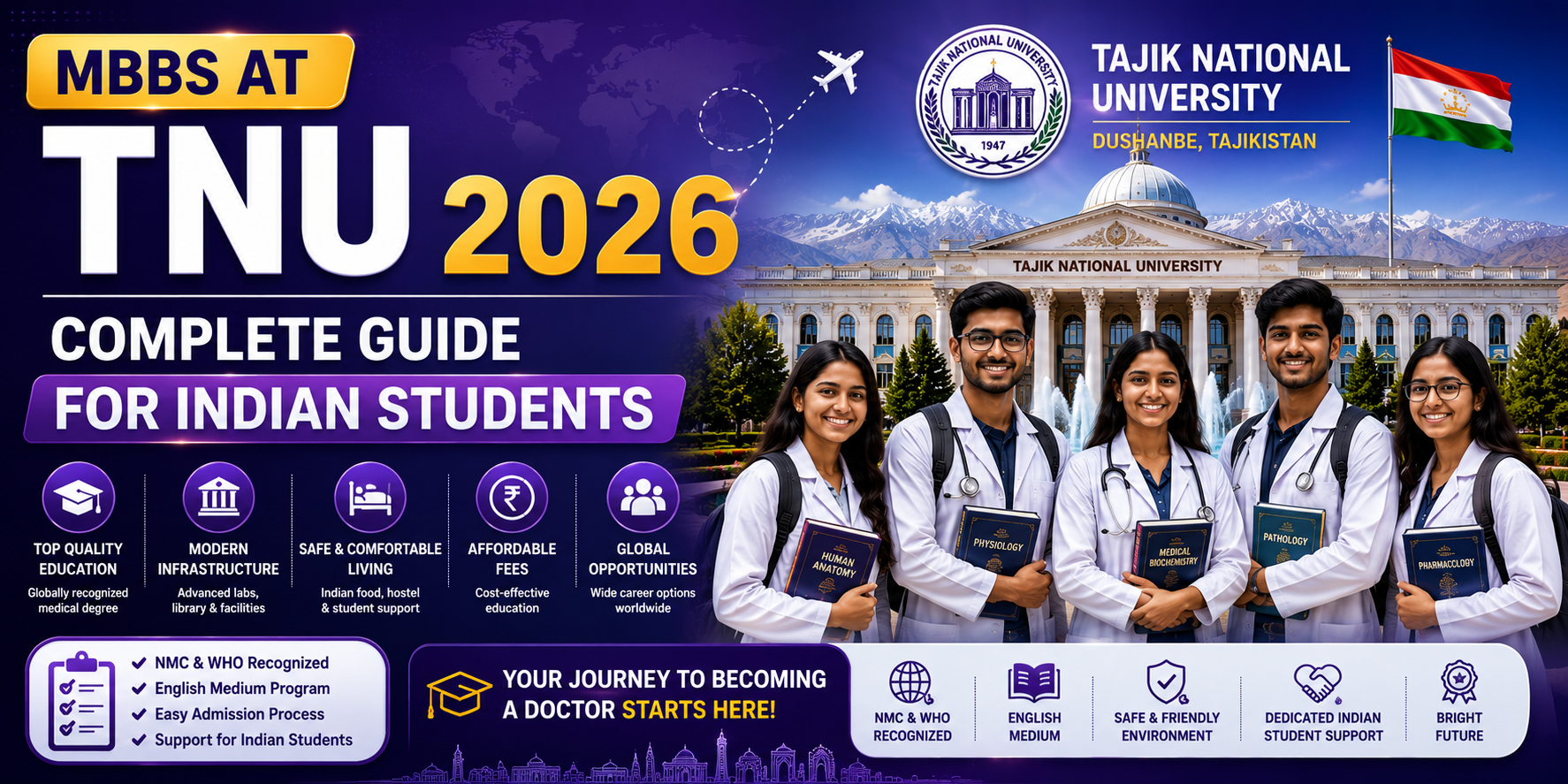
If you are an Indian student planning to pursue an MBBS and feeling anxious about your path to higher education, you may first want to examine the core predicaments shared by all current Indian medical students.
Every year, millions of candidates sit for the NEET-UG exam, while the number of admission slots in India’s public medical colleges is extremely limited, pushing admission competition to increasingly fierce heights year after year.
Though private medical colleges have vacant seats, their tuition fees range from 6 million to over 100 million rupees, a cost completely unaffordable for ordinary families.
For this reason, studying MBBS abroad has become a high-cost-performance alternative favored by a growing number of families.
Tajikistan has gradually emerged as a popular study-abroad destination for Indian students in recent years, owing to its low overseas study costs, internationally accredited medical school qualifications, and a policy environment friendly to international students.
Why Tajikistan National University Is Popular Among Indian Students
Among all local institutions, Tajikistan National University (TNU) stands as the top choice among the Indian international student community.
This 2026 Guide to Studying MBBS in Tajikistan will comprehensively break down all core information for enrollment at TNU, specifically covering seven dimensions:
- MBBS tuition fees
- Living costs
- Accommodation fees
- Additional expenses
- Accreditation status
- Overall value
- General overview of TNU
Founded in 1947 and located in the capital city of Dushanbe, TNU is regulated by the Ministry of Education and Science of Tajikistan.
Its teaching practices meet international medical standards, and its student body includes international students from:
- India
- Nepal
- Bangladesh
- Pakistan
- Multiple countries across Africa
- The Middle East
Seven Exclusive Advantages of TNU
It also boasts seven exclusive advantages tailored to Indian students that give it particular appeal:
- Low tuition fees
- Fully English-medium instruction
- Globally recognized degrees
- A safe environment
- Modern facilities
- A large community of Indian students
- Low living costs
Why MBBS Abroad Is Gaining Popularity
The primary reason for the recent surge in popularity of Tajikistan’s MBBS programs is the increasingly fierce competition for medical school admission within India itself.
For middle-class Indian families planning to pursue a Bachelor of Medicine and Bachelor of Surgery (MBBS) degree, the exorbitant cost of India’s domestic private medical colleges has long been an insurmountable barrier.
The total fees for private MBBS programs across different states and institutions in India range from 700,000 to 120 million Indian rupees, a sum far beyond the financial capacity of ordinary middle-class households.
This gap has spurred demand for affordable overseas medical education, and Tajikistan has emerged as a highly competitive alternative to meet this need.
International Recognition of Medical Degrees
Medical degrees awarded by Tajikistan’s universities are recognized by international medical authorities, allowing graduates to register for national medical licensing exams in multiple countries and apply for postgraduate study opportunities worldwide.
This directly resolves the top concern of families considering overseas study: the compliance and validity of their child’s degree.
Transparent Fee Structure at TNU
Tajikistan National University (TNU), located in the capital city of Dushanbe, is the leading preferred choice for these students.
Unlike the widespread irregular practice at many overseas medical colleges of charging hidden fees—including:
- Donation fees
- Per-capita levies
- Mandatory development fees
- Exorbitant administrative fees
TNU maintains a fully transparent fee structure.
Leveraging four core advantages:
- Low tuition
- Affordable student housing
- Extremely low local living costs
- No hidden charges of any kind
TNU delivers far greater cost-effectiveness than private medical colleges in India.
TNU MBBS Fee Structure 2026
TNU’s 2026 MBBS program has a 6-year duration that includes full internship and clinical training, with a clear breakdown of all expenses:
- Tuition is $4,500 per year for the first five years.
- Tuition is $2,500 for the final internship year.
- Annual housing fees range from $500 to $700.
- Medical insurance costs $100 to $200 per year.
- Visa extension fees run from $200 to $300.
- Study materials cost $100 to $250 annually.
The total of all expenses amounts to only $28,000 to $30,000, far lower than the cost of attending a private Indian medical college.
Dushanbe’s cost of living also ranks among the lowest of all popular global MBBS study destinations, further reducing the overall financial burden on students’ families.
Total MBBS Cost in Indian Rupees
Indian international students planning to travel to Tajikistan to pursue an MBBS may refer to the following complete collated set of study-abroad costs and living support information.
First, affected by annual exchange rate fluctuations, we use the annual average exchange rate to convert all costs into Indian Rupees to calculate the total study cost.
Estimated Cost Breakdown
- Tuition fees: 22 to 28 lakh INR
- Accommodation costs: 2 to 3 lakh INR
- Basic daily living expenses: 4 to 7 lakh INR
- Standard miscellaneous fees: 1 to 2 lakh INR
The total full-program budget is approximately 28 to 35 lakh INR.
This total cost is far lower than the study expenses of most private medical colleges within India.
Accommodation and Student Life in Dushanbe
Tajikistan National University provides international students with well-facilitated exclusive dormitories that can meet their basic study and living needs.
The capital Dushanbe also has a large number of dining options suited to Indian students' dietary preferences, which resolves the dietary adaptation challenge for students studying abroad in a foreign country.
Monthly Living Expenses in Dushanbe
We further break down Dushanbe's monthly cost of living, which covers four categories:
- Dining
- Transportation
- Internet and miscellaneous utilities
- Personal miscellaneous expenses
Total monthly spending ranges from 150 to 300 US dollars, equivalent to approximately 12,000 to 25,000 Indian Rupees.
To align with Indian international students' daily currency calculation habits, we list the spending ranges for both currencies.
Additional Expenses Students Often Overlook
It is necessary to remind students that many international students easily overlook a range of hidden extra costs, including:
- International student health insurance
- Visa renewal fees
- Round-trip airfare between India and Tajikistan
- Costs for professional learning materials
These expenses must also be incorporated into overall budget planning in advance.
Complete MBBS Journey: From Application to Career Development
For Indian international students planning to travel to Tajikistan to pursue a Bachelor of Medicine and Bachelor of Surgery (MBBS), this section sorts out all core reference points for the entire process, following the timeline of your decision-making from application preparation to career development.
Pre-Departure Documentation Requirements
Before leaving your home country, you must complete 7 documentation procedures including:
- Passport application
- Academic credential notarization
The total cost of processing these documents amounts to tens of thousands of Indian rupees.
Medical Education Framework
The Tajikistan National University, which you may intend to apply to, runs a medical program that aligns with international medical education frameworks and offers English-medium international classes tailored for Indian students.
Its core training system includes 5 established training components.
Clinical Training Requirements
During the clinical training phase, you must complete rotations in 6 departments including:
- Internal Medicine
- Surgery
All practical rotation training is carried out at the university’s affiliated medical institutions.
Accreditation Verification Before Admission
During the school selection phase, you must verify the institution’s latest accreditation status through official databases.
The three core authoritative accreditations to check are:
Career Opportunities After Graduation
Your development path after graduation is clear.
Returning to India
If you plan to return to India to practice medicine, you must meet the requirements set by the NMC and pass either the FMGE or NExT exam.
Practicing Abroad
If you intend to practice or pursue further study outside India, you can choose to take:
- USMLE for the United States
- PLAB for the United Kingdom
- Advanced degree programs such as MD and MS
Six Core Advantages of the TNU MBBS Program
This paper targets Indian medical students planning to pursue an undergraduate medical degree overseas and analyzes the application value of the 6-year MBBS program at Tajikistan National University.
First, it outlines six core advantages of the program:
- On-campus accommodation costs are lower than student housing in most mainstream study-abroad countries.
- Full English-language instruction eliminates academic language barriers.
- The medical degree holds official recognition from the International Medical Education Directory.
- Dushanbe has a very low cost of daily living.
- The university charges no mandatory donations or arbitrary per-student fees.
- The local community of Indian international students grows year by year and provides tailored support for newcomers.
Four Challenges Requiring Advance Preparation
Next, the paper lists four challenges that require advance preparation:
- Cross-cultural adaptation stress.
- Climate adaptation challenges, as Tajikistan’s winter temperatures are far lower than those in most parts of India.
- Clinical practice requires mastery of basic Russian or Tajik.
- Students planning to return to India to practice medicine must prepare early for the FMGE or NExT licensing exams.
Cost Comparison and Final Considerations
The program’s annual tuition is approximately 4,500 USD, and the total budget for the full 6-year program amounts to roughly 2.8 million to 3.5 million Indian rupees, a cost far lower than that of private medical schools in India.
Finally, the paper supplements core considerations for school selection, corrects the misconception that cost should be the sole deciding factor, and clarifies three necessary conditions for career success:
- Sufficient academic investment
- Solid training in clinical skills
- Early preparation for licensing exams
These points fully cover all core decision-making dimensions for the target audience when selecting a school.
Conclusion
For applicants who aspire to practice medicine and wish to balance high-quality medical education with the costs of studying abroad, we recommend the cost-effective 2026 MBBS program at Tajikistan National University.
Before submitting an application, please complete core verification checks to ensure this educational pathway aligns with your long-term career goals.
For the latest compliance requirements, students should also refer to the official NMC guidelines before making a final admission decision.