
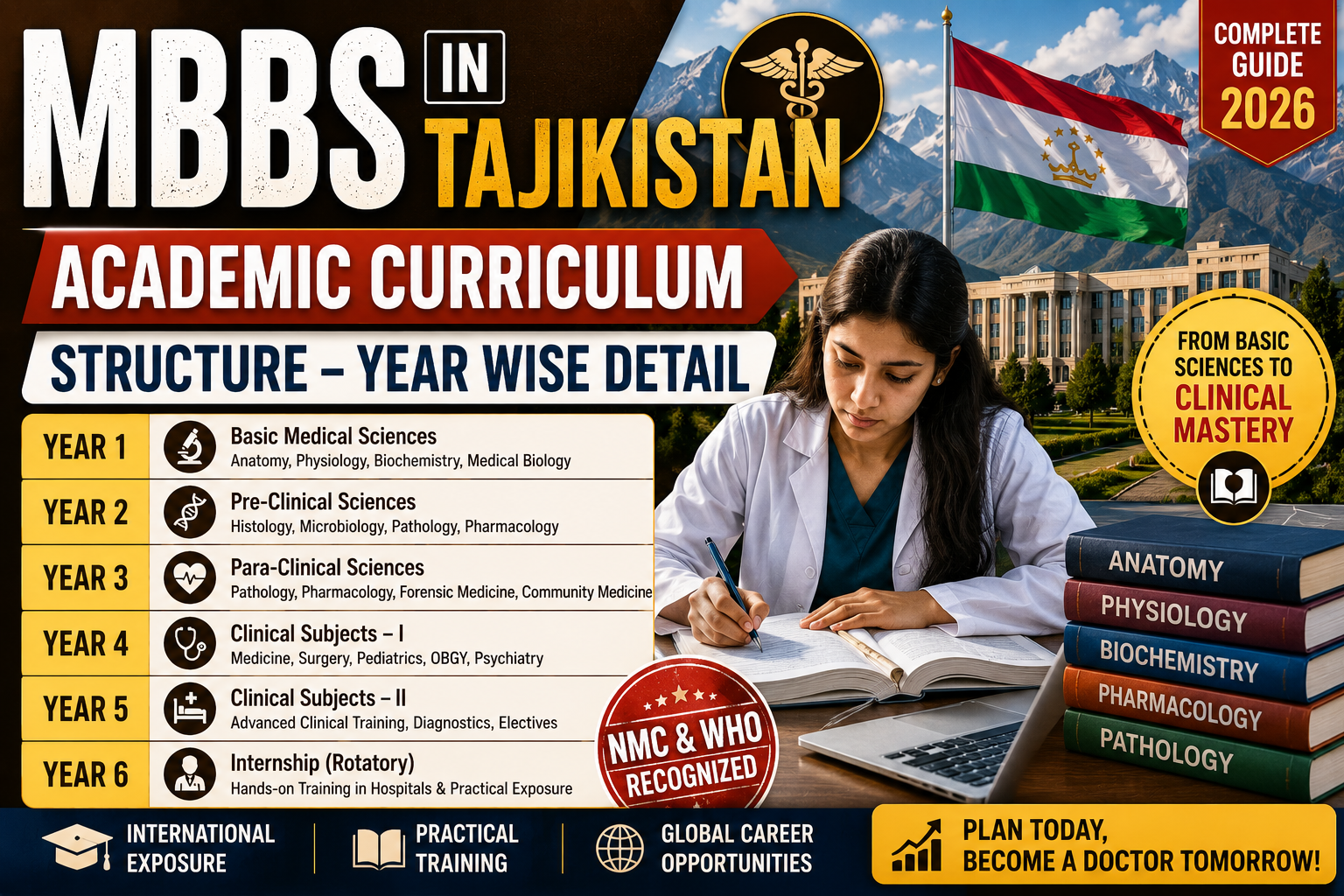
Medical education abroad: Affordable fees, exposure to global practices makes this popular among Indian pupils MBBS in Tajikistan is an example of such a new destination with a well-organized atmosphere, experienced faculty members, and the degrees that are globally accepted. Year-wise academic structure for a Medicine degree in Tajikistan In Tajikistan, it is absolutely necessary to comprehend the year-by-year academic layout of how students study medicine.
The MBBS course in Tajikistan lasts for about 5 to 6 years, which consists of theoretical study, practical training and clinical exposure. The curriculum complies with global medical standards as per the World Health Organization and information present at World Directory of Medical Schools, thus ensuring it has worldwide recognition.
Year 1: Pre-Clinical Foundation
The initial year is geared at laying down a solid foundation in the sciences behind medicine. Students are introduced to the basic subjects that determine medical education.
Key Subjects:
- Anatomy
- Histology
- Biochemistry
- Physiology
Students are also taught basic medical terminology and are first introduced to what it is like to work in the lab. The mode of teaching consists of lectures, practicals and interactive learning.
Year 2 — Reinforcing Fundamental Concepts
Year 2 → Students continue with medical sciences but extend their knowledge of the body and its systems.
Key Subjects:
- Physiology (advanced)
- Biochemistry (advanced)
- Microbiology
- Pathology
Many practical sessions become more in depth and students start to learn all about mechanisms of disease. This stage in the medical study is very important as it assesses how well-versed individuals will be at clinical subjects
3rd Year: Intro to clinical what you will be doing
In year three we convert from academia to reality in the clinic.
Key Subjects:
- Pathology
- Pharmacology
- Microbiology
- Forensic Medicine
Students learning clinical environments at hospitals starters. They learn about diagnosis and disease progression, and a little bit of the fundamentals of patient care.
Most students, while comparing educational opportunities around the globe to study MBBS abroad, are also evaluating options like MBBS in Georgia which offers similar international exposure and state-of-the-art infrastructure.
Year 4: Foundation arms of core clinical training
Fourth Year: The fourth calendar year is laden with clinical subjects and hands-on experience in hospitals.
Key Subjects:
- General Medicine
- Surgery
- Obstetrics and Gynecology
- Pediatrics
Students work with patients directly under supervision, learn to perform clinical procedures and hone diagnostic skills. This phase is important, as it molds applicable medical knowledge.
Year 5: Clinical Specialist
During the fifth year, clinical exposure increases and there is a transfer of (increasingly) patient responsibility to students.
Key Areas:
- Internal Medicine
- Surgery (advanced)
- Psychiatry
- Orthopedics
They attend ward rounds, case discussions and do minor procedures. This year is designed to improve their decision-making and prepare them for real-world medicine.
Internship (Final Year)
The last step is an obligatory internship in hospitals under supervision of professionals.
Training Includes:
- Rotations in major departments
- Patient diagnosis and management
- Emergency care exposure
- Practical application of theoretical knowledge
This practical training gets students ready to start working as physicians.
Global Recognition & Accreditation
The medical universities in Tajikistan are approved by international bodies, including the World Health Organization and included into the World Directory of Medical Schools.
Students pursuing MBBS abroad should ensure meeting the National Medical Commission guidelines to practice medicine, allowing Indian students graduate from foreign countries to sit exams (FMGE/NExT) and obtain their license.
Teaching Methodology
Tajikistan has a modern practical MBBS curriculum, which is quite different from the traditional Indian method.
- Classroom lectures with digital support
- Laboratory experiments and simulations
- Clinical exposure from early years
- Problem-based learning methods
This can be a good approach as it makes the students theoretically sound as well.
Top Reasons Why You Should Study MBBS in Tajikistan
- Affordable tuition fees
- Globally recognized degrees
- English-medium programs
- Modern infrastructure and hospitals
- Safe and student-friendly environment
With its structured syllabus and global exposure, Tajikistan is ideal for medical aspirants.
Conclusion
In Tajikistan there is a step-by-step process regarding mbbs in relation to the academic curriculum and it offers a deep insight into medical sciences. Each year, from the basic sciences to advanced clinical training, is important in forming a physician capable of caring for patients.
Global acknowledgement and international career opportunities NOTE: Studying MBBS in Tajikistan not only provides you international exposure but also gives you recognition globally as this country is recognized by organizations like WHO, MD or National Medical Commission (NMC) and many more.
This is the destination where students can have an ideal education in medical field at a reasonable price and go out to practice a successful medical career.
Students must also qualify NEET as mandatory eligibility criteria for pursuing MBBS abroad and practicing.