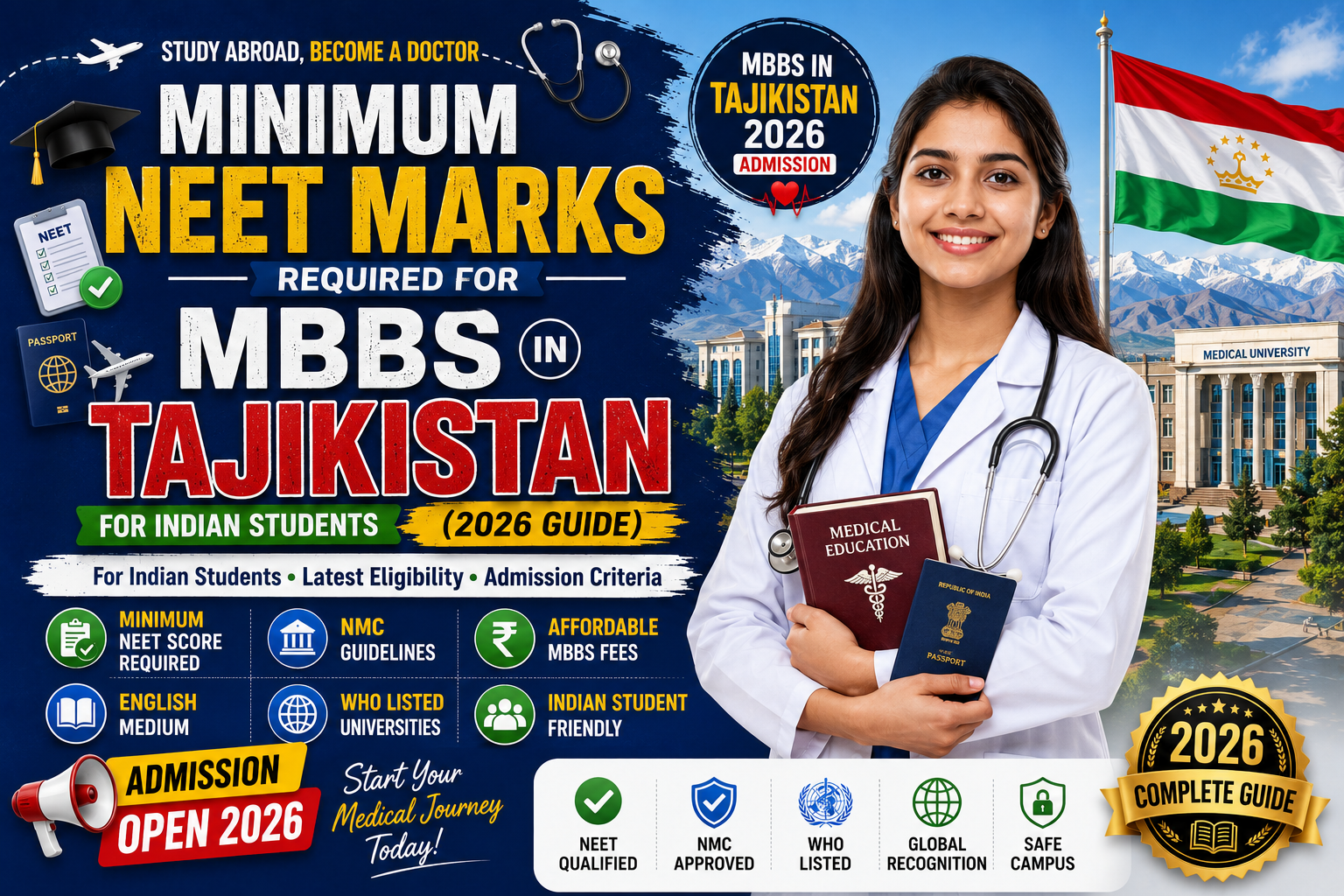
Every year, thousands of Indian medical students who pass the NEET exam search globally for cost-effective international medical education resources. Among these options, the MBBS program in Tajikistan has long been a popular choice, thanks to its advantages including low tuition fees, full English-language instruction, globally recognized medical school accreditation, and a simple application process. This raises a key question: what is the minimum NEET score required for Indian students to apply for this program in 2026?
In fact, this score is determined by two factors: the latest eligibility criteria released by India's National Medical Commission (NMC), and the independent admission requirements of the target institution. In most cases, students only need to pass the NEET; the specific cutoff score shifts each year in line with the official qualifying percentile published by India's National Testing Agency (NTA). Passing the NEET is not only an admissions requirement—it is also a mandatory condition for graduates to obtain Indian medical practice qualifications after returning home, per current NMC regulations.
Do Indian Students Pursuing an MBBS in Tajikistan Have to Pass the NEET Exam?
Yes. Passing the NEET is a mandatory requirement for Indian students who plan to study for an MBBS in Tajikistan and return to practice medicine in India in the future. According to the latest regulations from the National Medical Commission (NMC) of India, Indian students pursuing an MBBS abroad must pass the NEET in the year they enroll in their program, or meet the corresponding eligibility rules. This requirement ensures that students can qualify to take India’s medical licensing exam after they complete their degree. For this reason, even if the overseas institution’s admission process does not require a high NEET score, Indian students must confirm that they meet the NMC’s eligibility rules before enrolling.
Many students who plan to study medicine abroad share a common misconception: they believe that if their NEET score is relatively low, they lose all eligibility to submit an overseas study application. In fact, the most critical factor for study abroad applications is passing this exam, not achieving an extremely high score.
Minimum NEET Score Requirements for Tajikistan’s MBBS Program
The minimum NEET score required to study MBBS in Tajikistan is determined based on the annual NEET qualifying percentile. This standard fluctuates each year according to exam difficulty, the number of test-takers, and the overall performance of all candidates.
General requirements are as follows:
- Candidates in the general category must reach the specified qualifying percentile.
- Candidates in reserved categories may receive score concessions in accordance with government regulations.
- Most educational institutions in Tajikistan only verify whether a student has passed the NEET, and do not require a specific high score.
Therefore, as long as a student successfully passes the NEET and meets all other admission requirements, they are usually eligible to apply to multiple recognized medical universities in Tajikistan. Students should not fixate on their exact score level; instead, they must check the officially released NEET qualification status each year to confirm they meet the latest application eligibility standards.
Why NEET Eligibility Matters More Than a High Score
Unlike India’s fiercely competitive public medical colleges, medical schools in Tajikistan generally do not require extremely high NEET scores. Local admissions focus on meeting eligibility thresholds rather than intense rank-based competition, and every student who passes the NEET has a meaningful chance of gaining admission. A passing NEET score helps students achieve these key goals:
- Meet the eligibility requirements set by the NMC.
- Apply to accredited medical colleges.
- Retain the right to obtain a medical practice license in India in the future.
- Complete the enrollment and visa application process smoothly.
For this reason, students with moderate NEET scores often view pursuing an MBBS in Tajikistan as a practical, cost-effective alternative to attending a private medical college in India.
NMC Eligibility Requirements for Indian Students
Before choosing any institution, students must carefully review the latest guidelines released by India’s National Medical Commission (NMC). Under current regulations, students are generally required to meet the following condition:
- Pass the NEET exam.
- Complete 10+2 with Physics, Chemistry, Biology, and English.
To apply to an overseas medical school, you must first obtain the minimum required passing score on India's 12th-grade national standardized examination. The university you enroll in must meet the program duration and curriculum requirements set by applicable regulations, and hold international recognition. Meeting these requirements will help you avoid future problems related to academic credential verification.
The Importance of Choosing an Accredited Medical School
In addition to meeting the eligibility requirements of passing the NEET national standardized examination, selecting the right university is equally critical. You must verify whether your target school is listed in the WDOMS and meets international academic standards, and you must independently confirm that it satisfies India's latest regulatory requirements.
Similarly, medical education should align with the international healthcare standards promoted by the WHO and other authoritative medical education frameworks. Choosing a well-regarded institution not only improves academic quality, but also expands future career opportunities in different countries.
Why Indian Students Tend to Pursue MBBS in Tajikistan
In recent years, Tajikistan has become one of the cost-effective destinations for Indian students seeking high-quality medical education. Local universities there are equipped with modern infrastructure and experienced teaching staff, and offer English-medium instruction and clinical practice opportunities for international students. Their tuition fees are lower than those of most private medical colleges in India. In addition, the country features multicultural campuses, dormitory facilities, and simplified admission procedures. As long as students meet the NEET eligibility requirements and select an accredited institution, Tajikistan serves as a strong pathway to an international medical career.
Admission Process for MBBS in Tajikistan After Qualifying NEET
If you have already passed the NEET exam, the overall application process for the MBBS program in Tajikistan is straightforward. However, every step must be completed carefully to avoid delays in enrollment or visa approval. Most universities open their applications several months before the start of the semester. Submitting your application as early as possible can increase your chances of receiving an admission offer from your target university and securing a dormitory spot.
The standard enrollment process consists of five steps:
- Verifying your academic qualifications.
- Submitting all required documents.
- Receiving the university’s admission letter.
- Applying for a student visa.
- Traveling to Tajikistan to start your medical program.
It is recommended to apply through a reliable admissions consulting agency to ensure your materials meet all requirements. Before submitting your application, you can learn about the full process and university-specific details via the "MBBS in Tajikistan" channel.
Documents Required for Admission
Before Indian students apply to pursue an MBBS degree in Tajikistan, they must prepare all academic and personal documents in advance. While specific requirements vary slightly across different universities, most institutions require standard documents that can verify an applicant’s educational background and identity.
The common required materials include:
- 10th-grade transcript and certificate.
- 12th-grade transcript and certificate.
- NEET qualification score report.
- Valid passport.
- Passport-sized photographs.
- Medical fitness certificate.
- Birth certificate (if required).
- University admission letter.
- Student visa documents.
All applicants must ensure that every document is accurate and within its validity period, to avoid delays in the application process.
Can I Apply with a Low NEET Score?
Many Indian medical applicants ask the following question: Can I apply for Tajikistan’s MBBS program if I get a low NEET score?
Most universities in Tajikistan only require applicants to obtain NEET qualification, rather than an extremely high score. As long as you meet the official NEET qualifying percentile, satisfy the academic requirements and other criteria set by the host university, you are eligible to submit an application.
Unlike public medical colleges in India, which have extremely high rank requirements and fiercely competitive admission thresholds, universities in Tajikistan generally offer admission to all students who have passed the NEET exam and completed the required high school coursework. Therefore, if your NEET score is lower than expected, you do not need to feel discouraged. You only need to check the latest eligibility requirements and choose a properly accredited university that matches your academic background.
How to Verify if a University Holds Valid Accreditation
Before submitting an admission application, you must first check the accreditation status of the medical school—this is the most critical step, as the accreditation outcome directly affects whether you will be able to obtain a medical practice license smoothly in the future.
You need to confirm that your target university meets the following criteria:
- It is listed in the World Directory of Medical Schools (WDOMS).
- It complies with the latest guidelines issued by the National Medical Commission (NMC) of India.
- It offers medical programs that meet international standards.
- It can provide sufficient clinical training and internship opportunities.
Verifying these elements before enrolling will help you make a sound decision and reduce the risk of encountering accreditation-related problems in the future.
Career Opportunities After Completing MBBS in Tajikistan
Graduating from a recognized official medical university in Tajikistan can bring many career opportunities for Indian students. After completing the MBBS program, graduates can plan different development paths based on their own career goals and the regulations of the country where they intend to practice.
Common career directions include:
- Taking the Indian medical licensing exam in accordance with the latest regulations of the National Medical Commission (NMC) of India.
- Pursuing a master's degree in medicine.
- Applying to take the medical licensing exam of other countries, provided they meet the relevant qualification requirements.
- After satisfying local licensing requirements, working in hospitals, medical organizations, research institutions, or the public health sector.
Students must keep track of the latest updates released by the NMC on exam eligibility and licensing regulations.
Why MBBS in Tajikistan is Becoming Popular Among Indian Students
The popularity of the MBBS program in Tajikistan keeps rising, and the core reason is that it achieves an excellent balance between low costs and high-quality education. Compared with many private medical schools, students can receive internationally recognized medical education at a much lower cost.
Several factors drive the growing demand for this program:
- Low tuition and living expenses.
- English-taught MBBS courses offered to international students.
- Access to modern laboratories and teaching hospitals.
- Experienced teaching faculty.
- A safe environment that meets students' needs.
- A steadily increasing number of student applicants from India.
- Globally recognized qualifications of partner medical schools.
- A simple application process after passing the NEET exam.
In addition, students can gain multicultural exposure, which helps them develop communication skills and adapt to various medical settings.
Key Points to Remember Before Applying
Before receiving an admission offer, every student must carefully research the qualifications of the target school, clarify its fee structure, verify its dormitory conditions, and confirm the program's recognition. Rushing to submit an application without thorough checks will create hidden risks later.
Equally important, students must understand the latest admission rules, practice license requirements, and academic standards before making a decision. All eligibility information must be obtained from official channels. Updates to global medical education standards can be found on the World Health Organization (WHO) website, and school qualifications can be verified through WDOMS. For Indian students, they must follow the latest notices released by the National Medical Commission (NMC) and the NEET portal.
Conclusion
Indian students planning to apply for the MBBS program in Tajikistan must first clarify the core eligibility threshold for applications: you must first obtain the official NEET qualifying score for the corresponding year. Most accredited medical schools in Tajikistan do not require high scores, but you must meet all the eligibility standards set by India's National Medical Commission (NMC).
When submitting your application, complete the following four core steps in order:
- Select an accredited medical school.
- Verify that the school is registered in the World Directory of Medical Schools (WDOMS).
- Confirm that the school complies with the latest NMC guidelines.
- Make sure the school can provide high-quality medical education with sufficient clinical practice opportunities.
Completing these procedures carefully will lay a solid foundation for your career as a medical professional.