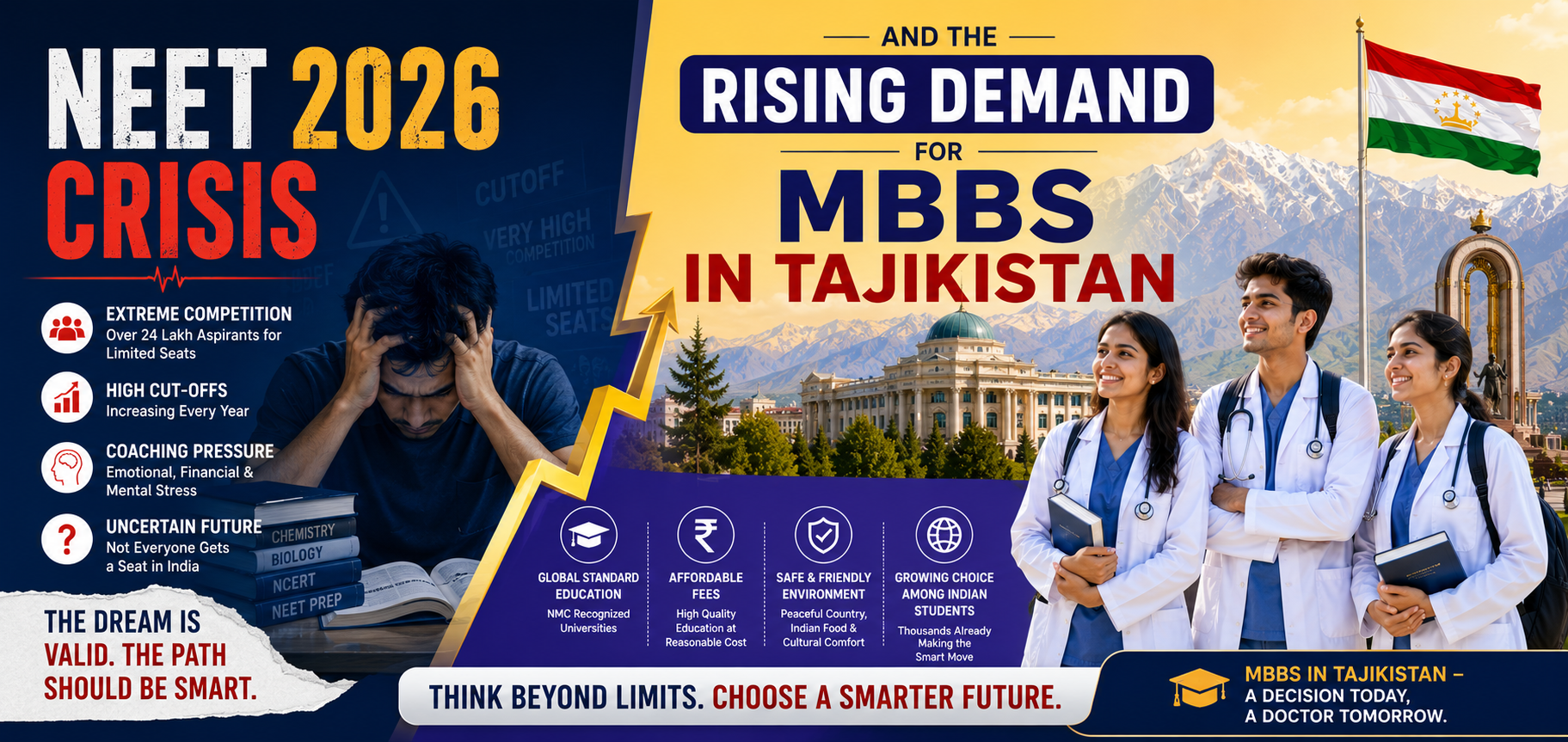
As the opening introductory section of this full paper, this article first lays out the core issue in the current field of Indian students pursuing overseas medical education: against the backdrop of the crisis triggered by the 2026 NEET exam, Tajikistan’s MBBS programs have become the top overseas alternative for Indian medical students.
As the only statutory threshold for admission to Indian medical education, the 2026 NEET-UG was hit by successive controversies over exam paper leaks and large-scale exam violations. As the incident grew in severity, the case entered the adjudication stage at the Supreme Court of India. Members of the public have already submitted petitions calling on India’s National Testing Agency (NTA) to roll out systemic reforms and improve accountability and transparency in the exam process.
This crisis directly affected the 2.2 million registered candidates, dealt a huge blow to countless students aspiring to enter medical school, and drastically exacerbated the overall uncertainty of India’s domestic medical examination system.
In fact, over the past decade, competition for places in India’s domestic medical education system has grown increasingly fierce. There has long been a massive gap in the supply of seats at public medical colleges, while tuition fees at private medical colleges have risen year after year. These factors have for years driven a large number of Indian medical students to actively explore the possibility of pursuing medical education overseas, and the sudden 2026 NEET crisis has further pushed up Indian students’ demand for overseas study.
Among all overseas medical study destinations, Tajikistan’s MBBS programs have successfully stood out for their core advantages: low tuition fees, full English-medium instruction, the medical accreditations of their partner universities being recognized by the world’s mainstream medical industry, local living costs far lower than those of major European and American study destinations, and a simple, streamlined admissions process.
Subsequent sections of this paper will analyze all the factors that attract Indian students to Tajikistan, and comprehensively demonstrate the suitability and value of this emerging destination for the group of Indian medical students.
Why MBBS in Tajikistan Appeals to Indian Students
If you are a middle-class Indian pre-med student planning to pursue an MBBS degree overseas, the medical study abroad programs in Tajikistan can precisely match your core higher education admission needs.
We benchmarked these programs against India’s domestic private medical colleges and medical programs in mainstream Western study destinations, and sorted out seven core advantages of Tajikistan’s programs, which fully align with the key pain points of Indian students when making their study admission decisions.
Financial Challenges Faced by Indian Students
You are highly likely to face the predicament of exorbitant tuition fees exceeding 6 million to 10 million Indian rupees at India’s domestic private medical colleges, additional high donation requirements, and cutthroat application competition.
You also have to worry about the uncertainty of the 2026 NEET policy, while harboring concerns over potential risks of studying abroad such as language barriers, degrees not being recognized by domestic and international authorities, and insufficient clinical training.
How Tajikistan Addresses These Challenges
In response to these pain points, Tajikistan’s MBBS programs provide targeted, actionable solutions one by one:
- First, its tuition is far lower than that of India’s domestic medical colleges, and its courses are accredited by international authoritative bodies.
- Second, its cost of living is lower than that of most Western countries and other popular MBBS study destinations, fitting your limited budget.
- Third, there are no additional registration fees of any kind, with full transparency in all charging practices, which greatly reduces extra financial pressure.
- Fourth, its degrees are listed in the WDOMS, fully meeting the requirements of India’s NMC, and graduates can apply for medical practice licenses in multiple countries.
- Fifth, it offers English-taught programs, which eliminates language barriers, and also supports preparation for international licensing exams and future advanced studies.
- Sixth, its application process is simple, only requiring passing grades in Physics, Chemistry and Biology at the 10+2 stage, a NEET score that meets NMC requirements, valid academic documents, and a passport and visa.
- This process is far more transparent and predictable than India’s domestic college application system, and adapts to the policy uncertainty of the 2026 NEET.
Finally, we proactively clarify a common misconception: medical schools in Tajikistan always balance theoretical learning and clinical training, completely resolving the concern that “low-cost study abroad equals insufficient practical training.”
Key Advantages of MBBS Programs in Tajikistan
For Indian students planning to pursue an undergraduate medical degree overseas, the MBBS study-abroad program in Tajikistan precisely meets the core decision-making needs of study-abroad households through six key advantages.
Clinical Training and Practical Learning
First, in terms of its training logic, all enrolled medical students participate in laboratory training, hospital rotations, and hands-on practice throughout their studies.
Local partner universities also arrange early clinical exposure to balance classroom learning and practical training, steadily improving students’ career readiness.
Compliance with Medical Licensing Standards
Second, the program addresses the core pain point of licensing compliance: it follows the relevant requirements of India’s National Medical Commission (NMC).
We remind prospective students to verify the latest NMC rules before enrollment, and partner universities consistently align their operations with NMC standards and various international medical education norms.
Strong Indian Student Community
Third, it is supported by a mature Indian student community.
Currently, thousands of Indian medical students are studying in Tajikistan. Local Indian student associations organize cultural events, build peer networks, and provide new students with comprehensive support covering academics, housing, cultural adaptation, and exam preparation, to ease homesickness.
Cost-Effective Education
Fourth, it boasts a prominent cost advantage. In addition to low tuition, local expenses for dormitories, meals, transportation, and daily needs are all inexpensive.
The overall financial burden on households is far lower than that of other mainstream destinations for medical study abroad.
Global Career Opportunities
Fifth, in terms of career pathways, graduates of accredited Tajikistani universities can either return to India to practice per NMC requirements, take the USMLE to apply for U.S. residency, meet GMC requirements to practice medicine in the UK, pursue further study or employment in global scientific research, public health, and clinical fields, or join international health organizations.
The international recognition of their academic credentials greatly boosts their career mobility.
Student-Friendly Environment
Sixth, the local environment is very friendly to international students, and universities provide dedicated support services.
The vast majority of Indian students report positive experiences with campus life, housing, and cultural integration, which eliminates the safety concerns of parents.
For verification and official guidance, students should refer to WDOMS, NMC, WHO, NEET, and MBBS in Tajikistan.
Impact of the NEET 2026 Admission Controversy
Recently, the 2026 NEET admission controversy in India has exposed flaws in the country’s domestic centralized admission system, and this incident is rapidly reshaping Indian students’ decision-making logic for studying medicine abroad.
Candidates who originally only set their admission goals on domestic medical schools in India began to seriously evaluate overseas medical study options after the outbreak of the 2026 NEET exam crisis.
Drawing on this core triggering event, this paper puts forward the reflection that educational aspirations cannot rely entirely on a single examination process.
It then sorts out three core characteristics that study destinations favored by Indian medical students must meet:
- Stability
- Affordability
- International recognition of academic qualifications
Why MBBS in Tajikistan Is Emerging as a Practical Alternative
Tajikistan precisely addresses the five major domestic admission pain points facing Indian medical students:
- Fierce admission competition
- Scarce government quotas
- Exorbitant tuition at private colleges
- Uncertain admission outcomes
- Heavy long-term financial strain
This has directly driven the rapid growth in demand for pursuing an MBBS in Tajikistan.
Before submitting applications, candidates must verify six core dimensions:
- The official accreditation status of the university
- Clinical training opportunities
- Supporting dormitory facilities
- The compatibility of the curriculum
- Eligibility to practice medicine after returning to India
- Language requirements for clinical training
They must confirm all information through official channels including the World Directory of Medical Schools (WDOMS) and India’s National Medical Commission (NMC).
Conclusion
As a result, Tajikistan’s MBBS programs have become one of the most pragmatic and feasible admission options for Indian medical students in the wake of this crisis.