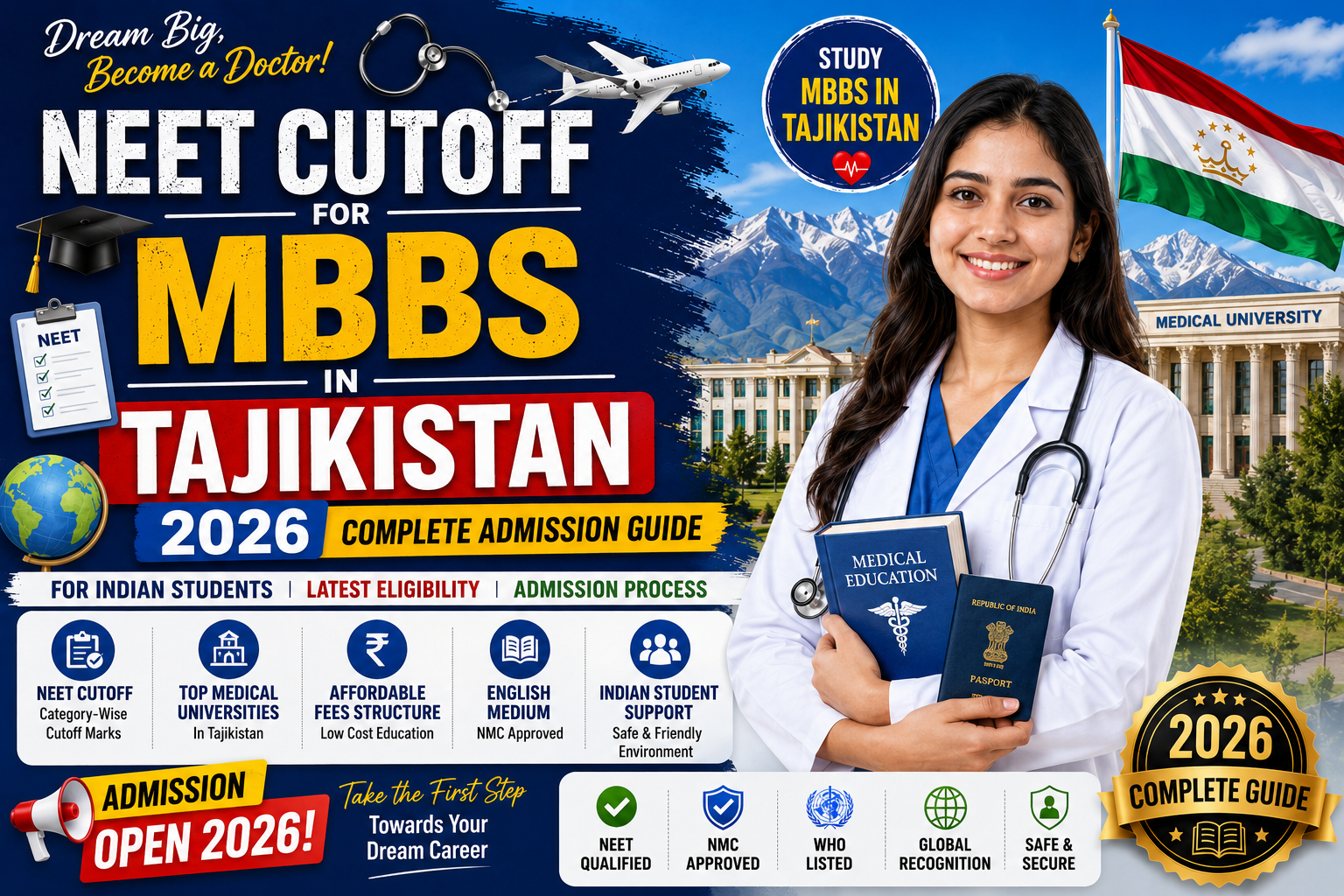
Every year, thousands of Indian medical students who pass the NEET exam search for cost-effective study-abroad destinations to pursue their medical degrees. Russia, Kazakhstan, and Georgia have long been traditional top choices for these applicants. In recent years, however, the pathway to study for a Bachelor of Medicine and Bachelor of Surgery) MBBS in Tajikistan has grown rapidly in popularity. Tajikistan not only charges low tuition fees, but its host universities are globally recognized, offer English-taught programs, and maintain a very welcoming environment for international students.
Many Indian applicants planning to apply for the 2026 intake mistakenly believe they need an extremely high NEET score to submit an application, but the actual eligibility criteria are far less strict. This guide will cover all core application information, including the latest NEET admission cutoff scores, eligibility requirements, application procedures, and minimum qualifying scores.
What Exactly Will the NEET Cutoff Score Be for the MBBS Program in Tajikistan in 2026?
For all Indian students planning to study this major overseas, it is first essential to understand the latest regulation issued by the National Medical Commission of India: if they intend to return to India to practice medicine after completing their studies, they must meet the mandatory NEET requirement to be eligible to apply to any overseas medical school. Unlike the high score requirements for public medical schools within India, universities in Tajikistan only require applicants to meet the minimum qualifying percentile of that year's NEET exam. It is projected that the 2026 qualifying percentile will remain largely consistent with levels from previous years.
- General Category – 50th Percentile
- OBC Category – 40th Percentile
- SC Category – 40th Percentile
- ST Category – 40th Percentile
- PwD candidates – As per applicable NMC guidelines
The specific minimum qualifying score for NEET may be adjusted based on two core variables: exam difficulty and the overall performance of test-takers. Therefore, students must wait for the official release of NEET results before making any university admission decisions.
Why Do Indian Students Applying for MBBS in Tajikistan Have to Pass the NEET Qualifying Threshold?
Many Indian students mistakenly believe that overseas medical schools do not refer to NEET scores for admission, and this claim is only partially true. While educational institutions in Tajikistan can admit students based on their academic qualifications, Indian students who wish to obtain legal credentials as foreign medical graduates and eventually receive a medical license to practice in India must meet the NEET eligibility standards set by the National Medical Commission (NMC) of India.
Passing NEET allows students to:
- Retain their eligibility to take India’s future national licensing exam.
- Participate in legally compliant internship processes.
- Avoid legal or academic disputes that could disrupt their career development.
- Ensure that their degree fully meets India’s current regulatory requirements.
Eligibility Criteria for MBBS in Tajikistan 2026
Students applying to Tajikistan’s medical universities must not only pass the NEET exam, but also meet multiple academic requirements.
Academic Qualification Requirements
Applicants must complete 12th-grade coursework through a formal education board, with the mandatory subjects of Physics, Chemistry, Biology, and English.
In general, applicants must meet the following score thresholds:
- For general-category applicants, the combined score for PCB subjects must be no lower than 50%.
- For reserved-category applicants who meet current regulatory provisions, the minimum required score is 40%.
Students who are about to take their board exams may also submit applications, as long as they meet all eligibility requirements before admission is finalized.
Age Requirement
Applicants must be at least 17 years old by December 31 of the year they seek admission.
Nearly all formal medical universities in Tajikistan list meeting the minimum age requirement as a non-negotiable condition for admission.
Does a Higher NEET Score Increase One’s Chances of Admission?
Unlike public medical colleges in India, MBBS admissions in Tajikistan do not rely on competition tied to all-India rankings, nor do they proceed through state-level admission counseling processes.
In India, a higher NEET score reflects stronger foundational academic preparation and naturally gives applicants a greater advantage in the admissions process.
However, most universities in Tajikistan focus only on meeting the minimum admission requirements during their review.
As long as an applicant satisfies Tajikistan’s university enrollment policies and submits all required documents on time, they can receive an admission offer even if their NEET score only meets the threshold.
This creates a practical option for Indian students who miss out on admission to Indian medical schools: this path allows them to pursue their education at an affordable cost, without compromising on educational quality.
International Recognition of Medical Universities
Many Indian international students are most concerned about the international recognition of their academic credentials.
All leading medical schools in Tajikistan are listed in the WDOMS and follow globally accepted medical education standards. This WDOMS listing enhances the global credibility of their degrees and also supports graduates in applying for medical practice credentials in compliance with the local regulations of any country.
Before applying for admission, students must verify that their chosen institution has obtained official accreditation from the relevant regulatory authority. In addition, global health organizations such as the WHO continue to promote the implementation of international standards for medical education and clinical practice, which enables institutions with authoritative accreditation to provide greater support for students’ future career development.
Admission Process for MBBS in Tajikistan (For Students Who Have Taken the NEET)
Students who have passed the NEET exam and meet the academic eligibility requirements may begin the process:
- Complete document verification.
- Submit the university application.
- Receive the admission letter.
- Pay the tuition fee.
- Apply for a student visa.
- Prepare for travel.
Most institutions have simplified their application systems. Indian applicants only need to provide their mandatory NEET scores and are not required to take any additional entrance exams.
We recommend that Indian students applying for undergraduate medical programs in Tajikistan start their admission procedures as early as possible. During the peak admission season, visa reviews, document notarization, and the availability of remaining degree spots may all affect application progress. Early preparation can avoid delays caused by these risks.
Required Admission Application Materials
Before submitting an admission application, students must prepare all necessary materials in advance. Standard required materials include:
- 10th-grade transcript
- 12th-grade transcript
- NEET score report
- Valid passport
- Passport-sized photographs
- Birth certificate (if required)
- Medical fitness certificate
- Admission application form
- Visa-related documents required by the university
Preparing all materials ahead of time can prevent delays during the admission and visa application stages.
Tuition and Living Costs in Tajikistan
One of the core reasons Indian students choose to pursue undergraduate medical degrees in Tajikistan is the country's high cost-effectiveness. Compared with private medical colleges in India, Tajikistan's medical schools provide high-quality education at a far lower cost.
- Annual tuition fees generally range from USD 3,000 to USD 5,000, depending on the institution.
- Students should also budget for:
- Hostel accommodation
- Food expenses
- Medical insurance
- Visa renewal fees
- Personal expenses
Indian students can usually cover their monthly living expenses with a reasonable budget, making Tajikistan one of the most affordable overseas destinations for undergraduate medical study.
Before enrollment, be sure to request the latest fee list from the university, as tuition standards differ across institutions.
Why Do Indian Students Who Pass NEET Choose MBBS in Tajikistan?
Passing the NEET opens up a wide range of opportunities for Indian students who want to pursue a medical degree abroad. Tajikistan has become a top destination for many of these students, thanks to its low tuition fees, high-quality education, and globally recognized accreditations for its medical schools.
The core advantages include:
- Tuition fees are more affordable than in most other countries.
- Many institutions offer MBBS programs taught in English.
- Campuses are equipped with modern laboratories and well-facilitated classrooms.
- Students can gain hands-on clinical experience through affiliated teaching hospitals.
- Most institutions provide Indian-style meals and on-campus housing.
- The country has a safe, student-friendly living environment.
- The medical degree is globally recognized.
- There is a diverse community of international students.
- The admission process is simple, and no additional entrance exams are required.
These advantages make Tajikistan’s MBBS programs an excellent fit for students who passed the NEET but were unable to gain admission to a public medical college in India.
Can Students With Low NEET Scores Apply for Admission?
This is one of the most common questions from medical school applicants, and the answer is yes.
Applicants only need to meet the minimum percentile cutoff set by the NEET. Unlike medical colleges in India, Tajikistan’s institutions generally do not require a high NEET ranking as a mandatory condition for admission.
Students who only meet the NEET qualifying cutoff score can still submit an admission application, as long as they meet the academic eligibility criteria and complete all admission procedures within the deadline set by the university.
However, passing the NEET exam alone does not guarantee admission. Students must also meet age requirements, hold the specified academic qualifications, and submit all complete and accurate application materials.
Career Development Opportunities After Completing an MBBS in Tajikistan
Graduating from an accredited medical university in Tajikistan opens up many career development opportunities, but all students must fully understand the medical licensing requirements of the country where they intend to practice in advance.
After completing their MBBS studies, graduates can choose to:
- Take the medical licensing exam required in India, in accordance with the latest regulations of the National Medical Commission (NMC) of India.
- Pursue a postgraduate medical program in India or other countries.
- Apply for licensing exams in the United States, the United Kingdom, Australia, or other countries, provided they meet the eligibility criteria of the corresponding country.
- Work in hospitals, research institutions, medical organizations, or the public health sector after meeting local licensing requirements.
It is critical to choose a university listed in the World Directory of Medical Schools (WDOMS). Such accreditation enhances the international credibility of one's degree and supports the eligibility review for various license applications.
Common Mistakes Students Should Avoid
Many international students applying for the MBBS program in Tajikistan make avoidable mistakes during the application process.
Common mistakes include:
- Submitting an application without passing the NEET exam.
- Failing to verify a university’s accreditation status before choosing a school.
- Ignoring the latest application guidelines.
- Delaying the processing of a passport or visa.
- Submitting incomplete application materials.
- Relying on unofficial or misleading information.
- Failing to check the latest fee schedule before enrollment.
Conducting thorough research and preparing materials on time can help students avoid unnecessary delays and various problems.
Key Precautions Before Enrollment
Before finalizing their admission to an MBBS program in Tajikistan, students need to verify several core factors.
They must confirm that their target university:
- Offers an MBBS program taught entirely in English.
- Has experienced faculty.
- Provides sufficient clinical training.
- Has adequate dormitory facilities.
- Adheres to international medical education standards.
- Has good infrastructure.
- Has affiliated teaching hospitals.
- Provides student support services.
- Offers a positive academic environment.
At the same time, students must continuously follow the latest notices from competent authorities such as the WHO and NMC.
Making reasonable and prudent decisions during the initial stage of the admissions application process can exert a positive effect on applicants' academic performance and their future career development prospects.
Frequently Asked Questions (FAQs)
Is it mandatory to pass the NEET exam to study for an MBBS in Tajikistan?
Yes. According to current Indian regulations, Indian students who wish to pursue an MBBS overseas while retaining their eligibility for medical practice registration in India must first pass the NEET exam.
What is the minimum NEET score requirement for Tajikistani higher education institutions?
Tajikistan does not set a fixed admissions cutoff score. Students only need to reach the minimum qualifying percentile released for that year's NEET exam.
Can students apply for admission if they only meet NEET's qualifying line?
Yes. Most medical schools in Tajikistan accept students who only pass the NEET qualifying line and meet the required academic eligibility criteria.
Is the MBBS degree from Tajikistan internationally recognized?
Medical degrees issued by medical schools listed in the World Directory of Medical Schools (WDOMS) and accredited by relevant competent authorities hold international recognition, though graduates must comply with the specific regulations of the country where they plan to practice medicine.
Are the costs of studying in Tajikistan affordable for Indian students?
Yes. Compared with many private medical schools in India and many other popular study-abroad destinations, Tajikistan has low tuition fees and reasonable living costs, making it an attractive option for Indian students.
Conclusion
For Indian students planning to travel to Tajikistan in 2026 to pursue an MBBS degree, you must first understand the minimum score requirements and eligibility criteria for India's National Eligibility cum Entrance Test (NEET) before starting your application process. You do not need to earn an extremely high NEET score; you only need to pass the exam, meet the academic requirements, and select a properly accredited institution to enroll smoothly.
When choosing a school, you must confirm that the institution is recognized by India's National Medical Commission (NMC), listed in the World Directory of Medical Schools (WDOMS), and follows the globally accepted medical education standards supported by the World Health Organization (WHO). Completing these preparations as early as possible will help you successfully start your journey in medicine.