
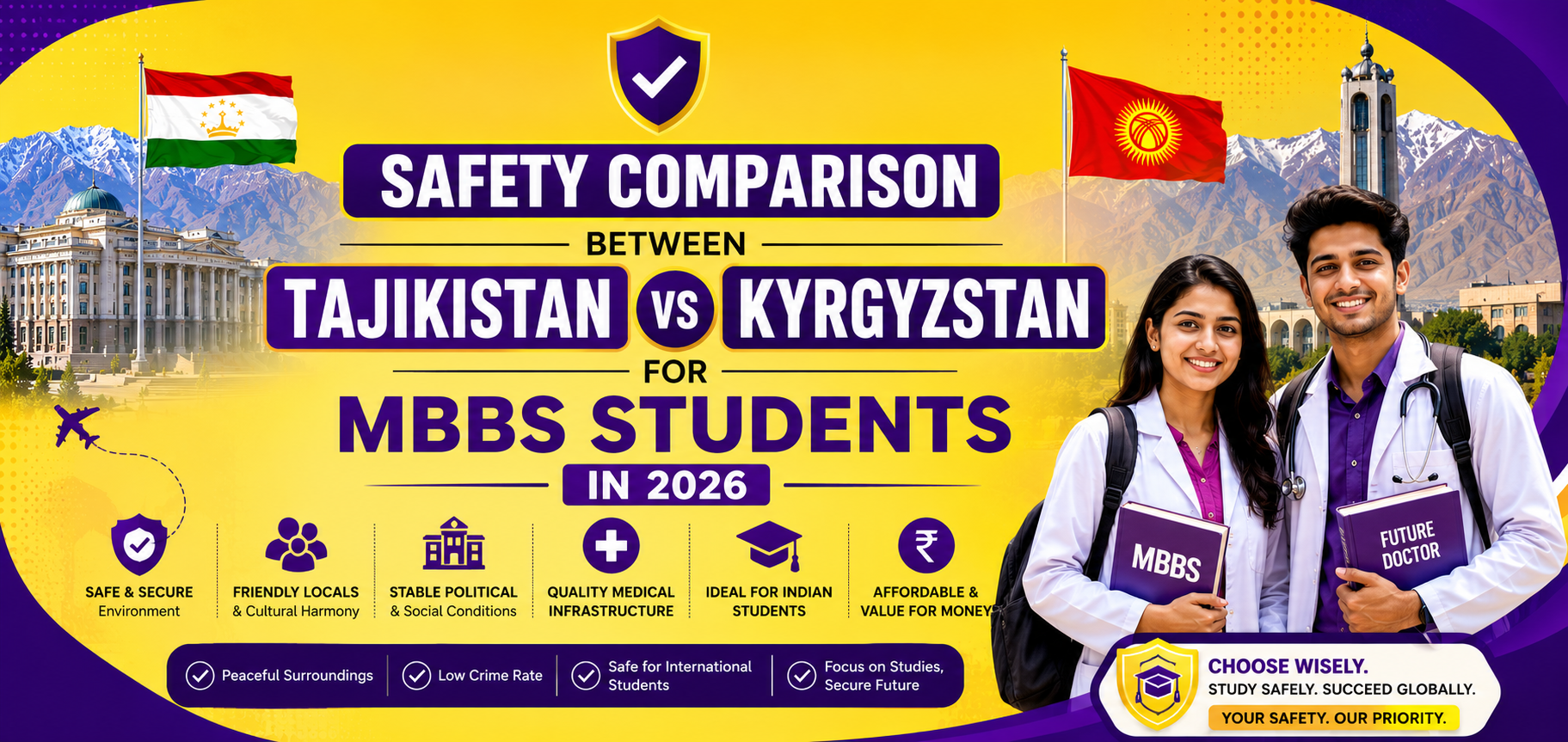
Among international medical students planning to pursue an MBBS degree in Tajikistan and Kyrgyzstan in 2026, the vast majority rank the safety of their study destination as the top core priority when selecting a school. This consideration carries far greater weight than other common decision-making factors, including tuition, university rankings, and post-graduation career prospects.
In recent years, these two Central Asian countries have gradually become popular new study destinations for international medical students, and are particularly favored by Indian students applying for MBBS in Tajikistan. Their shared core attractions include low overseas study tuition, medical degrees recognized by leading international authorities, and low local living costs. Yet all prospective applicants share one core overarching question: which of Tajikistan and Kyrgyzstan is safer for international students?
To answer this question, this paper first corrects the narrow public perception that safety levels can be measured solely by the single indicator of crime rates. It sorts out 9 actionable safety assessment parameters covering personal safety, political stability and other relevant domains, to build a logical framework for full-dimensional comparison.
Relevant reference information can be obtained from WDOMS, NMC, WHO, NEET-UG, and MBBS in Tajikistan.
The paper then introduces the latest travel risk ratings released by the U.S. Department of State as an authoritative reference: Kyrgyzstan has a Level 1 safety rating, while Tajikistan has a Level 2 rating. Based on this, it draws the preliminary conclusion that Kyrgyzstan’s safety rating is slightly superior.
The paper also clarifies that both countries’ core study-abroad cities—Tajikistan’s Dushanbe and Kyrgyzstan’s Bishkek—are generally safe and stable. Occasional safety risks only arise in Tajikistan’s border regions adjacent to Afghanistan and the Gorno-Badakhshan Autonomous Region; no persistent security threats exist in the country’s other core study areas.
In subsequent work, this paper will carry out a more detailed side-by-side comparison of the two countries’ safety conditions, focusing on two core dimensions: political stability, crime rates and personal safety.
Global Peace Index and Student Safety Environment
This paper opens by introducing the 2025 Global Peace Index (GPI) released by the Institute for Economics & Peace, a third-party organization, to establish an authoritative foundation for the study-abroad safety profile of Tajikistan and Kyrgyzstan: Kyrgyzstan scored 1.988, and Tajikistan scored 1.996. The gap between the two countries’ peace scores is extremely small, and both are classified as relatively peaceful study-abroad destinations.
The core group focused on in this study is Indian international students pursuing a Bachelor of Medicine and Bachelor of Surgery (MBBS) in the two countries.
MBBS in Tajikistan provides this group with dedicated international student dormitories, Indian-style meals, official university support services, and cultural support from the Indian Students’ Union.
The Indian international student population in Kyrgyzstan is one of the largest groups of Indian students in Central Asia; these students can adapt to local life by relying on the local large Indian diaspora community, student support groups, Indian restaurants, and well-developed educational infrastructure.
Dushanbe, the capital of Tajikistan, has sufficient police staffing and a low crime rate, with only minor safety risks consistent with those seen in other international study hub cities.
Six-Dimensional Safety Support Comparison
The core design of this study is to compare the two countries’ study-abroad safety support capacities across six core dimensions, with all dimensions following the consistent narrative order of analyzing Tajikistan first, then Kyrgyzstan.
Dormitory and Campus Safety
For the dormitory and campus safety dimension, universities in Dushanbe that host international students have installed full-coverage CCTV systems in dormitory areas and all public campus spaces; universities in Kyrgyzstan additionally assign 24-hour on-duty security staff to international student dormitories.
Traffic Safety
For the traffic safety dimension, Tajikistan’s traffic management authorities have added overnight patrol posts on commuter routes with high concentrations of international students; universities in Kyrgyzstan operate dedicated campus shuttle buses for campuses located far from urban areas, avoiding potential risks of shared minibuses.
Emergency Medical Services
For the emergency medical services dimension, both countries include all international students, including MBBS students, in a dedicated campus medical insurance plan, which enables fast access to the emergency channels of the city’s top tertiary Class-A hospitals.
Cultural and Social Safety
For the cultural and social safety dimension, local cultural adaptation courses are offered during the new student intake period to reduce the risk of conflicts triggered by cultural differences.
Female Student Safety
For the female student safety dimension, all universities in both countries have set up dedicated female student safety assistance points that support one-button calls to security personnel.
This study will carry out the comparative analysis of the sixth dimension in subsequent research.
Border Security and Regional Differences
For all international students applying for overseas MBBS programs, the only discrepancy between the student safety support frameworks of Tajikistan and Kyrgyzstan lies solely in the border security dimension: educational institutions in Tajikistan’s border regions require international students to report their cross-regional travel plans in advance, while Kyrgyzstan has no such unified reporting requirement.
All high-safety-risk zones mentioned in external sources are far from the core cities of the two countries that host international students, and the daily lives of students residing in Dushanbe, Tajikistan’s capital, and Bishkek, Kyrgyzstan’s capital, will not be disrupted by these potential safety hazards.
Advantages for International MBBS Students
Tajikistan
Tajikistan’s four core advantages for international students are:
- Low tuition
- A peaceful campus atmosphere
- Low student density
- Comprehensive campus security
The size of Tajikistan’s Indian student community has grown steadily, and Dushanbe is one of the safest locations in the country suitable for international students.
Kyrgyzstan
Kyrgyzstan’s five core advantages for international students are:
- Larger Indian student community
- Complete educational infrastructure
- Higher global profile
- Better official travel advisory rating
- Well-established student support system
These factors together enhance students’ sense of safety and comfort.
Final Assessment and Recommendations
This paper conducts a comprehensive assessment across multiple indicators, including travel advisory ratings, Global Peace Index scores, international student population size, and educational maturity. It concludes that Kyrgyzstan only holds a very marginal edge in overall safety, the actual safety gap between the two countries is extremely small, and the daily safety standards of Dushanbe and Bishkek are basically identical.
Both are relatively safe study destinations suitable for MBBS students.
This paper also lists 5 verification tasks that students must complete before making a decision, as well as 5 dimensions to evaluate when selecting a school.
Relevant reference information can be obtained from WDOMS, NMC, WHO, NEET-UG, and MBBS in Tajikistan.
The authors of this paper note that the vast majority of international students in these two countries can successfully complete their studies and enjoy a safe, supportive academic environment.