
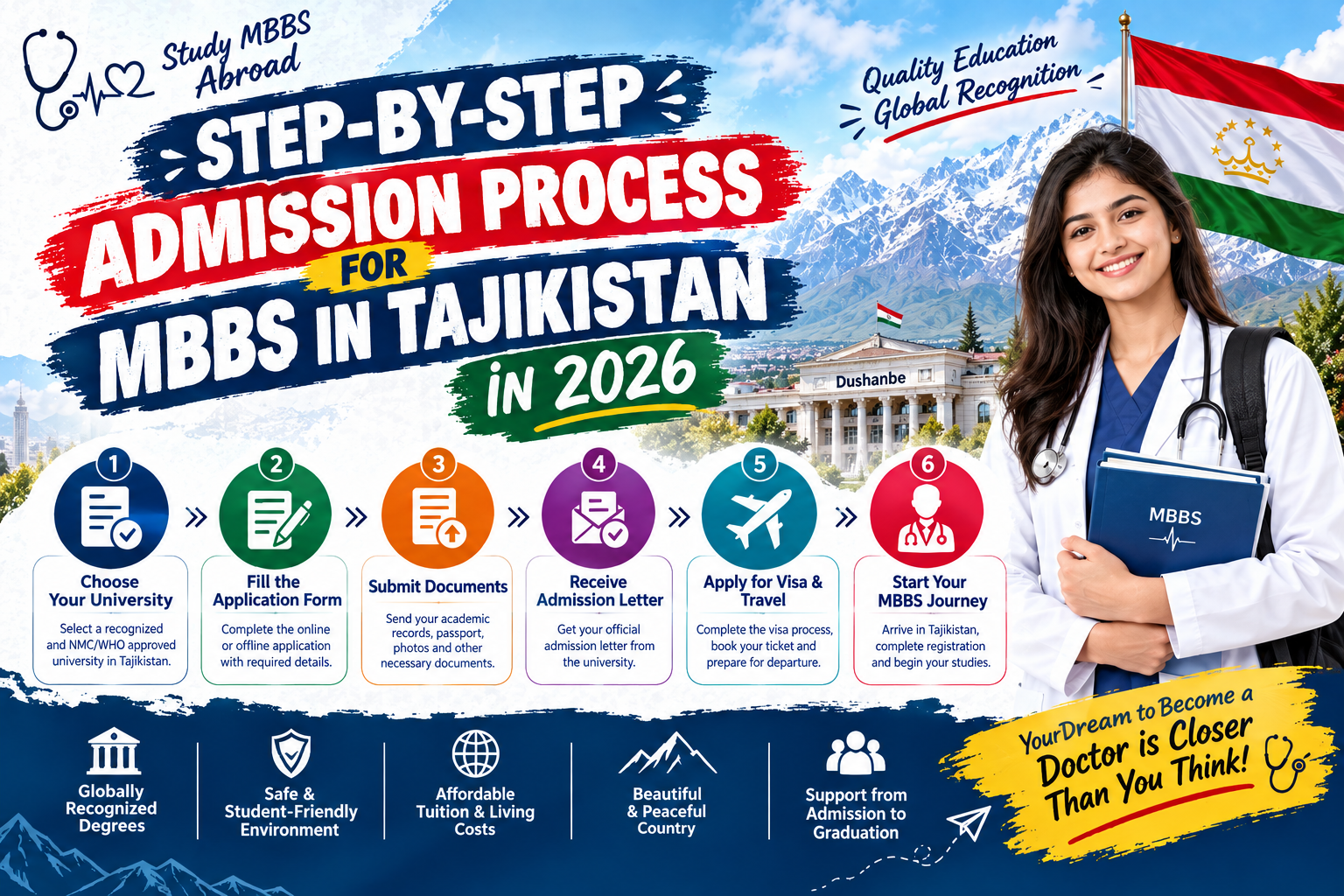
The message usually arrives fast: “Congratulations, your medical seat is confirmed.” Exciting, yes. But an offer letter alone doesn’t confirm that the university, course duration, internship, and future licensing route are suitable for an Indian student. Admission for MBBS in Tajikistan can be fairly straightforward if your documents are correct and the university has been checked properly. The process generally moves through eligibility verification, NEET qualification, university selection, application submission, offer-letter review, fee payment, invitation processing, visa application, and registration after arrival. Every step needs proof. Preferably in writing.
Step 1: Check the Basic Academic Eligibility
Can a student apply immediately after Class 12? Usually, yes, provided the academic and age requirements are satisfied. Indian applicants should have studied Physics, Chemistry, Biology or Biotechnology, and English from a recognised board. Under the commonly applicable framework, general-category candidates need at least 50% aggregate marks in PCB, while eligible reserved-category candidates generally require 40%. PwD requirements may differ. Applicants should ordinarily be at least 17 years old by December 31 of the admission year. Some universities may set a higher PCB expectation or review individual marks in Biology, Chemistry, and Physics. For international students from countries other than India, admission criteria can differ. They should check both the Tajik university requirements and the medical registration rules of their home country. Getting admitted abroad and becoming eligible to practise back home are separate matters.
Step 2: Qualify NEET-UG 2026
Here’s the part Indian students shouldn’t try to work around. Under applicable regulations, Indian citizens and Overseas Citizens of India seeking a primary medical qualification abroad generally need to qualify NEET-UG if they intend to pursue medical registration in India. The category-wise qualifying marks change each year. Check the official NEET website for the 2026 information bulletin, application dates, examination schedule, result, and declared cutoff. Don’t accept a predicted score as final before NTA publishes the result. Qualifying NEET doesn’t mean securing the score required for an Indian government medical college. Those cutoffs are usually much higher. For foreign medical admission, the student must satisfy the official qualifying standard along with every other regulatory condition.
Save these records:
- NEET application confirmation
- Admit card
- Scorecard
- Result document
- Registered email and mobile details
Make several digital backups. Six years later, you won’t want to search an inactive email account for a missing scorecard.
Step 3: Shortlist the Right Medical University
A low fee catches attention. It shouldn’t close the decision. Students considering MBBS in Tajikistan should compare universities using academic and regulatory factors rather than relying on campus photographs or the number of Indian students already enrolled. Avicenna Tajik State Medical University in Dushanbe is among the better-known names, but every institution and programme must be checked separately for the 2026 intake.
Your comparison should include:
|
Area |
What to verify |
|
University status |
Legal recognition in Tajikistan |
|
Medical programme |
Accreditation and exact degree title |
|
Course duration |
Academic years plus internship |
|
Teaching language |
English in lectures, practicals, and examinations |
|
Clinical training |
Hospital names and start of rotations |
|
Local registration |
Eligibility to obtain a licence in Tajikistan |
|
Tuition |
Official annual fee and increase policy |
|
Student support |
Hostel, visa, insurance, and international office |
Talk to current fourth-, fifth-, or final-year students. Freshers can describe admission and hostel food, but they usually can’t judge clinical training.
Step 4: Verify NMC Compliance Before Applying
This deserves more attention than it usually gets. Honestly, many families examine hostel rooms more carefully than the internship structure. The National Medical Commission publishes regulations and clarifications for foreign medical graduates. Indian applicants should examine current conditions related to programme duration, required medical subjects, English-medium education, clinical training, internship, and eligibility for medical registration in the country awarding the qualification. NMC doesn’t offer a simple permanent list of foreign universities that guarantees registration for every graduate. Avoid treating claims such as “100% NMC approved” as a complete verification.
Ask the university for written confirmation of:
- Total academic duration in months
- Complete semester-wise curriculum
- Internship duration and institution
- Location of every clinical rotation
- Medium of instruction
- Eligibility for local medical registration
- Degree-awarding authority
- Whether the programme requires any transfer
If an agent says the course lasts five years and the internship will be “managed later,” stop. That answer isn’t good enough.
Step 5: Check WDOMS and Accreditation Information
A listing in the World Directory of Medical Schools is useful for confirming directory details about a medical school and its programme. However, WDOMS states that inclusion doesn’t itself constitute recognition, accreditation, or endorsement. You may also see “WHO-approved university” in advertisements. The World Health Organization works on international public health; it doesn’t issue an automatic individual college approval that guarantees a graduate’s registration in India.
Students should check three different things:
- The university’s legal status in Tajikistan
- The accreditation of the specific medical programme
- The programme’s compatibility with Indian regulations
One directory listing can’t replace these checks. Neither can a row of logos on a brochure.
Step 6: Confirm the Course Duration and Internship
Medical programmes in Tajikistan are sometimes advertised as five years, five-plus-one years, or six years. That inconsistency is exactly why students need official documents. Before applying for MBBS in Tajikistan, request a curriculum showing the number of semesters, teaching months, holidays, examinations, clinical postings, and internship schedule. Confirm whether the internship is part of the quoted duration and whether it takes place at the same university or its approved teaching hospitals. A typical advertised structure may include five academic years followed by one year of internship or practical training. But don’t assume every institution follows an identical model. Indian students should verify whether the programme meets the full duration and internship requirements that apply to their admission batch. The cheapest shorter-looking course can become extremely expensive if it creates an eligibility problem later.
Step 7: Calculate the Complete Six-Year Cost
Tuition is only the beginning. Medical tuition in Tajikistan may broadly range from USD 3,000 to USD 5,500 per year, depending on the institution and programme. Hostel charges may fall around USD 500–1,200 annually. Food and ordinary living expenses can add roughly USD 120–250 per month. Students using private apartments, food-delivery services, frequent taxis, or imported products will spend more.
|
Expense |
Approximate range |
|
Annual tuition |
USD 3,000–5,500 |
|
Hostel per year |
USD 500–1,200 |
|
Food and daily living |
USD 120–250 per month |
|
Insurance and medical tests |
Varies |
|
Visa and registration |
Varies |
|
Flights |
Depends on route and season |
|
Initial clothing and supplies |
USD 200–500 approximately |
The complete cost of MBBS in Tajikistan may reach approximately ₹20–35 lakh or more. Currency movement, annual fee revision, mess charges, air travel, and personal habits affect the final amount.
Ask the university or authorised representative about:
- Application charges
- Invitation-letter fee
- Annual registration
- Visa renewal
- Health insurance
- Medical examination
- Hostel deposit
- Laboratory and examination fees
- Indian mess
- Airport pickup
- Consultancy charges
Fees can look low. Very low. Until the exclusions begin.
Step 8: Prepare the Required Documents
Now the practical work starts. Most universities initially accept scanned documents and request originals or verified copies later.
Applicants commonly need:
- Valid passport
- Class 10 marksheet and certificate
- Class 12 marksheet and certificate
- NEET-UG scorecard
- Passport-size photographs
- Birth certificate, where required
- Medical fitness certificate
- HIV test report, if prescribed
- Police clearance certificate, if requested
- Completed university application form
- Parent or sponsor details
- Bank or financial documents, where applicable
Document requirements vary, so obtain a personalised checklist for the 2026 intake. Some papers may require notarisation, apostille, legalisation, or certified translation. Check name spellings carefully. “Mohd” on one document and “Mohammad” on another may appear minor, but such differences can delay verification.
Step 9: Submit the University Application
Applications for the main autumn intake often begin during spring or early summer and may continue through August or September. Exact dates differ by university. Applying earlier gives students more time for document corrections, invitation processing, visa formalities, and hostel allocation.
The application process usually involves:
- Completing the official form
- Uploading clear document scans
- Paying an application fee, if required
- Attending an interview or assessment
- Responding to document queries
- Receiving a provisional offer
Use clear, full-page scans rather than cropped mobile photographs. The passport number, name, marks, signatures, and official stamps should be readable.Some universities may conduct a basic interview covering English communication, school-level science, motivation for studying medicine, and financial preparedness. It isn’t usually designed like NEET, but students should still prepare.
Step 10: Review the Offer Letter Carefully
I always recommend reading an offer letter twice—once for excitement, once for facts. The document should mention the correct student name, programme, academic session, university, tuition, payment schedule, and reporting conditions. Check whether it is provisional or final. Confirm its authenticity directly through the university’s official email address.
Pay attention to:
- Programme name and degree
- Teaching medium
- Total duration
- Annual tuition
- Refund conditions
- Deadline for payment
- Hostel allocation
- Reporting date
- Documents required at arrival
A sentence such as “fees are non-refundable” deserves attention before payment, not afterwards.
Step 11: Pay Only Through a Verified Channel
This is where haste becomes expensive. Transfer university fees only to the institution’s official bank account or an authorised account that can be independently verified. A request to send a large payment to an individual’s personal bank account should raise questions. Ask for an invoice, beneficiary details, payment purpose, and official receipt. Keep the SWIFT record or bank confirmation. Avoid paying the entire six-year tuition in advance unless the university formally requires it and you have verified the policy. Year-wise or semester-wise payment is usually easier to document and financially safer. Cash without a receipt? No.
Step 12: Obtain the Invitation Letter
After the university confirms admission and any required initial payment, it generally begins the invitation process. The official invitation is used for the student visa or entry procedure. Processing time can vary. Don’t book a non-refundable flight because someone says the letter will arrive in three days. Wait for the actual document and confirm the next visa step.
Check that the invitation contains:
- Correct passport number
- Full name matching the passport
- University name
- Programme or study purpose
- Validity dates
- Issuing authority details
Any error should be corrected before submitting the visa application.
Step 13: Apply for the Student Visa
Visa requirements depend on current Tajik immigration procedures and the applicant’s nationality. Indian students should verify the latest list with the Embassy of Tajikistan or the officially authorised visa channel. Commonly required documents may include the passport, application form, photographs, university admission letter, official invitation, fee receipt, medical documents, insurance, and proof of funds. After receiving the visa, check the name, passport number, category, entry validity, and expiry date. Simple work. Necessary work. Families should avoid treating visa approval as automatic. Incomplete documents, passport errors, or inconsistent information can delay the process.
Step 14: Arrange Hostel, Insurance and Travel
The admission is confirmed. Now daily life needs planning. Ask for written hostel information, including room-sharing arrangement, annual charge, security deposit, heating, electricity, Wi-Fi, kitchen access, bedding, distance from campus, and move-in date. Current photographs or a live room video are more useful than old promotional images. Purchase suitable medical and travel insurance according to current university and immigration requirements. Keep essential medicines with valid prescriptions and pack original documents in cabin baggage.
Students should carry:
- Passport and visa
- Admission and invitation letters
- Original academic certificates
- NEET scorecard
- Fee receipts
- Insurance documents
- Medical reports
- Hostel confirmation
- Emergency contact details
Don’t put all originals inside checked luggage. Bags occasionally travel on their own itinerary.
Step 15: Complete Registration After Arrival
Landing in Tajikistan doesn’t finish the admission process. Students generally need to report to the university, submit original documents, complete medical screening, confirm tuition payment, register for the hostel, and complete immigration or residence formalities. Attend the university orientation. It normally explains attendance rules, academic schedules, examinations, local laws, emergency procedures, and international-student services.
Keep copies of every post-arrival record:
- Student identity card
- Enrolment certificate
- Hostel agreement
- Immigration registration
- Insurance policy
- Medical reports
- Tuition receipt
- Academic timetable
Missing a registration deadline can cause unnecessary stress. Put reminders on your phone. Boring, but effective.
FMGE, NExT and Planning Beyond Admission
The admission process should be planned with graduation in mind. Eligible foreign medical graduates must satisfy NMC requirements and complete the licensing or registration pathway applicable when they return to India. FMGE remains relevant in 2026. NExT regulations have also been notified, though implementation developments should be followed through official NMC notices. Students beginning a medical programme now shouldn’t assume that the licensing process will remain unchanged for six years. Start light MCQ practice during the early academic years. Build stronger exam preparation during pathology, pharmacology, microbiology, and clinical subjects. Preserve the curriculum, marksheets, clinical logs, internship documents, and attendance records throughout the programme. Admission gets you inside the university. Consistent preparation gets you back ready.
Common Admission Mistakes to Avoid
Sometimes the biggest problem is one rushed decision. Students commonly choose a university only because it has the lowest first-year fee, accept verbal recognition claims, ignore the internship, submit mismatched documents, pay into unverified accounts, or apply through several agents simultaneously.
Other warning signs include:
- Guaranteed Indian registration
- No need for NEET
- No local language needed in hospitals
- Internship details will be confirmed later
- WDOMS listing means approval everywhere
- Full payment required immediately
- Refusal to provide an official fee sheet
Ask uncomfortable questions. A reliable admission route should tolerate them.
Frequently Asked Questions
When does admission for 2026 usually begin?
Applications commonly open during spring or early summer for an autumn intake. Some universities may accept applications through August or September, but early submission provides more time for the invitation and visa.
Is NEET compulsory for Indian students?
Indian applicants seeking a foreign medical qualification and intending to pursue registration in India generally need to qualify NEET under the applicable regulations.
Is there a separate entrance examination?
Many institutions assess international applicants through academic documents and an interview. A university may conduct its own science or English assessment, so check its specific 2026 policy.
What is the approximate total programme cost?
A broad estimate may range from ₹20 lakh to ₹35 lakh or more, including tuition, hostel, food, travel, and routine charges. Students should obtain a current written quotation before applying.
Is WDOMS listing enough for Indian registration?
No. WDOMS listing doesn’t automatically guarantee NMC compliance or registration. The programme, internship, student eligibility, and qualification must meet the rules applicable in India.
Can students apply before the NEET result?
Some universities may accept a provisional application using Class 12 records. Indian applicants should avoid final non-refundable commitments until their NEET qualification and regulatory eligibility are clear.
Conclusion
A safe foreign medical admission doesn’t happen through one phone call. It requires eligibility checks, university verification, a complete cost calculation, accurate documents, an authentic offer letter, secure payment, visa approval, and post-arrival registration. Take your time. Keep records. Verify claims independently. Students planning MBBS in Tajikistan in 2026 should compare universities on course duration, internship, clinical access, language support, local licensing eligibility, and full fees—not merely the first-year package. A careful application may take a few extra weeks. Fixing a poor admission decision can take years.