
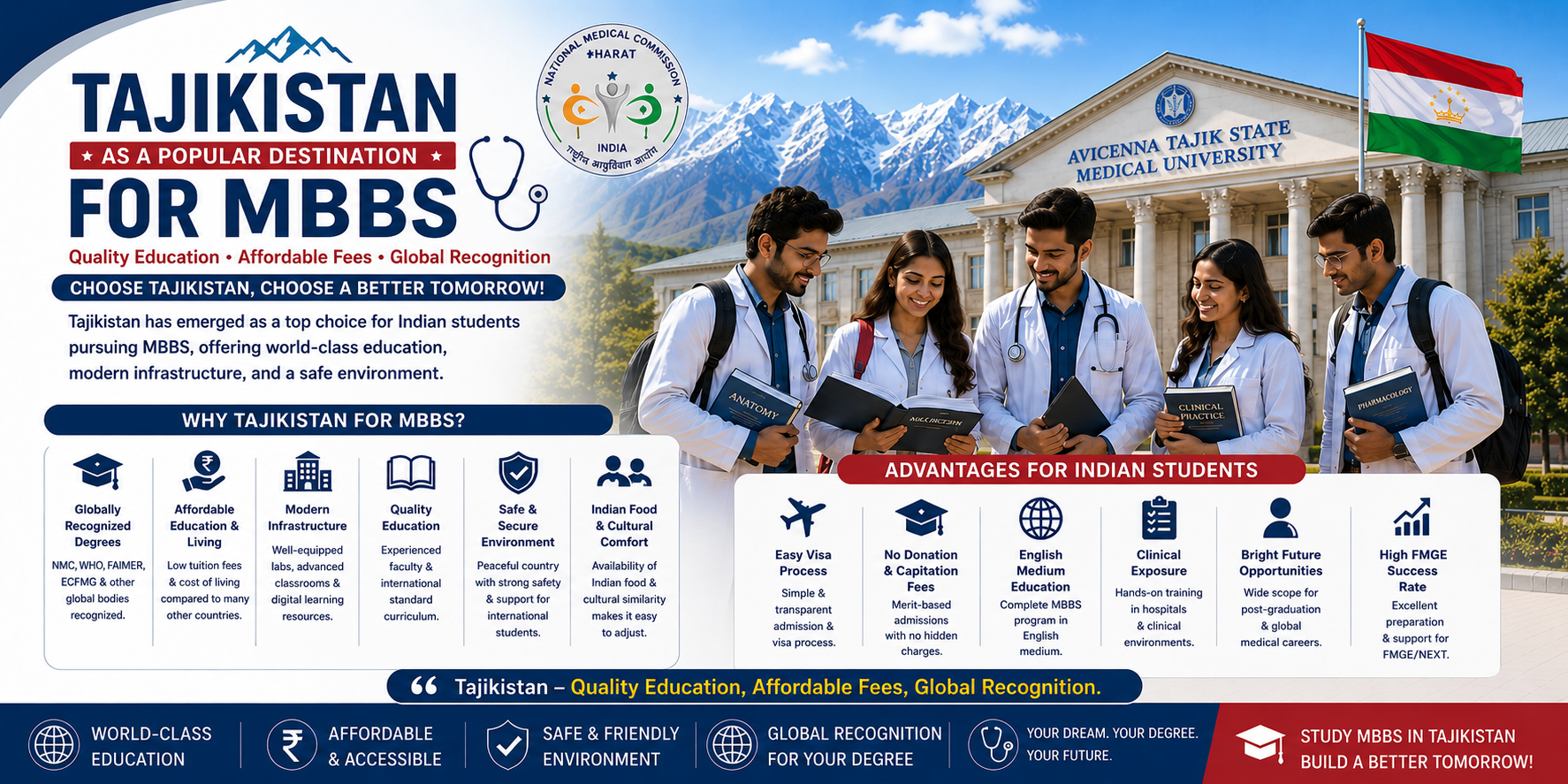
Among the Options Available Abroad for Indian Students Wanting to Study MBBS in Tajikistan, Over the Past Years, Tajikistan Has Emerged as One of the Most Popular Options. This is Due to the Existence of Medical Universities That Are Recognized as Meeting International Standards, the Availability of Advanced Methodologies in Teaching, and the Presence of a Student-Centered Environment. Medical Colleges in Tajikistan Are Considered to Be More Affordable Than the Cost of Private Medical Colleges in India. Hence, It Is an Opportunity That Parents From the Middle Class Are Willing to Give to Their Children. The Presence of Indian Students and the Teaching of Subjects in English Are Also Considered to Be Advantages.
Tajikistan Has So Many Advantages as a Country That the Indian Students Choosing to Study Medicine Are Increasing all the Time.
- Medical Colleges Are Recognized
- Modern Facilities
- Safe Environment for International Students
- Affordable Tuition and Living Costs
- Programs Offered in English
Step 1. Eligibility Criteria
Before Commencing Admission Procedures Students Will Need to Ensure That They Meet the Minimum Required Criteria, Set by the University as Well as the Authorities. This Is Crucial to Avoid Situations Where Students Are Denied Admission to Their Programs and Suffer From Problems in Obtaining a License to Practice. While Their Main Concern Is Meeting the Qualifications to Study MBBS in Tajikistan They Will Also Need to Meet the NEET Requirements as Well as Age Restrictions.
Required Qualifications
- NEET
- Age Requirements
Students Will Also Need to Show Proof of Completion of Class 12 and of Courses in the Sciences. Students Should Avoid Late Applicants, as Medical Colleges.Lead to Students Being Denied Admission Due to Failure to Meet the Age Requirements.
According to the NMC's guidelines, Indian students who wish to return to India to practice medicine must have completed the NEET and obtained a medical qualification.
Step 2: Do Your Research, and Choose the Best Fit Medical University
Choosing a university is perhaps the most important decision for students in the entire process. While selecting a medical program, many students look only at the cost, but recognition, quality of clinical exposure, faculty, and infrastructure also warrant consideration. The university that students choose has a long-lasting impact on their future career options and postgraduate opportunities.
Factors to Consider While Selecting a University
- How is the University Recognized/Accredited?
- Do they Appear on the World Directory of Medical Schools (WDOMS)?
- Do they Comply with the NMC?
- Which Hospitals are Affiliated?
- What Clinical Exposure Do They Offer?
- What are the Hostels/Student Facilities?
- What is the Faculty’s Experience?
Step 3: Apply
After selecting a university, students must submit an application. Most medical universities in Tajikistan have an online system that facilitates applications for international students. To avoid delays to the processing of an application, students must ensure that the application corresponds exactly to their official documents.
What is Often Included in Medical University Applications?
Some biographical data, academic qualifications, contact details, passport data, and course details.
Step 4: Gather the Required Documents to Finalize Your Application Submission
Without the correct documents, applicants cannot gain admission to a university. Each required document must be verified and judged original. Students must ensure that each of the required documents is prepared well in advance to avoid delays.
What are the Required Documents?
- Mark sheets of class 10 and 12
- School leaving certificates
- Identification
- Passports
- Passport size photographs
What are the Additional Documents?
- Scorecards and Medical Fitness Certificates
- Birth Certificate (if required)
Step 5: Receive the Admission Letter
After document verification at the university, eligible students will be issued an official admission letter. This letter is proof of a student's acceptance to the MBBS program in Tajikistan and is required for visa processing.
The admission letter will provide students with the course and fee structure, the reporting date, and instructions for enrollment.
Step 6: Confirm Admission and Pay Fees
Students are required to pay the admission/registration fee as proof of acceptance of the offer and to reserve their seat.
Payments are to be made through the prescribed authority only and students are required to retain their receipts for reference.
Step 7: Apply for a Student Visa
A student visa is required for students to travel to Tajikistan. Hence, students are to apply for the visa without delay after confirming admission to the university. This will avoid delays in travel to Tajikistan and enable students' arrival prior to commencement of the academic session.
Common Visa Documents
- Passport (valid)
- Admission Letter
- Fee Payment Receipt
- Visa Application Form
- Passport Size Photos
Step 8: Understand NMC Guidelines Before Departure
Compliance to NMC Guidelines is the most important step to enable students to practice medicine in India. Students should ensure the university selected is of the adequate course length and provides the required clinical training and internship.
Step 9: Prepare Travel Plans
Students are to make travel arrangements after their visa is approved.
Thorough preparation is helpful almost everywhere when adjusting to student life in Tajikistan.
Preparation of Needs
- Reservations for University Hostel
- Reservations for university hostel placement
- Meal provision
- Safety measures
Travel Preparation
- Flight reservations
- Currency conversion
- Travel insurance
- Necessary documents
Step 10: Finalize Registration at University
Students in Tajikistan must complete the final stage of registration after arrival. This entails verification of documents, allocation to the hostel, health examination, and issuance of a student ID.
Most universities conduct orientation to assist students in understanding the rules of the university and the local culture.