
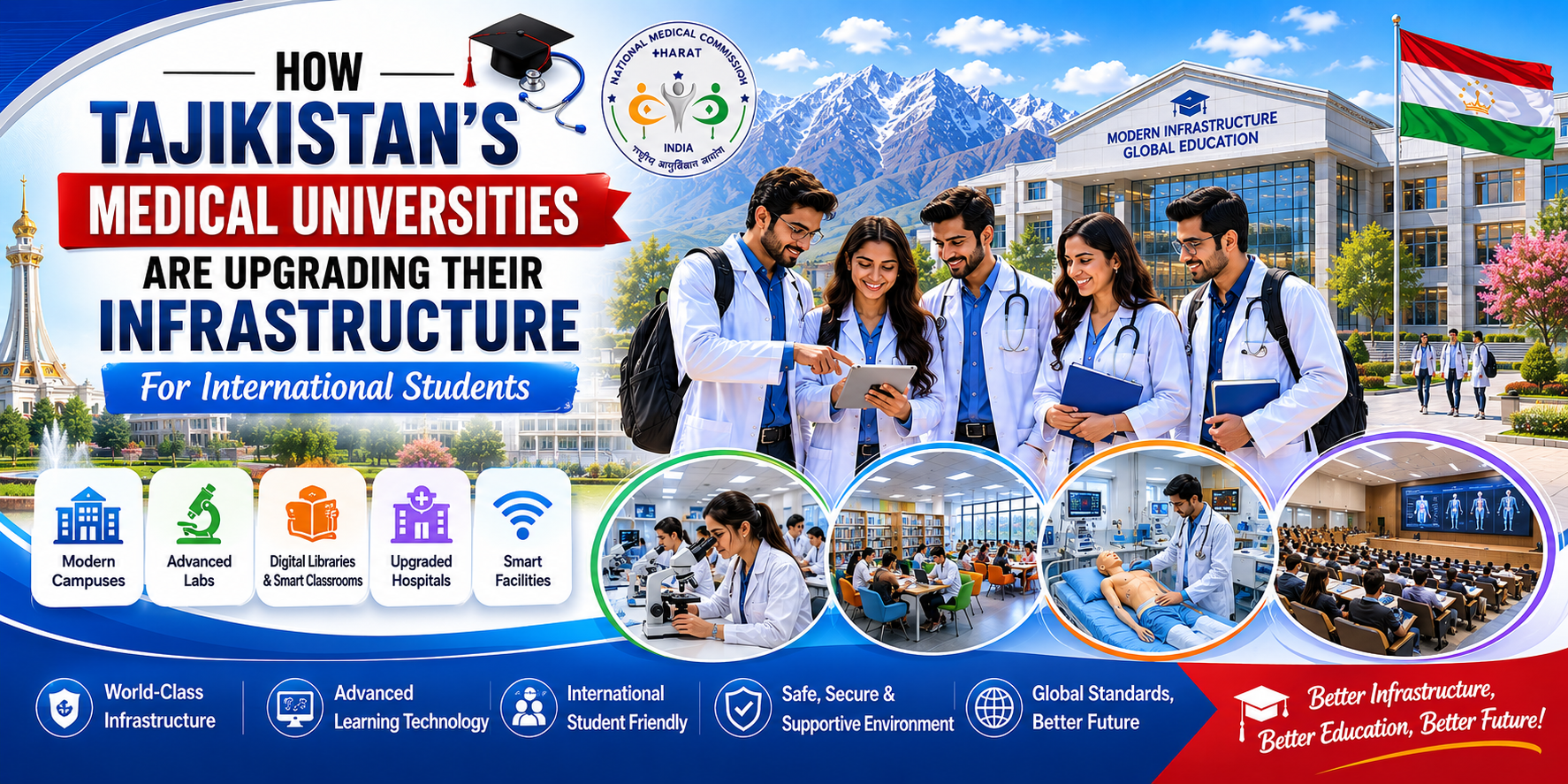
Investments in medical education by many countries have led to radical changes and innovations in many areas of this education system. Traditional classrooms and textbooks are no longer adequate. International students expect medical institutions to provide modern laboratories, advanced clinical training, and digital learning resources. Comfortable accommodation on supportive campuses is also required. Medical universities in Tajikistan are responding to the needs of the global community by continuing to develop and upgrade their infrastructures to bring and accommodate more international students.
The strong investment and upgrades to medical university infrastructure in Tajikistan is a major reason India students believe it is a good choice to study their MBBS there. The focus is to create an environment that is conducive to a medical education of the highest international standards.
International learners have many more options available to them to study medicine than ever before. In this article, we will look at the infrastructure improvements being made by medical universities in Tajikistan and how they seek to enhance the experience of their international learners.
The Role of Technology in Healthcare and Medical Education
Advancements in medical education bring modernization and technology to the classroom. The lecture halls and printed textbooks are a thing of the past.
Universities need to keep investing to build the infrastructures that modern healthcare and systems demand. Teaching hospitals, laboratories, simulation centers, information IT systems, and student support need to be integrated and built.
Medical universities in Tajikistan have recognized this increasingly globalized and interconnected world and are actively working to modernize their campuses to suit the needs of international students and global healthcare practices guided by organizations such as the WHO.
Modernization of Academic Buildings and Classrooms
One conspicuous trend occurring in Tajikistan medical universities is the modernization of teaching facilities.
More and more institutions are modernizing their traditional classrooms into technology-integrated rooms to boost their teaching and learning activities. This makes teaching and learning more interactive and fosters better engagement and communication between faculty and students.
Classrooms of the Future Are Fitted With
- Multimedia presentation systems and smart teaching technologies
- Audio-visual learning tools
- Ergonomic/flexible desks and chairs
- Classrooms with enhanced illumination/lighting and air-conditioning
- Learning environments that are climate and air quality controlled
Upgraded learning environments provide medical students with a comfortable and effective learning and teaching environment.
Expansion of Medical Laboratories
Medicinal education/laboratory learning is one of the most crucial and essential components of modern-day medical practice. To become competent healthcare practitioners, medical students should modernize their knowledge with practice.
With this in mind, modern-day Tajik medical schools have expanded and renovated their medical laboratories.
Anatomy Laboratories
Modern anatomy laboratories allow students to learn and practice the art of anatomy and help students learn the structures and systems of the human body.
Physiology Laboratories
These labs help students learn how systems of the human body function in both healthy and diseased states.
Biochemistry Laboratories
Well-equipped biochemistry labs help students develop skills in various biochemistry analytical and diagnostic techniques and experiments.
Microbiology Laboratories
Through scheduled practical sessions, students are provided with the opportunity to gain knowledge and skills related to microorganisms and infectious diseases, as well as the laboratory investigative skills and techniques.
Upgraded laboratory infrastructure supports practical skills and improves learning outcomes and student confidence.
Clinical Skill Development and Simulation Centers
One of the major breakthroughs in medical education in recent years is the ability to learn through the application of simulation.
Simulation centers enable students to practice clinical competencies within a safe environment, prior to their clinical interactions with actual patients.
An increasing number of medical universities are incorporating simulation-based training facilities that may comprise:
- Clinical Skills Labs
- Procedure Training Labs
- Emergency Simulations
- Patient Assessment
- Communication Skills
Simulation technology allows the learner to correct errors and implement learning within a safe environment, and as a result, students are afforded the opportunity to gain clinical confidence prior to their clinical practice.
For foreign students who undertake the MBBS program in Tajikistan, access to simulation-based learning is a considerable enhancement to the level of education provided.
Strengthening Hospital Partnerships and Clinical Infrastructure
Extensive clinical education is a requirement of medical training. Universities recognize the need for students to interact with patients and members of the health profession to develop the clinical skills required for practice.
Consequently, a large number of enterprises are enhancing the relationships of teaching hospitals and health care institutions.
These Associations Enable
- Clinical placements
- Bedside teaching
- Direct patient care
- Exposure to different specialty departments
- Internship placements
Enhanced clinical infrastructure ensures that students are able to gain clinical practice in different medical disciplines that comprise Medicine, Surgery, Pediatrics, Obstetrics and Emergency Medicine.
Investing in Digital Learning Technologies
The rapid global digitization of educational practices has influenced medical universities in Tajikistan to implement technological innovations in their teaching practices.
The renovation of Digital Infrastructure traditionally involves:
E-Learning Systems
Students using online learning systems can easily access lectures, assignments, and learning materials at any time.
Digital Libraries
Modern digital libraries have:
- Medical journals
- Research databases
- eBooks
- Academic publications
- Clinical guidelines
Virtual Learning Resources
Digital anatomy software, medical imaging, and virtual case studies have become huge learning aids that impact how students learn. These resources help students learn current medical information and develop the skills to learn independently.
Improved Hostel and Accommodation Facilities
International students perceive accommodation quality to have a direct impact on overall satisfaction and academic performance. To remedy this, a number of universities have dedicated funds to improve student housing.
Modern Hostels May Have
- Furnished rooms
- Fast internet
- Study areas
- Game areas
- Security Systems
- Laundry
- Dining
Comfortable hostels allow students to focus on their studies and help them adjust to living in a different country.
Enhanced Internet and Campus Connectivity
Medical students have a need for good internet connection. Students need good internet connection to:
- Research
- Attend lectures
- Communicate
- Access digital libraries
- Prepare for exams
To cater to these needs, more universities have developed their digital connectivity infrastructures and improved campus wide internet.
Better internet access fosters learning and helps students communicate with their families.
Expansion of Library Resources
Despite the prominence of digital learning in medical education, libraries still play a major role. To keep up with digital learning, most universities have dedicated funds to improve their libraries (both physical and online).
Students Have Better Access To
- Medical text books
- Clinical books
- Research journals
- Study Preparation Materials
- Study Spaces
Libraries play a critical role in self-study and library presence. The self-study is a component of the library's focus in improving academic performance.
Expanded Student Support Services
Building and equipping classrooms is not the only focus of infrastructure development. Medical schools are turning their attention to the student support services.
International students are challenged by the culture, language, and adjustment to the academic system in a foreign country.
To Support the International Students, Medical Schools Are Offering
International Student Offices
These offices help students with their administrative needs, assist them with travel and accommodations, and guide them in a variety of issues.
Academic Counseling
These services assist students balance their academic load and develop effective study skills.
Cultural Integration Programs
These programs help foreign students adjust to the dominant culture while helping them to stay connected to their home societies.
Support services positively impact student success and wellness.
Emphasis on Safety and Security Services
Protecting students is the number one priority of medical schools.
These schools are investing in security services, including:
- Controlled entry to the campus
- Security staff
- Camera surveillance
- Rapid response plans
- Student welfare services
Safety and security services help students stay focused on their education.
Recreational and Wellness Services
Medical education is an intensive academic study. Schools are supporting wellness by adding recreation services and infrastructure.
Many are adding:
- Sports complexes
- Fitness centers
- Recreational areas
- Dedicated activity areas
- Wellness services
These encourage active lifestyles and provide opportunities for students to interact socially.
Supporting Research and Innovation
Research is a growing focus for advanced medical education.
To attract gifted students and faculty and stimulate research and innovation, universities are beginning to invest in research infrastructures. Increasing the scope of research in schools can improve:
- Research-oriented facilities/ laboratories
- Research equipment
- Research mentorship
- Academic collaborations
Participating in research fosters development of critical thinking and is beneficial for students’ professional careers.
The Effects on Indian Students
For Indian students pursuing MBBS in Tajikistan, positive changes in infrastructure are beneficial in the following ways:
- Better learning in modern lecture halls
- Improved opportunities for practical training
- Better accommodations and support services
- Better infrastructures for teaching and learning
- Better access to clinical training
- Better access to digital learning and teaching aids
These changes help Indian students and other students pursuing Medical Education in Tajikistan to be better prepared for the realities of their profession.
The Future of Medical Education Infrastructure in Tajikistan
Medical education infrastructures in Tajikistan will continue to improve as universities strive to attract larger numbers of international students and as universities strive to improve their international standings and reputations. Some possible future changes that can be expected are:
- More sophisticated simulation technologies
- More sophisticated training and education technologies
- More sophisticated research technologies
- More sophisticated international collaborations
- More sophisticated health care education technologies
These continued investments will likely improve Tajikistan’s standing and reputation as an emerging new place for international medical studies.
Conclusion
The medical schools of Tajikistan are undergoing a great deal of transformation to modernize educational environments and services in order to make them more suitable for their modern international clientele. There are changes in laboratories, simulation centers, accommodations, digital libraries, and student services due to the focus on infrastructure development and a great deal of investment made by the various institutions.
For students that have made the decision to pursue an MBBS in Tajikistan, these changes have provided much more than just simple construction improvements.
They commit to offering excellent medical training and valuable clinical education along with a caring environment for their students.
As universities advance and grow their systems and infrastructures, international students will continue seeing improved technologies within their classrooms and among their peers, preparing them for medical success both within India and globally.
Important References
- Verify medical university listings through the WDOMS
- Review medical education regulations through the NMC
- Check global healthcare and education standards from the WHO
- Confirm eligibility requirements such as NEET before planning medical studies abroad.