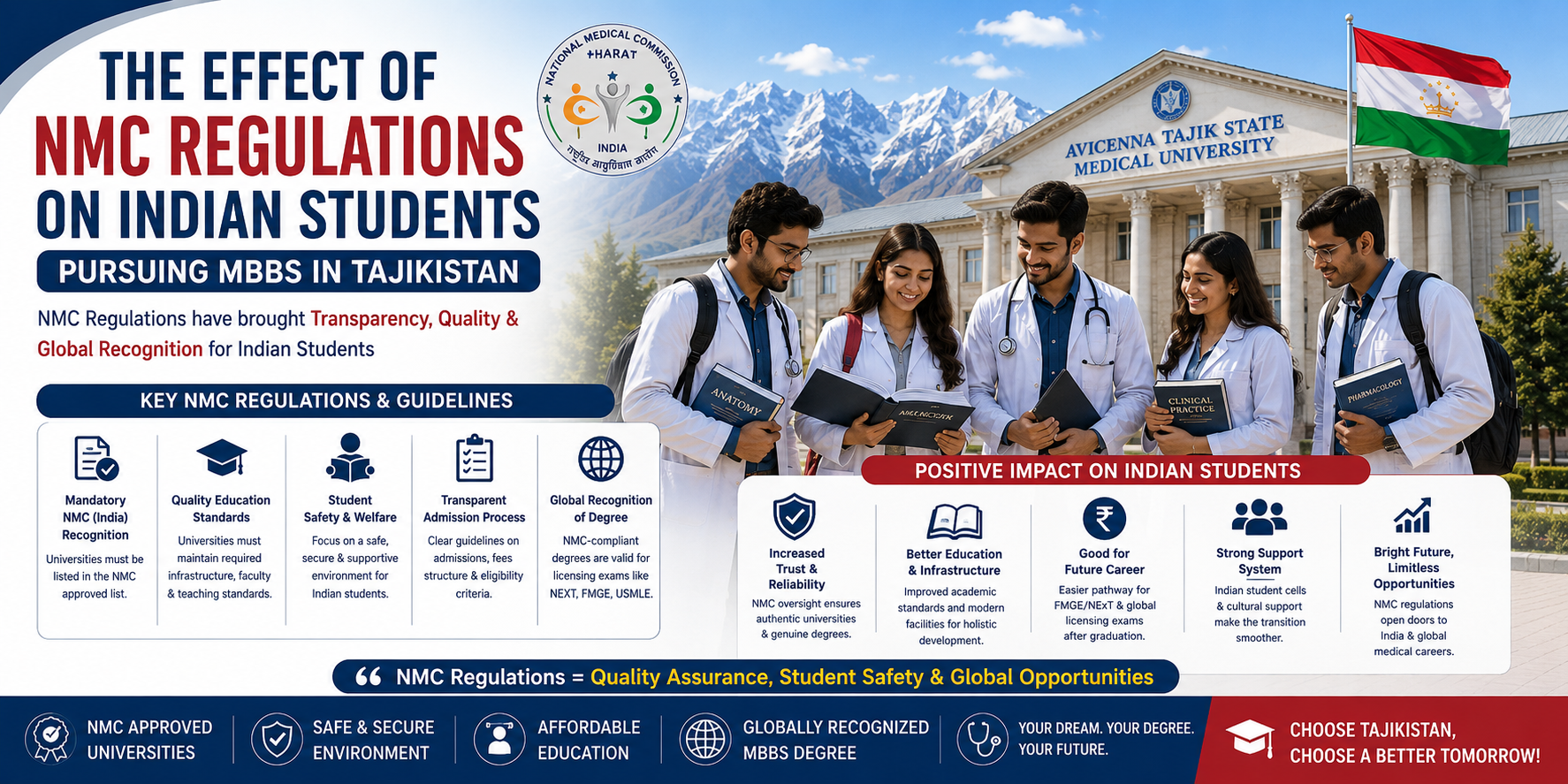
Each year, thousands of Indian citizens leave the country in pursuit of their medical degrees. While the development of Tajikistan as a center for medical education due to lower costs, established universities, and a growing international student body attracts many students, the National Medical Commission (NMC) regulations have altered the ways in which Indian students assess the medical education offered abroad.
Indian students are now faced with the challenge of selecting medical programs that will allow them to secure a medical license in India. NMC regulations are, therefore, extremely influential for students looking to pursue MBBS in Tajikistan.
This paper aims to understand the impact of the NMC regulations on the decisions made by students, the development of the education system, and the influence these changes have on Indian citizens pursuing their medical degrees in Tajikistan.
New Era of Influence of NMC Regulations on Quality of Medical Education Abroad
For a long time, medical students based their selection of medical universities on the costs of tuition, the quality of the university's infrastructure, and the ease of admission. The NMC regulations have shifted the focus toward the quality of education and the preparedness of professionals.
The goal of the NMC regulations is quite simple. Indian students that graduate from foreign medical institutions need to have the same knowledge and skills that Indian students have who graduate from Indian medical institutions.
This method has established a better framework for students wanting to study medicine abroad, and has prompted universities to stay in line with globally accepted academic standards.
For students wishing to pursue MBBS in Tajikistan, this emphasizes the importance of extensive research prior to making a commitment.
Better Research from Students and Parents
A major impact of the NMC regulations has been the better research of students and parents in regards to overseas medical education.
In the past, a large majority of families depended solely on educational agents, not confirming the credentials of the universities themselves. At present, there has been a notable increase in students self-reporting on:
- The status of University recognition
- The framework of the University’s academic syllabus
- The details of the University’s internship program
- The availability and accessibility of clinical training
- The international eligibility standards of the University
This has improved the quality of available information to students and parents, and assisted students in avoiding potentially career restricting choices.
Increased Acceptance of University Recognition
For many students, the new regulations on medical universities have prioritized ranked/recognized universities and avoided making the decision solely on cost.
Now, many students verify that universities are listed in the World Directory of Medical Schools (WDOMS). If a medical school is listed in WDOMS, then it is a good practice to assume the school has met the accepted standards for medical education, and will support licensure in several countries.
This has established a good practice for students to focus on professional practice over financial drawbacks.
This has also encouraged universities in Tajikistan to improve the quality of academic offerings and increase the visibility of their offerings abroad.
The Requirements of Modern Medicine
There is a clear need for the education and training of medical professionals to go beyond the theory.
The doctor can diagnose and treat patients and handle various situations in the healthcare system.
NMC regulations focus on incorporating theory into practice and the need for clinical exposure, motivating students to focus more on learning from the hospitals.
For Indian students studying in Tajikistan, it means focusing more on:
- Learning clinical rotations
- Training and teaching patients
- Learning clinical skills
- Learning through hospital programs
- Training through hospital programs
It has been acknowledged that a career in medicine is almost solely dependent on acquired clinical skills as opposed to classroom theory.
In the long run, a focus on clinical training will improve the system for the doctors of the future and the patients of the future.
Long-Term Career Planning Under NMC Regulations
NMC regulations also encourage clients to think about their career in the long term.
Before, students placed all of their focus on acquiring their MBBS degree. Now students are starting to think about various different things, such as:
- Will I go back to India after I graduate?
- Do I want to go for post-graduate studies to specialize?
- Do I want to do research?
- Will I practice in other countries?
- What licenses do I need to get to practice in other countries?
These questions help students make the best choices regarding the education they want to get when they begin their medical education.
Indian students pursuing an MBBS in Tajikistan are starting to think about their careers in the long term, not just until they graduate.
Regulations and policies can be seen as things that slow down the system, but in actuality, they can be things that help bring about improvements.
International universities know that satisfying evolving regulatory needs is critical to retaining their international student pipeline and gives them a competitive advantage. International students benefit by strengthening the learning environment and educational outcomes.
STRONGER REGULATIONS, STRONGER MEDICAL EDUCATION
One of the critical outcomes of new regulations has been the greater emphasis on the transparency of the medical education process.
Students are now interested in:
- How long is the course?
- How long is the internship?
- How is teaching conducted?
- How is prior learning and experience (clinical) assessed?
- How are students evaluated?
Now, medical schools are becoming more clear and more specific about the programs for the students. This increases students’ abilities to differentiate between schools and makes students’ decisions based on truth rather than the promotional and marketing initiatives.
INCREASING MEDICAL EDUCATION RESPONSIBILITY
NMC standards have somewhat increased students’ responsibility for their medical education. Students are more responsible for:
- Knowing if they meet criteria and are eligible to go to the next step (regulatory)
- Knowing and maintaining their academic records
- Knowing regulatory changes
- Taking and passing medical (practice) licensing exams
- Gaining clinical (practice) competencies
This greater level of responsibility and self-awareness helps prepare students for the realities of the medical profession where they will need to continue learning (the practice) and be responsible for their own professional medical practice.
IMPROVING MEDICAL EDUCATION STANDARDS = GLOBAL COMPETITIVENESS
As the medical profession is becoming more global, the NMC standards are helping raise the educational standards for Indian Medical Graduates and improving Indian Medical Graduates’ global competitiveness.
Medical graduates from Tajikistan who have high academic achievement will have more competitive medical practice opportunities in countries such as:
- India
- UK (United Kingdom)
- US (United States)
- Canada
- Australia
- New Zealand
- Middle East
Greater educational standards will improve confidence of both medical employers and educators across the globe.
Navigating the Impact of NMC Regulations
The NMC regulations create several challenges for medical students, even if the net effect is positive for a majority. These include the following:
Complex Regulations
The medical field has a lot of regulations that may be hard to understand, especially for families and applicants that are new to the process. Students have to understand the regulations on their own instead of depending on the unofficial sources.
Medical Education requires the candidate to be aware of any changes even after the candidate has filed their application. Regulations on Medical Education keep changing and the candidate has to be proactive in order to keep abreast to the information of the National Medical Commission.
Students have to think about the implications of their decisions on their lives several years into the future when choosing a Medical School and the paths that will get them there. Even with the challenges, the informed plans of students can eliminate their potential risks.
Why Tajikistan Stays Attractive
Active consideration of the aforementioned factors, even in changing circumstances, explains why Indian students continue to choose Tajikistan. The factors include:
- Low tuition and living costs
Medical universities in Tajikistan have supportive and engaging learning environments and offer quality medical education in English.
While students have to diagnose recognition status, quality of the curriculum, and compliance of graduation requirements, Tajikistan is still an economically viable option for medical studies.
Tajikistan is a viable option for medical students who have limited options for medical studies.
How to Prepare for Success under NMC Regulations
Students that want maximize their future potential have to take a balanced approach and consider the following:
- Choose a recognized medical school with a strong reputation and quality clinical training.
- Focus on Academics. This is still the most critical component of any career opportunity.
- Direct involvement with patients and practice during an internship or attachment contributes incredibly to professional confidence and builds upon overall capability and competence.
Keep Informed
Maintain a regular update of information from the official websites of the NMC and the World Directory of Medical Schools (WDOMS).
Consider the Future of Licensing
Developing an earlier understanding of the route and process of licensing can assist students to develop and prepare for the rest of their medical career while they are still within school.
Awareness of examinations such as NEET and other licensing requirements can also help students stay aligned with their long-term professional goals.
Conclusion
Rather than acting as a barrier to studying medicine, the introduction of NMC regulations has encouraged Indian students to pursue foreign medical courses with greater transparency, a conscious choice, and an understanding of the improvement in the standards of medical education and clinical training.
For students considering their MBBS in Tajikistan, the regulations ensure the trade in medical education meets their professional requirements at the end of their training.
Those select students aspiring to set up a successful medical practice in India and other countries are the students who will focus on the recognized universities, adjust to new regulations and focus on their academic and clinical excellence. The NMC regulations serve as a framework to develop the future of medicine, build confident and competent medical practitioners and address global competitiveness in alignment with global healthcare standards promoted by organizations such as the World Health Organization (WHO).