
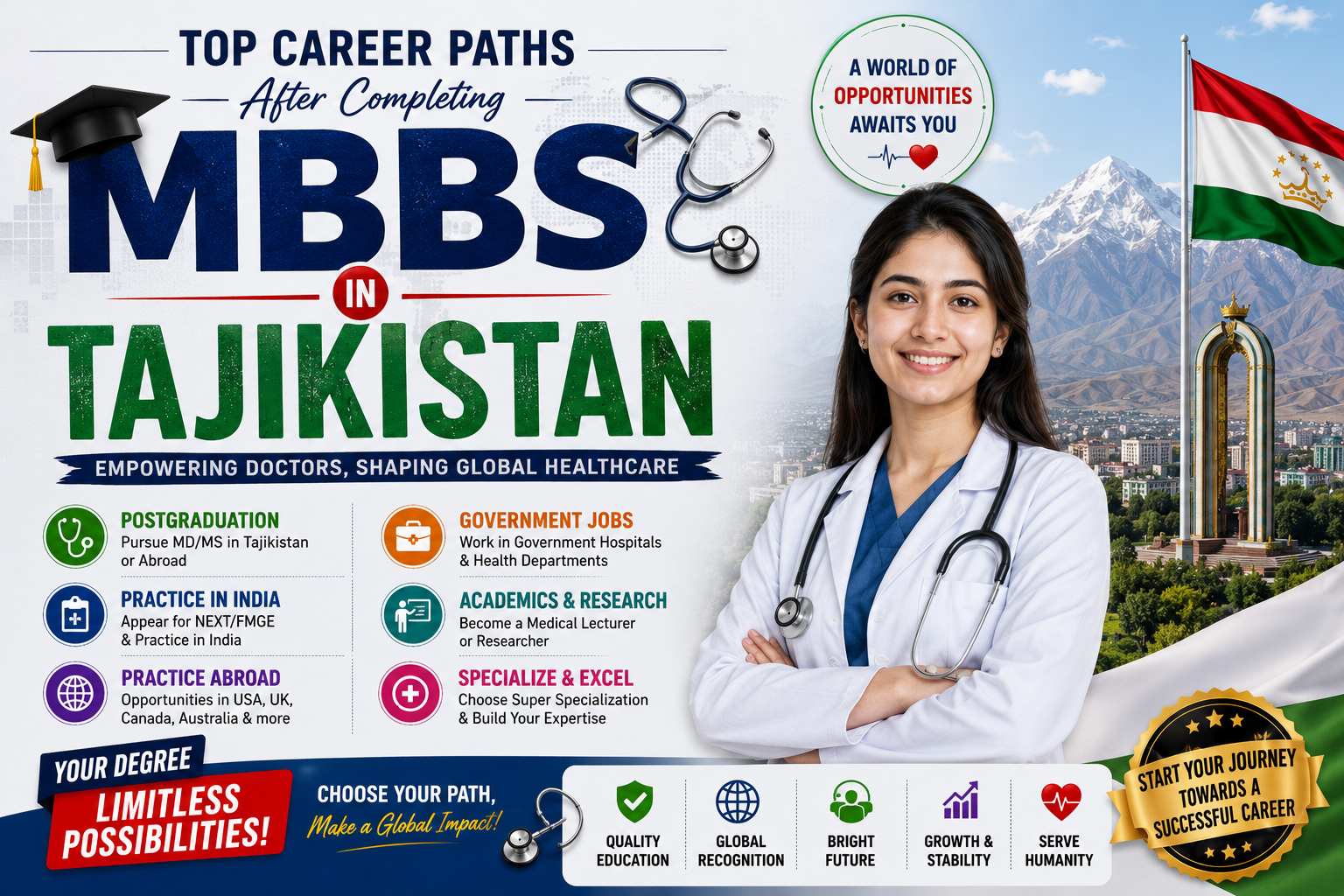
For Indian students aspiring to be medical professionals, studying MBBS in Tajikistan is one of the best and most economical options. Tajikistan has medical institutions that provide medical education that is worldwide recognized, trained faculty, and affordable tuition and has institutions that are recognized by the National Medical Commission (NMC), are in the World Directory of Medical Schools (WDOMS), and are in line with international standards of medical education and the World Health Organization (WHO).
Most students who wish to pursue MBBS in Tajikistan primarily focus on the admission procedure, the tuition fees, and the choice of the university. It is of equal importance that students are aware of the job opportunities available to them after the completion of their studies. MBBS offers students several options that include research, public health, and education management in addition to medical practice.
Those students who embark on their journey to pursue MBBS in Tajikistan must be aware of the opportunities available to them after the completion of the course. Graduates with the appropriate licensing, and postgraduate education in addition to the development of skills have the opportunity to pursue successful medical careers in a number of countries.
Why Choose MBBS in Tajikistan
MBBS in Tajikistan has gained immense popularity among Indian medical seekers due to affordability and international recognition. There is a combination of classroom teaching, lab work, education by simulators, and clinical training in medical institutions in Tajikistan.
The universities on the NMCA, WDOMS, and WHO International Standards for Education in Health catalogue are accredited by the NMCA. This accreditation allows the graduates to sit for the licensing exams in other countries, subject to the law of the respective country.
Candidates who qualify through NEET before the admission are eligible to take the medical licensing exam in India.
Career Option 1: Practice Medicine in India
Practicing medicine in India is the most preferred career option for Indian students after completing their MBBS in Tajikistan.
Indian graduates are required to comply with the evolving medical licensing regulations of the National Medical Commission before securing permanent registration.
With the completion of the registration formalities, they are eligible to work in:
- Government hospitals
- Private hospitals
- Corporate healthcare
- Medical colleges
- Community health centres
- Primary healthcare centres
- Emergency hospitals
There is a huge demand for qualified doctors in rural and semi-urban areas of India, providing ample employment opportunities to licensed medical practitioners.
Career Option 2: Pursue Postgraduate Medical Education
Postgraduate studies are also a preferable option prior to starting professional practice.
The most opted specializations include the following:
- General Medicine
- General Surgery
- Pediatrics
- Orthopedics
- Radiology
- Dermatology
- Psychiatry
- Obstetrics & Gynecology
- Anesthesiology
- Emergency Medicine
- Cardiology
- Neurology
Postgraduate studies provide a considerable advancement in skills and knowledge, increased earning potential, and overall career advancement.
Considering the eligibility requirements, students who have completed their MBBS in Tajikistan have the option to pursue their Postgraduate studies in India or any other country.
Career Option 3: Medical Practice Abroad
One of the bigger benefits of getting an MBBS in Tajikistan is being able to get a universally acknowledged degree, being accepted in the majority of the world.
Graduates can apply to get their medical licenses in:
- The UK
- The USA
- Australia
- Canada
- Germany
- New Zealand
- Most Middle Eastern countries
Each nation has their own procedures and exams for licensure, internships, and language requirements.
Graduates that have a sound plan for their MBBS years usually have lucrative opportunities abroad.
Career Option 4: Hospital Administration
Not all medical graduates practice medicine.
Many MBBS graduates use their medical degree to venture into Hospital Administration.
Their medical background helps them plan and manage:
- Healthcare systems
- Hospital Operations
- Quality of Medicine
- Safety of Patients
- Clinical Medical Coordination and Compliance
- The Implementation of Healthcare Policies
Graduates can aim for key positions in a large Hospital after obtaining an MBA in Hospital Administration or Healthcare Management.
Career Option 5: Medical Research
One of the fastest growing sectors in the world is Medical Research.
Those graduates who are more inclined towards innovative careers can pursue a field in:
- Clinical research
- Pharmaceuticals
- Biotechnology
- Vaccines
- Medical Devices
- Public health
- Research
Professionally, this field will help you create new medicines, improve treatment techniques and Healthcare Research and Technology.
Graduates who completed their MBBS in Tajikistan can opt for Research after their Masters or PhDs.
Career Option 6: Public Health Specialist
After the recent Healthcare Crises, Public Health has acquired great significance.
Medical graduates can participate in the following:
- Disease prevention programs
- National health missions
- International health organizations
- Vaccination campaigns
- Health education programs
- Rural health development
An MPH (Master of Public Health) opens up many more options in this field.
Career Option 7: Medical Teaching
Teaching is one of the most esteemed professions after an MBBS.
Medical teachers educate future doctors on:
- Anatomy
- Physiology
- Pharmacology
- Pathology
- Surgery
- Medicine
- Pediatrics
- Community Medicine
Medical colleges, universities, and other training institutions are in constant need of qualified educators.
Graduates can become lecturers or researchers after completing a postgraduate degree in Medical School.
Career Option 8: Healthcare Entrepreneurship
It is quite common for doctors to start their own healthcare ventures.
These may include:
- Private practices
- Diagnostic centers
- Telemedicine
- Health-tech
- Specialized hospitals
- Consultation services
- Medical training
The doctor-entrepreneur opportunity has flourished along with the advancement of digital healthcare.
Career Option 9: Working in the Pharmaceutical Industry
Pharmaceutical companies are interested in hiring doctors to fill many clinical roles such as:
- Medical Advisor
- Drug Safety Officer
- Clinical Research Associate
- Medical Science Liaison
- Medical Writer
- Product Specialist
- Pharmacovigilance
These roles have a great career trajectory and allow doctors to practice medicine.
Career Option 10: Medical Writing and Health Content
The field of medical communication is growing rapidly.
Doctors can assist in the creation of:
- Reports on clinical research
- Medical Texts
- Health Articles
- Drug info documents and letters
- Construction of Continuing Medical Education (CME) Programs
- Patient Educational Material
Medical Writing relies on the knowledge of a physician and provides many career opportunities.
Career Option 11: Digital Healthcare and Telemedicine
The medical field has changed thanks to digital healthcare.
Now, doctors can offer video consultations and patients in faraway areas can receive medical care.
Some of the options for employment in Telemedicine are:
- Virtual Consult Platforms
- Digital Hospitals
- Virtual Healthcare
- Remote Patient Monitoring
- AI Healthcare
This field will grow more and more in the future.
Career Option 12: Government Healthcare Services
Government jobs are the aim of many MBBS graduates.
Benefits of government jobs are:
- Job security
- Defined promotion system
- Pension (if applicable)
- Remote area healthcare service
- Administrative healthcare positions
Doctors may end up working in government central or state healthcare systems depending on recruitment rules.
There are also plenty of government contract positions.
Skills That Improve Career Success After MBBS in Tajikistan
For a medical career, simply completing the MBBS degree is not enough.
Graduates should focus on improving and developing new skills, such as:
- Developing a clinical judgement and reasoning
- Communication
- Ethics
- Research
- Leadership
- Digital Healthcare
- Emergency response and the ability to keep up to date with recent advancements
The skills listed above should be a focus during a doctor’s career, as they help improve their level of competitiveness, relative to the market and other healthcare practitioners.
International Recognition is Important
There are many factors to consider when a student chooses a university, but the most important should be the level of recognition the university has internationally.
Some of the most important factors are:
- Recognition by the NMC
- Listing in the WDOMS
- International Standards of Medical Education of the WHO
- Eligibility for the NEET Exam
- Adequate Recognition for Licensing Exams and Opportunities for Post Graduation in other countries.
Expected Salary After MBBS in Tajikistan
The earnings of MBBS graduates depend on various factors like choice of specialization, country of employment, years of experience, and the healthcare sector.
Generally speaking, graduates employed in private hospitals, specific medical departments, international healthcare systems, or those who opt for postgraduate specialization generally earn a higher salary than an average MBBS graduate.
The salary of an individual can also depend on other factors such as:
- Medical Specialization
- Clinical Experience
- Country of Employment
- Government vs. Private Sector
- Certifications
- Communication Skills
- Research Experience
Instead of focusing only on the starting salary, graduates can consider other factors such as the growth and advancement of their profession and opportunities for specialization.
Launching a Successful Career After MBBS
Career planning for students who pursue MBBS in Tajikistan should be done during their academic years and not just once they graduate.
This can be done by:
- Paying attention to academic studies
- Successfully completing internships and learning clinical skills
- Improving English and learning to communicate and interact with patients
- Learning about the latest updates in the medical field and adopting new practices
- Learning about the licensing exams and preparing for them
- Attending medical workshops and conferences
- Learning about research and developing skills in this area
- Networking with doctors and mentors
- Continuing education with new courses and postgraduate education
Planning MBBS studies in Tajikistan early on can considerably improve the chances of a successful international career in the field of medicine.
Conclusion
The decision to pursue an MBBS in Tajikistan is more than the affordable price of studies and can open the door for graduates to many rewarding career paths. These include clinical practice, postgraduate specialization, international pathways in medicine, research, public health, medical education, healthcare management, pharmacy, medical technology, and medicine.
Achieving success following graduation involves the selection of a prestigious university, satisfying the NEET eligibility criteria, confirming endorsement by the NMC, checking listing status in the WDOMS, and understanding the universal standards advocated by the WHO. MBBS graduates from Tajikistan can construct successful and professional medical careers by integrating quality education with continuous learning and effective career management.