
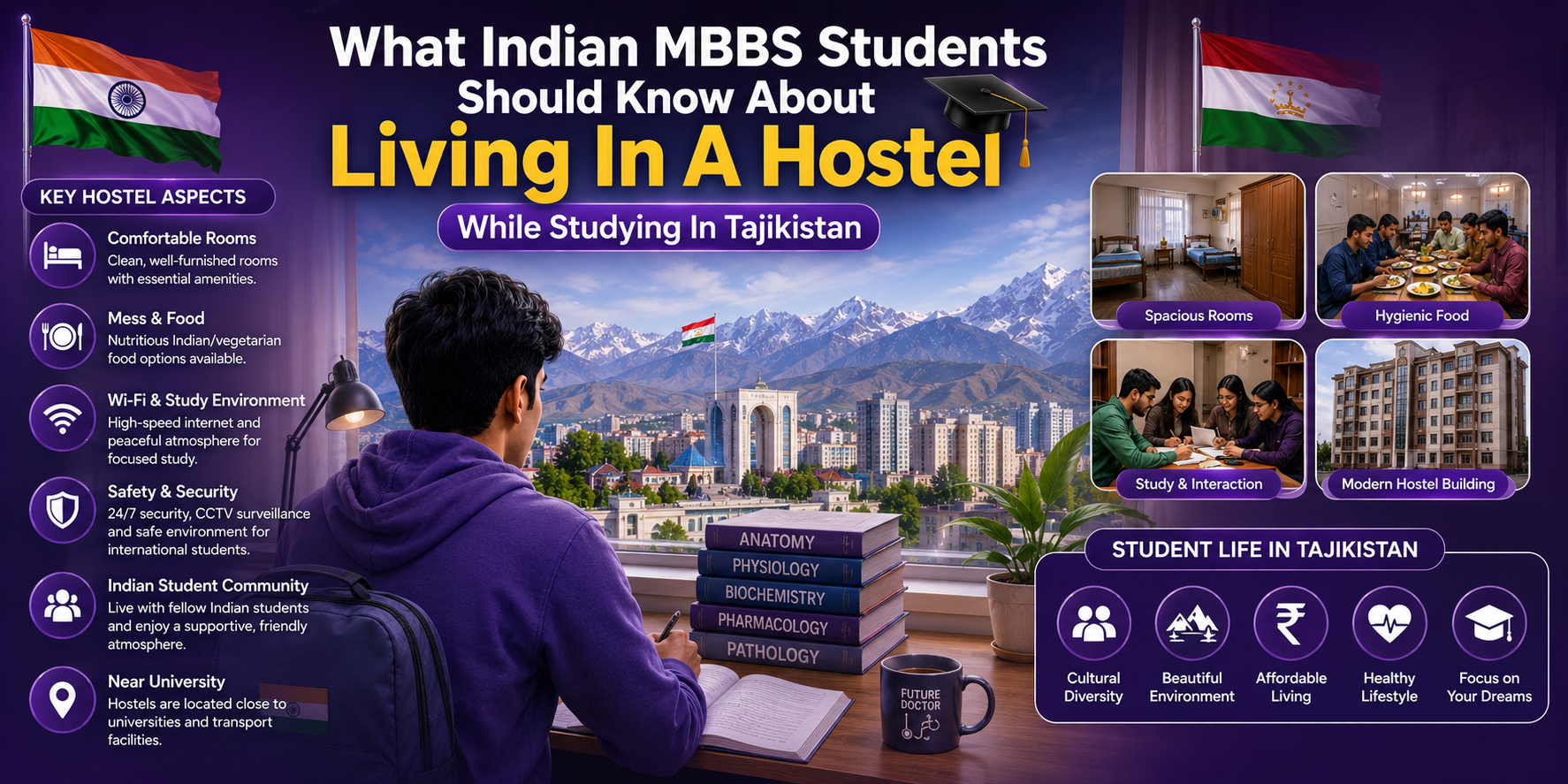
Indian students want to know about more than just the academics when it comes to studying MBBS in Tajikistan — they want to know about the possible hostel life. With students dedicating five to six years studying at these universities, the accommodation that they are provided with becomes their second home.
Indian students, along with their parents, are concerned about the safety, comfort, and overall living conditions of the hostels provided in Tajikistan. We are happy to report that the bulk of the medical universities in Tajikistan built hostels that meet the needs of their international students. There are furnished rooms that come with security, and hostels that serve Indian food and have recreational facilities. The hostels in Tajikistan are a wonderful combination of comfort and variety and appreciate the needs of their students.
Indian MBBS students can refer to this article for an outline of hostels living in Tajikistan.
Importance of Hostel Accommodation for International Students
Students who move to a foreign country to acquire medical education do have to deal with challenges that are beyond their education. These students have to find a way to live in an entirely new environment adjusting to a different culture, climate, and even language.
University hostels offer students a safe, affordable living location that is conveniently close to the facilities they will need on their campus and offers a supportive environment.
University hostels offer students a safe, affordable living location that is conveniently close to the facilities they will need on their campus and offers a supportive environment.
Recent Developments in Hostel Systems
Several medical universities in Tajikistan are modernizing their hostels to meet the demand from an increased international student population.
Students can look forward to:
- Rooms with furniture
- Beds
- Desks and Chairs
- Wardrobes
- Heating
- Washrooms
- Common Kitchens
- Storage
Most hostels are built on existing university campuses, or are located really close to the main academic buildings.
Room Sharing Adaptations
Most students from India book shared rooms.
The common arrangements are:
Double Occupancy
Privacy and sharing are well balanced.
Triple Occupancy
The supportive environment and cost saving accommodations are well balanced.
Separate Accommodations for Boys and Girls
Privacy and safety are attained by maintaining separate hostel buildings or separate floors for male and female students.
How rooms are allocated also depends on what is available.
Safety and Security Features
Safety is the main concern for all parents looking to send their children to a different country.
Most University hostels in Tajikistan address this concern by having a security system that includes each of the following:
- A single entry and exit point
- Security staff
- CCTV
- A visitor registration system
- Hostel wardens
- Emergency support
This system assures a protective environment and students are able to pursue their academic goals with a peace of mind.
Cleanliness and Maintenance
Hostel cleanliness and ease of maintenance have direct effects on student well-being.
Most maintenance teams in university hostels are responsible for:
- Cleaning Up Common Areas
- Waste Disposal
- Electrical Repairs
- Plumbing Repairs
- Maintenance of the Building
Most students are expected to maintain the cleanliness of their own rooms, while the administration of the hostel manages the common areas.
Personal responsibility for cleanliness can also help students become more self-sufficient and independent while staying abroad.
Availability of Indian Food
Food is a major concern for many Indian students when they move abroad.
The good news is that hostels and university canteens in Tajikistan are increasingly tailoring their menus to serve Indian students.
Food items on the menu include:
- Rice
- Chapati or Roti
- Dal
- Vegetable Curries
- Paneer Dishes
- Prepared Chicken
- Indian Spices and Seasonings
Some hostels also have community kitchens, which allow students to cook their own food.
Having their own kitchens is a great way for students to maintain the same eating habits that they had in their own country.
Learning Basic Cooking Skills
Moving to a different country can be the first time that many students have had to live on their own.
Some students take this as an opportunity to learn the following:
- Making Tea or Coffee
- Preparing Instant Meals
- Making Rice
- Basic Indian Cooking
- Making Healthy Snacks
Life skills like these can help students while they are in medical school and well beyond that.
Multicultural Student Environment
Exposure to students from different regions and countries is a key benefit of staying in a hostel.
Students in hostels often interact with students from:
- India
- Nepal
- Bangladesh
- Pakistan
- African countries
- Central Asian countries
- Middle Eastern countries
This diversity is crucial to students’ development by:
- Strengthening their communication skills
- Making them adaptable
- Giving them a global perspective
- Helping them become more culturally aware
- Making them more skilled at building friendships
The personal growth that students through diversity is just as important as the academic development they receive.
Internet and Connectivity
Digital resources have become a major aspect of learning for medical students.
The majority of university hostels offer:
- Wi-Fi
- Internet in study rooms
- Good mobile connections
- Enhanced services for online learning
Students utilize these for:
- Medical research
- Attending online classes
- Keeping in touch with their families
- Study for upcoming tests
Internet services help students connect to the resources they need.
Study Environment in Hostels
Long hours of dedicated study are a requirement for medical education.
To facilitate this:
- Hostels have quiet study rooms
- Study areas
- Individual study desks
Hostels have libraries and areas for group discussions.
Study groups are a vital aspect of preparing for university exams and personal assessments.
Taking care of all the things they need to do to study and manage their time teaches students life skills they need to be a doctor.
They need to know how to:
- Effectively use time
- Balance school with other commitments
- Manage personal finances
- Plan schedules
- Focus on personal wellness
- Manage unforeseen obstacles
Aspects of these skills impact the development of an individual both personally and professionally.
The Diaspora Celebrating Festivals
A false notion is that students are unable to celebrate any cultural festivals when studying abroad.
Actually, Indian students in Tajikistan celebrations include:
- Diwali
- Holi
- Navratri
- Eid
- Independence and Republic Day
Cultural celebrations are supported by the universities and promote the sharing of different cultural backgrounds.
These celebrations promote students being a part of the community and being a part of the celebration instead of being disconnected.
Student Wellness and Healthcare Facilities
The well-being of students is taken into account by the medical universities.
The following are available at most of the institutions:
- On campus medical centers
- Basic health services
- Emergency medical care
- Health consultations
- Health insurance
Both the students and medical professionals in training have the opportunity to see and learn about different health care systems.
The global health standards of the WHO may be seen here:
Climate and Hostel Comfort
Tajikistan's climate may be different to that of most of India as it experiences different seasonal changes.
Most university hostels have:
- Winter heating
- Insulated hostels
- Hot water
- Good living conditions
The majority of students adapt to the climate in a few weeks and learn to manage the changing seasons.
Building Lifelong Friendships
It's a common sentiment among many medical graduates that some of their strongest friendships are from being in hostels.
Living together promotes students' ability to:
- Provide academic support
- Share experiences
- Overcome hurdles
- Celebrate wins
- Reminisce together about the past
Hostel friendships commonly extend beyond university indefinitely and are often the first step towards a valuable career network.
Hostel Life and Academic Success
Having a positive hostel environment can make a big difference in an individual's academic performance.
Some benefits are:
- Easily accessible classmates
- Opportunities to learn together
- Motivated peers
- Accessibility of shared study materials
- Improved time management
Medical studies are particularly challenging, thus a hostel community support system can positively change the hostel community.
Tips for Indian Students Before Moving to Tajikistan
Before pursuing MBBS in Tajikistan, students are advised to:
- Learn basic hostel manners
- Pack your personal items
- Know about the new culture
- Sort your important documents
- Learn basic meal preparation
- Communicate with your family on a regular basis
- Be flexible
Focusing on these tips can help you adapt easily to hostel life and be more academically driven.
Recognition and Future Career Planning
Students must consider the recognition and accreditation of a university by checking the:
National Medical Commission (NMC)
World Directory of Medical Schools (WDOMS)
It is important to check the accreditation status of the university of your choice to ensure you are able to pursue your desired career and have the necessary licensing.
Conclusion
Life in hostels is of utmost importance to all international medical students, including those pursuing MBBS in Tajikistan. Hostels give students much more than just a roof over their heads. They provide facilities for students to hone their life skills, and students build relationships and camaraderie that last for a lifetime and develop their self-sufficiency in the process. Students are helped to ensure that their medical training prepares them for a successful medical career.
The hostels of Tajikistan are designed with modern, secure, multicultural, academical, and Indian culinary facilities. For many Indian students, the years spent in medical schools are often transformative for their career and practice for medicine.