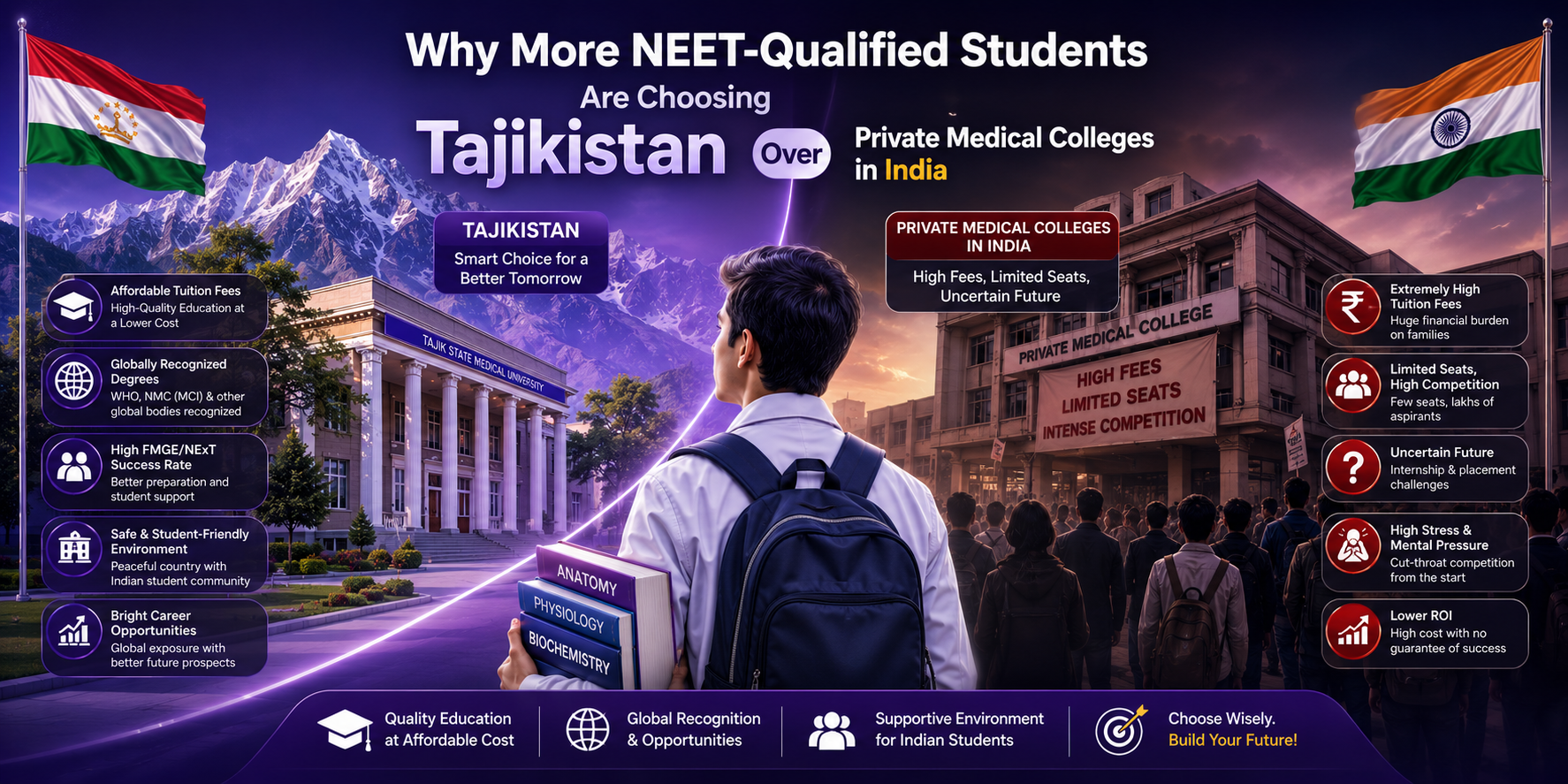
Medical aspirants in India include students from all over the country. Becoming a doctor is a career option that many students aspire to. The National Eligibility cum Entrance Test (NEET) is conducted every year and students who qualify this examination are eligible to get admission to medical colleges across India. However, the competition for securing admission to a government medical college in India is stiff because there are a limited number of seats.
Due to this, many students who qualify NEET are left with the option of either getting admission in the private medical colleges in India or going abroad to get a medical degree. Over the last couple of years, there has been a remarkable change in this trend; rather than seeking admission in the private medical colleges that charge exorbitantly, more students are choosing to go to Tajikistan to pursue their medical degree.
There are a multitude of reasons that are driving this trend, some of which include the cost effectiveness, education standards, recognition across the globe, the availability of a lot of value for money opportunities to get practical training, as well as having a better overall deal. The following are some of the reasons that are driving this trend.
The Challenge of Medical Admissions in India
The demand for MBBS seats across the country is greater than the seats that are available. Even students that have qualified NEET with good scores are unable to gain admission to the government medical colleges across the country because of high competition.
Private medical colleges often become the only option for students who cannot gain access to government medical colleges. Unfortunately, the cost of medical education in private medical colleges is prohibitively expensive for most families. In some private medical colleges, the cost of the MBBS program is considered a burden even for middle-class families.
In the given situation, many parents and students are looking for overseas opportunities that allow students to pursue medical education of good quality without paying a fortune.
Good Quality Education that is Affordable
For good quality medical education, affordable cost is one of the reasons that makes MBBS in Tajikistan really popular.
Tajikistan medical colleges have considerably low medical fees when compared to other medical colleges. These medical colleges are at par with the other medical colleges with international standards. MBBS Tajikistan is much cheaper when compared to many Indian private medical colleges.
For many Indian parents, Tajikistan is a great option as Tajikistan has affordable cost of medical education and good quality medical education.
Affordable Living and Education Costs
Costs of education and living in Tajikistan are affordable as are:
- Hostels
- Transport
- Food
- Medical Services
Tajikistan is an excellent option for Indian families to pursue medical education for their children.
Low Cost Education
Medical education in private Indian medical colleges has a huge cost. It can take a huge toll on the families' savings and a huge education loan is expected.
There is a considerable cost of education in MBBS in Tajikistan. There are considerably low costs as compared to Indian Private Medical Colleges. There is low cost education and low financial burden. Students can study without financial burden and without related stress.
Increasing financial flexibility is a major benefit of studying in Tajikistan.
Internationally Accepted Medical Universities
When choosing a foreign medical university, recognition is always important.
The World Directory of Medical Schools (WDOMS) cites three medical universities in Tajikistan.
World Directory of Medical Schools
World Directory of Medical Schools
Those wishing to study in Tajikistan will want to also ensure that their chosen university is aligned with the guidelines of the National Medical Commission (NMC).
National Medical Commission
National Medical Commission
Similarly, the World Health Organization (WHO) also endorses the aligned international standards of health care education.
World Health Organization
World Health Organization
International recognition guarantees the quality of medical universities in Tajikistan.
Updated Curriculum Meeting Global Medical Education Standards
In the health care sector, there is a growing need for knowledgeable and skilled doctors.
In response to this need, the medical universities of Tajikistan have implemented modern curricula with an emphasis on:
- Medical Sciences
- Clinical Medicine
- Laboratory Training
- Skills Development
- Research
- Community Health
This integrated approach is focused on the growing needs of the medical profession.
Adequate Clinical Exposure and Skill Training
The quality of the clinical training that medical students receive during their MBBS program is always of concern.
Many universities in Tajikistan focus on practical education and have strong links to teach hospitals and health care institutions. This provides students with the opportunity to gain exposure to clinical situations and interact with patients, all under the supervision of a faculty member.
Training is often in the rotation of the discipline.
Internal Medicine
In this discipline, students learn to diagnose disease and to develop treatment and management plans for patients.
General Surgery
Contact with patients and observation of operative techniques aid students’ practical understanding.
Pediatrics
Students learn about the health of children and the control of their development and the management of pediatric illnesses.
Obstetrics and Gynecology
Students learn the health care of mothers and the health care of women and the health care of the reproductive system.
Emergency Medicine
Students learn how to manage medical emergencies and develop the ability to make critical decisions.
These experiences promote self-confidence and readiness for the realities of the profession.
English-Medium Education
Language is vital for the teaching and learning process.
MBBS programs taught in English have been designed in many medical universities in Tajikistan for the international students, which helps the Indian students to better access lectures, tutorials, and the study of medical subjects with little or no language issues.
Instruction in English also helps in preparation for the licensing and post-graduate examinations.
A Growing Hub for Indian Students
More Indian students have been choosing Tajikistan for their studies in recent years.
This growing student community is beneficial for:
- Cultural adaptability
- Peer support
- Indian eateries
- Academic resource sharing
- Social ease
First-time international students can feel safe and relieved knowing how many fellow Indian students there are who can provide support.
Safer and Student-Friendly Environment
Safety is important for students and their parents.
An international student-friendly culture and safety record have helped make Tajikistan a desirable student destination.
Student Support Facilities
Characteristics of the various universities include:
- Secure Hostels
- Student Services
- Student Coordinators
- Active Assistance Programs
- Healthcare Support
While safety and convenience in studying abroad are top priorities, the supportive learning environment motivates and empowers students to pursue their studies.
Greater ROI
The return on investment (ROI) of an education is becoming a high priority for students and their families.
The total cost of education and the quality of education demand a value evaluation. Specifically, MBBS in Tajikistan provides value.
Benefits of Studying in Tajikistan
Tajikistan, the land of aspiring doctors, is the solution for:
- Affordable education
- Recognized qualifications
- Clinical exposure
- Several licensing opportunities
- Better job prospects
- Opportunities for education abroad
Career Enhancement Opportunities
Limited practice in one country is no longer the reality for medical graduates.
Career Pathways
The emerging thought for graduates of esteemed universities is:
- Licensure
- Specialty training
- Clinical Research
- Practice abroad
- Public health
- Global health
The global nature of health care systems is driving a demand for education pathways to meet diverse career opportunities.
Increasing Popularity
The internet has revolutionized educational choices.
Factors Students Evaluate
- Clinical quality
- Faculty
- Services
- Student ratings
- Infrastructure
- Potential careers
Research and analysis of education opportunities have largely contributed to the increasing popularity of Tajikistan among NEET students.
Reduced Pressure, Greater Possibility
Many disappointed students aim for government-backed medical seats. Studying abroad means they can chase their medical passion without wasting time, wherebefore they would have to wait years to apply again.
They can begin their medical studies to help them reach their goals. For many families, continual government seat entrance exam attempts represents a loss of time to study for other competitive exams. Studying in Tajikistan presents an affordable, acceptable option.
Continuing Growth
There are reasons for this phenomenon listed below, all of which are driving considerable shifts in medical education in Tajikistan:
- Ongoing competition for government seats
- High tuition in private colleges
- International education at a lower price
- Early awareness of medical education in Tajikistan
- Clinical training and infrastructure
- Improvement of English training systems
- Indian students' facilities and programs
- Global acceptance of medical education and rankings
Reports of positive feedback and students' outcomes are drawing interest to Tajikistan.
Conclusion
NEET-registered students' interest in MBBS in Tajikistan is indicative of a new direction in education decision-making. Students no longer take the traditional route; they explore educational options with a balance of quality, affordability, and clinical exposure combined with global rankings and career opportunities.
Many of the aspiring physicians look to the medical programs in Tajikistan to close the gap between expensive vs. quality medical education.
Important Verification Before Admission
Every student looking to enroll in a medical program should research the school’s accreditation with:
- National Medical Commission (NMC)
- World Directory of Medical Schools (WDOMS)
- World Health Organization (WHO)
However, it's apparent that Tajikistan is becoming one of the more favorable countries for Indian medical aspirants.
Medical school is becoming more and more competitive in India. With that, more and more NEET students are finding the medical education programs in Tajikistan a great option for pursuing their medical careers.